These Six Gold Companies Could Create Exceptional Wealth Sooner Than You Think

For smart investors watching the gold-Dow ratio rather than mainstream media headlines, this is an exciting time to be a precious metals investor. The world seems to be conspiring to push the price of gold higher, with continued zero interest rates, Chinese stock market volatility and more unrest in the Middle East. In this interview with The Gold Report, Gold Stock Trades Editor Jeb Handwerger lays out his short list of junior mining companies that have been actively adding value, and that will be in demand when all eyes are on the sector.
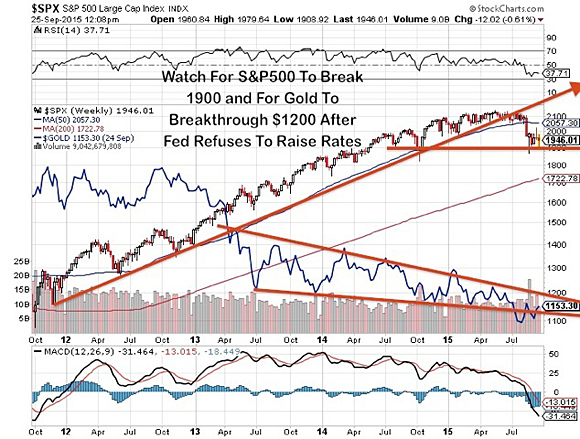
jebchartcover

The Gold Report: In your last interview with The Gold Report, you said that a Federal Reserve interest rate hike would be the best thing for gold. As we now know, the board decided to keep rates at almost zero. How does that impact your projections for precious metals? Continue reading "These Six Gold Companies Could Create Exceptional Wealth Sooner Than You Think"


Is It Time To Consider This REIT For Your Portfolio?

Daniel Cross - INO.com Contributor - Equities


As the market takes on more of a bearish mentality, investors look for alternative stocks to take shelter in. While cyclical sectors begin to underperform as the global economy flirts with a recessionary phase, defensive sectors start to look more attractive. While consumer staples often perform well during difficult times, one sector has all but faded from more investors minds since the financial crisis in 2008.

REIT's are generally good investments when other asset classes become more volatile. The real estate market isn't always correlated to the broader indexes and since 2008, many investors have avoided them based on a knee-jerk reaction that they will perform poorly when the market dips. The truth, though, is that certain REIT's are actually facing a bullish market right now.

While the Fed might have delayed its interest rate hike, it's a temporary issue that will eventually give way to a rising rate environment within the next year. This might not be positive news for prospective homeowners, but it is good news for companies that derive their income from rental prices. Continue reading "Is It Time To Consider This REIT For Your Portfolio?"

Binary Options Early Exit Strategy

Vinz de la Fuente - INO.com Contributor - Binary Options


Strategy Innovation

Investing in binary options requires various strategies to attain profits in every trade. Classic trading with binary options requires traders to choose from different kinds of assets which are stocks, currencies, commodities, and indices with basic options choices. Those choices include high/low, range/out-of-range/touch/no-touch where traders agree on the length of the option period, essentially choosing the expiry time and wait for it to end. Before, it was not possible to change a trade once it was made, but since innovation is also a part of binary options, brokers can now offer an early exit strategy which you can close the option before the expiry time.

Importance of Early Exit Strategy

Profitability is just one of the main goals in binary trading. You should also prevent losses in your investment or at least lessen them. You can avoid or reduce your losses if you close a trade early. For example, if an “out of the money” trade would result in an 85% loss, exiting the option early might result in a considerably better outcome, like a loss of only 30% - 50% vs. 80%. It will still vary in the current market condition when the option is bought back. An early exit increases trading flexibility because it gives every trader options vs. waiting for the expiry time and watching their losses grow when their investment moves opposite of the preferred direction. Another advantage is that the early exit option releases money that traders could use to buy more binary options. Despite the mentioned advantages, there are also other factors that need to be considered while using this option. Continue reading "Binary Options Early Exit Strategy"

Time To Short Apple?

I know to many Apple Inc. (NASDAQ:AAPL) fans, that probably sounds sacrilegious.

You may be thinking, "Adam has lost his mind, he must be thinking about another stock, surely not Apple." After all, they just announced two new iPhones and sold 13 million of them this past weekend. They are the leader in the smartphone market, coming out soon with their game-changing Apple TV and a bigger iPad. That is correct, but...

It's not that difficult to look at the market action in the stock and see that it is pathetic. All of that positive PR information comes out about Apple selling 13 million iPhones in a weekend, yet the stock goes down. What's with that? The PR people must be pulling their hair out thinking about what they can do next to push the stock up. One thing I love about Steve Jobs, the original Apple genius, was he didn't give much thought about the stock market. He was more interested in creating insane, cutting-edge products. The new regime at Apple is more interested in pushing the stock price up and being politically correct.

Also, the Apple Inc. (NASDAQ:AAPL) "act" is getting a little bit old and certainly Apple has not been able to innovate anything new in the past several years.

Even mega investor, Carl Icahn, can't believe that Apple's shares are not higher.

So what's going on with Apple? Continue reading "Time To Short Apple?"

Asian Financial Crisis: Now and Then

Lior Alkalay - INO.com Contributor - Forex


Are we set for a rerun of the 1997 Asian Financial crisis? Well, as Mark Twain said once, history does not repeat itself but it rhymes. The current turmoil does strikingly resemble that of the original 1997 Asian financial crisis. However, unlike the 1997 crisis, today’s circumstances are quite different.

Asian Financial Crisis of 1997

What initiated the Asian financial crisis back in the 90s? Well, it was the culmination of many things. Primarily, though it was the inability of Asian and other emerging economies to finance themselves. This was generally due to large current account deficits which led emerging markets to accumulate foreign debt. Eventually, they become dependent on foreign creditors.

When investors’ appetite for emerging market debt waned, those Asian economies had difficulty financing themselves. And let’s not forget Russia, which, coupled with its own circumstances, was pushed to default. Continue reading "Asian Financial Crisis: Now and Then"