Don't Get Ruined by These 10 Popular Investment Myths (Part VIII)

Interest rates, oil prices, earnings, GDP, wars, peace, terrorism, inflation, monetary policy, etc. -- NONE have a reliable effect on the stock market

By Elliott Wave International

You may remember that after the 2008-2009 crash, many called into question traditional economic models. Why did they fail?

And more importantly, will they warn us of a new approaching doomsday, should there be one?

This series gives you a well-researched answer. Here is Part VIII; come back soon for Part IX.

Myth #8: Terrorist attacks would cause the stock market to drop.

By Robert Prechter (excerpted from the monthly Elliott Wave Theorist; published since 1979)

I assume this is what economists mean when they say that something unexpected such as a terrorist attack would cause them to re-evaluate their stock market forecasts. At least, I doubt they mean that a terrorist attack would cause them to revise their estimates upward. It seems logical that a scary, destructive terrorist attack, particularly one that implies more attacks to come, would be bearish for stock prices. Continue reading "Don't Get Ruined by These 10 Popular Investment Myths (Part VIII)"
Weekly Futures Recap With Mike Seery

We've asked Michael Seery of SEERYFUTURES.COM to give our INO readers a weekly recap of the Futures market. He has been Senior Analyst for close to 15 years and has extensive knowledge of all of the commodity and option markets.

Michael frequently appears on multiple business networks including Bloomberg news, Fox Business, CNBC Worldwide, CNN Business, and Bloomberg TV. He is also a guest on First Business, which is a national and internationally syndicated business show.

Gold Futures

Gold futures in the December contract had a wild trading session this Friday afternoon in New York trading as low as 1,146 down over $20 only to explode higher finishing up $29 to close around 1,190 in one of the wildest trading days I can remember, as prices hit a 2 week high. If you are currently short this market I would exit at the 10 day high which occurred today so currently I’m neutral this market sitting on the sidelines as I still think gold prices are headed lower for the remainder of 2014 as money flows will continue into the S&P 500 in my opinion, however when prices hit a 2 week high it’s time to move on and sit on the sidelines and wait for another trend to develop. The U.S dollar was sharply higher this morning which caused precious metal prices to be sharply lower in early trade, however the U.S dollar sold off somewhat closing up around 20 points as massive short covering in my opinion is what’s to blame for today’s price action. The trend now in gold is choppy to neutral as volatility is extremely high at the current time so make sure you use the proper amount of contracts making sure that you risk 2% of your account balance on any given trade as 1,200 is the next resistance level in the December contract.
TREND: NEUTRAL
CHART STRUCTURE: SOLID
Continue reading "Weekly Futures Recap With Mike Seery"

A Negative Sign For Alibaba Group Holding Limited (NYSE:BABA)

Hello traders and MarketClub members everywhere! It has been quite a week. In today's video, I am going to look at Alibaba Group Holding Limited (NYSE:BABA) and share with you what I think could be going on in this hot stock.

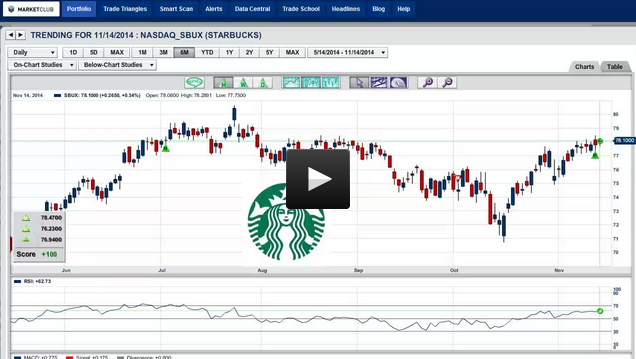
Also on my radar today, Starbucks Corp. (NASDAQ:SBUX), Cisco Systems Inc. (NASDAQ:CSCO), and Big Lots Inc. (NYSE:BIG). All three of these stocks gave major signals yesterday and I will be discussing their potential moves in the near-term.

I will be reviewing crude oil (NYMEX:CL.Z14.E) and gold (FOREX:XAUUSDO) to see if there's any changes in their overall direction. Lastly, I will be looking at something that's quite unusual in all three major indices that could be a clue to the next short-term move.

As always, we invite your comments and feedback below this post. Please feel free to provide us future video topic suggestions.

Every success with MarketClub,
Adam Hewison
President, INO.com
Co-Creator, MarketClub

Why Investing In Chinese Stocks Can Leave Investors Vulnerable To Risk

Something about the deal smelled fishy.

China Marine Food Group Ltd., a Chinese company then on the New York Stock Exchange, spent $27 million in January 2010 to acquire a firm whose main asset was "algae-based drink know-how." The weird thing: Three months earlier, the beverage formula had been valued below $8,800.

But when the U.S. Securities and Exchange Commission tried to review the deal, it got nowhere. The company's Chinese accounting firm refused to provide documents. And the SEC has been stymied since.

And China Marine? Its share price topped $8 in 2010. It's now around 12 cents.

The case represents a cautionary tale for investors eager to invest in Chinese companies on American exchanges. Chinese companies like Alibaba Group Holding Limited (NYSE:BABA), whose initial public offering this year set a record high, operate under lax standards compared with other stocks on U.S. exchanges. That means higher risks for investors. Continue reading "Why Investing In Chinese Stocks Can Leave Investors Vulnerable To Risk"

Rocks to Riches with Thomas Schuster

The Gold Report: Thomas, the price of gold sank in October even as the stock market was rebounding. Can gold also rebound?

Thomas Schuster: Gold will rebound, it always has and always will. The mining market is almost violently cyclic. Deep lows are followed by spectacular highs. The tough question is when will the gold price rebound happen? There are a lot of nay-saying precious metal bears in the market right now. Many forecasters are predicting that gold will continue to trade within a narrow range around $1,1001,225/ounce ($1,1001,225/oz) over the next few years.

"Integra Gold Corp.'s project looks very promising."

But the fact is, on a global scale, we are not replacing reserves as fast as we're mining them. That simple fact supports only one outcome: higher prices. A recent report on gold production by SNL Metals Mining observes that when we look at the amount of potential future production from major discoveries made over the last 15 years, we could only replace, at best, 50% of gold produced during that same period. The report also points out that the average time to bring a newly discovered mine into production has been significantly increasing. For mines that went into production between 1985 and 1995, the average wait was eight years from discovery to production. For mines that went into production between 2006 and 2013, the average wait is 18 years.

There are many reasons for this more details are needed in feasibility work-ups, there are more stringent social and environmental standards, and more demanding permitting processes. Many of these mines are of lower grade. They are more remote, and require lots of capital for developing infrastructure and processing capacities. The capital market is poor at the moment; it is difficult to raise money and it takes more time to move into production than it did before.

TGR: Why was gold so high previously and what happened to the price, in your opinion? Why was it so high, and why did it fall so far? Continue reading "Rocks to Riches with Thomas Schuster"