How 3 Healthcare Stocks Are Capitalizing on the Consistent Rise of Virtual Care

Virtual care has been on the rise in the United States for some time now. However, the restrictions imposed by the COVID-19 pandemic have catalyzed the adoption of telehealth services in the country.

The numerous benefits of telehealth included expanding access to care, reducing disease exposure for staff and patients, preserving scarce supplies of personal protective equipment, and reducing patient demand on facilities.

According to the CDC, this resulted in a 154% increase in telehealth visits during the last week of March 2020, compared with the same period in 2019.
Barring the occasional spikes in infection from virus variants that seem to have become endemic, the U.S. and global economy has, by and large, put Covid 19 in its rearview mirror.

However, even as the tailwind of the pandemic has all but faded away, continued uptake, favorable consumer perception, and tangible investment into this space are all contributing to the continued growth of telehealth.

According to a Harvard Business Review report, increasing the frequency and scope of virtual care nationwide would transform American health, improving the lives of patients who get sick during nights and weekends, those with chronic conditions, and those who live in rural areas.
With telehealth arriving as a new reality for healthcare enterprises with innovations around virtual longitudinal care (both primary and specialty), remote patient monitoring, and self-diagnostics set to turbocharge the accessibility, scalability, and reach of healthcare, here are three businesses well-positioned to capitalize on this rising tide.

CVS Health Corporation (CVS)

CVS operates as a health solutions company. The company operates through four segments: Health Care Benefits; Health Services; Pharmacy & Consumer Wellness; and Corporate/Other. Its Health Services segment provides a full spectrum of pharmacy benefit management solutions, delivers health care services in its medical clinics, virtually and in the home, and offers provider enablement solutions.

Over the past three years, CVS’ revenue has grown at an 8.1% CAGR, while its EBITDA has grown at 4.5% CAGR. During the fiscal first quarter that ended March 31, 2022, CVS’ total revenues increased 11% year-over-year to $85.28 billion.

With the aim to advance its value-based care strategy, CVS completed its acquisition of Signify Health and Oak Street Health on March 29 and May 2 of this year, respectively.

Doximity, Inc. (DOCS)

DOCS provides a cloud-based platform for medical professionals in the United States. The platform helps its members collaborate with colleagues, coordinate patient care, conduct virtual patient visits, stay up-to-date with medical news and research, and manage careers.

DOCS’ topline has grown at a phenomenal 58.9% CAGR over the past three years. During the fiscal third quarter that ended December 31, 2022, its revenue increased 18% year-over-year to $115.3 million.

Ahead of its earnings release on May 16, analysts expect DOCS’ revenue for the fourth quarter and fiscal year that ended March 31, 2022, to increase by 17.6% and 21.7% year-over-year to $110.09 million and $418.16 million, respectively.

Teladoc Health, Inc. (TDOC)

TDOC operates in the health services segment and provides virtual access to care. The company’s portfolio of services and solutions includes various medical subspecialties, from non-urgent, episodic needs to chronic, complicated medical conditions.

Over the past three years, TDOC’s revenue has grown at a 59.8% CAGR, while its total assets have grown at a 39% CAGR over the same time horizon. During the fiscal first quarter that ended March 31, 2023, TDOC’s revenue increased by 11% year-over-year to $629,2 million.

For the fiscal second quarter, analysts expect TDOC’s revenue to increase 9.5% year-over-year to $648.78 million and its loss per share to narrow by 1.2%. For fiscal 2023, the company’s revenue is expected to increase by 9% over the previous year to $2.62 billion.
The Best of the Best in Big Pharma

Two of the world’s major listed drugmakers - AstraZeneca (AZN) and GSK (GSK) - both celebrated a strong start to 2023 and confirmed their forecasts for the rest of the year.

However, the two stocks are valued very differently by Wall Street. AstraZeneca shareholders are willing to pay 20 times forward earnings per share for 2023, while GSK’s shareholders are willing to pay a mere 10 times earnings.

These investors may be missing a huge opportunity. Last year, GSK completed its biggest restructuring in 20 years. It spun off its consumer health division Haleon (HLN), which sells over-the-counter medicines.

It is using the $8.78 billion bounty from the split to make acquisitions to fill its pipeline.

GSK’s vaccine division is the company’s star. It has developed the first ever vaccine for the common infection respiratory syncytial virus (RSV), which it believes presents a similar sized market opportunity to its shingles vaccine, which generated over $1 billion in sales in the first quarter alone. This vaccine was the first to ever be approved against RSV just a few days ago.

The company also has a leadership position in infectious diseases, which account for two-thirds of the drugs in its pipeline target.

Meanwhile, AstraZeneca has benefited from fortuitous timing, investing in oncology just as the science made great leaps forward over the past decade. The company then built on its success, so it now has a pipeline with drugs based on every current promising approach to cancer.

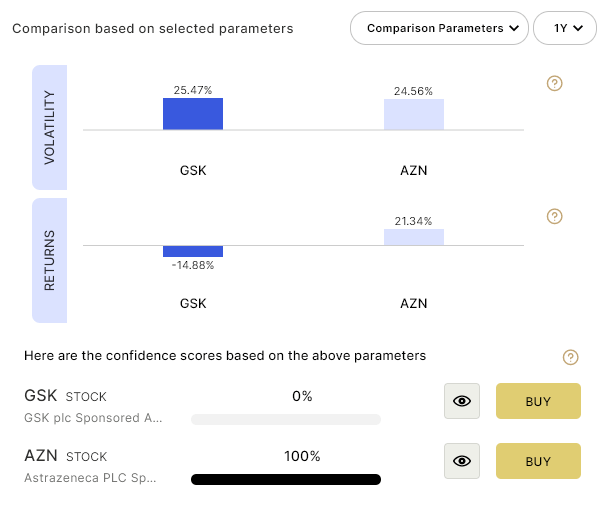
So, we have two very successful pharma giants. How do we pick which one to invest in? The quick and easy way to do this is to ask Magnifi to run the comparison for us. It’s as simple as asking Magnifi to “Compare AZN to GSK.”

Compare AZN to GSK

This is an example of a response using Magnifi. This image is not a recommendation or individual advice. Please see bottom disclaimer for additional information, including INO.com’s relationship with Magnifi. Continue reading "The Best of the Best in Big Pharma"

Why Banks Fail and What It Means for the Stock Market?

A lot, if not everything, in the world of finance, is based on trust: trust that the future would be better than the present; trust that a dollar bill would guarantee an equivalent worth of goods and services at a given point in time; and trust that wealth created would be safe, accessible, and transferrable at all times.

So, when events like those unfolding over the past fortnight undermine one or more of the aforementioned collective beliefs, the ensuing risks can quickly become systemic and existential.

On February 24, KPMG signed an audit report giving SVB Financial, Silicon Valley Bank’s parent company, a clean bill of health for 2022. On March 10, federal regulators announced that they had taken control of the bank, which reopened the following Monday as Deposit Insurance National Bank of Santa Clara.

This was the second-biggest bank failure since Washington Mutual’s collapse during the height of the 2008 financial crisis. It was soon followed by the third-biggest, with Signature Bank shuttered by the regulators to stem the fallout from Silicon Valley Bank’s failure.

The resulting crisis of confidence has somehow been contained with an assurance that all insured and uninsured depositors would get their money back, the announcement of a new lending program for banks, and 11 banks depositing $30 billion in the First Republic bank.

However, the contagion risk subsided only after claiming an illustrious victim from the other side of the Atlantic, with UBS agreeing to take over its troubled rival Credit Suisse for more than $3 billion in a deal engineered by Swiss regulators.

Since we are more or less up to speed, let’s look deeper into what can make banks seem unbankable in a little over two weeks.

Continue reading "Why Banks Fail and What It Means for the Stock Market?"

Market Anticipation Builds as 3 Key Companies Prepare to Announce Earnings

Corporate America was bracing itself to report the biggest drop in earnings since the pandemic began three years ago, with profits for S&P 500 companies expected to fall by as much as 8% due to inflation, increased borrowing costs, and other headwinds.

However, businesses appear to be blowing past these low expectations, with 77% of reports beating analysts' estimates, with reported earnings being 7.2% above expectations.

A relatively weak dollar due to the trend of de-dollarization gaining momentum and the looming crisis over raising the debt ceiling due to political differences regarding government expenditure on both sides of the aisle might also have been unwitting tailwinds that have helped the likes of Apple Inc. (AAPL) keep the mood buoyant on the Street

After reporting stronger-than-expected results, the tech giant’s shares surged by 4.8% on May 5.

However, the first quarter still would mark a second straight quarterly fall for U.S. corporate earnings after COVID-19 hit corporate results in 2020.
Given this backdrop, let’s look at the prospects of three stocks ahead of their earnings release this week.

The Walt Disney Company (DIS)

DIS has recently been in the news for being on a legal collision course with Florida Governor Ron DeSanctis. Differences between the company and the governor began with DIS’ opposition to the Parental Rights in Education Act, which prohibits lessons on sexual orientation and gender identity in public schools through the third grade.

In an alleged retaliation, the Florida Senate approved the Disney Special Tax-District Bill, which would seek to move the control of the Reedy Creek district from the company back to the state. DIS has expanded the lawsuit contesting this move to include new regulations passed by the state’s legislature that allow officials to nullify development agreements brokered by the company. Continue reading "Market Anticipation Builds as 3 Key Companies Prepare to Announce Earnings"

Silver Update: Roller Coaster Ride

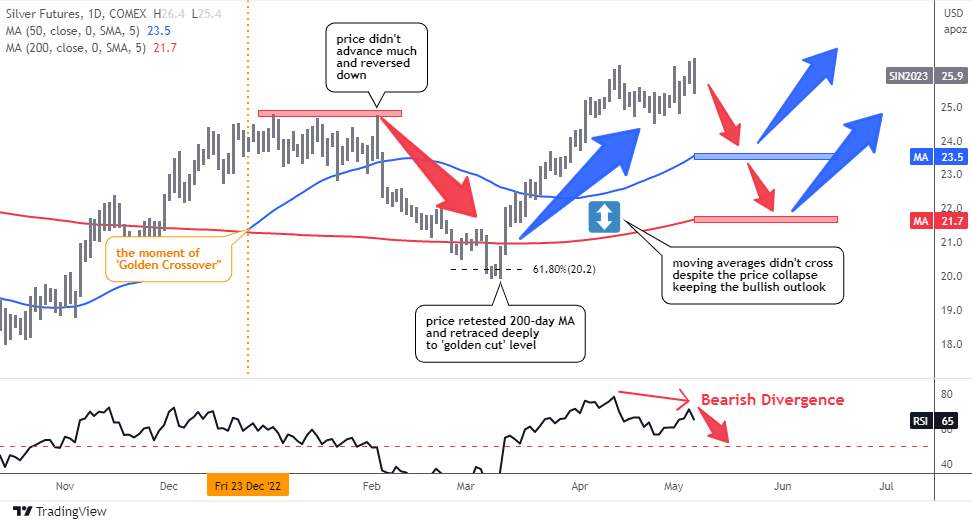
The previous post “Golden Pattern For Silver, Not Gold” from December highlighted a bullish pattern called the 'Golden Cross' that appeared on the daily chart of silver futures. This occurred when the 50-day moving average crossed over the 200-day moving average.

While the majority of readers considered this signal to be reliable, they did not expect the price of the metal to rise above $30.

The following daily chart will show how the pattern has played out since then.

Silver Futures Daily

Source: TradingView

When the ‘Golden Cross’ signal was posted, the price of silver futures was at $23.9 (marked by the orange vertical line), and it went up almost $1 to reach $24.8 before stalling for over a month.

The price was unable to break above this new high and subsequently collapsed, dropping below the blue 50-day MA and testing the red line of the 200-day MA, briefly breaking through to reach the ‘golden cut’ Fibonacci retracement level of 61.8% at around $20. Continue reading "Silver Update: Roller Coaster Ride"