New President, New Investment Decisions!

It is said that the first 100 days of a new Presidents term are potentially the most important days of their time in office. This is because, during that first 100 days, they are making all sorts of new policy changes, appointing people to positions, and generally laying out an outline of what they will try to accomplish in the coming years.

Thus far, President Joe Biden has been no different from any President before him. He has written new executive orders, made appointments, and allowed certain arms of the Federal government to have 'more' control of certain things. President Biden's actions have in some small and some large ways already affected your money.

Let's talk about a few things the President has done and how your money has been affected.

To me, one significant move President Biden has taken was appointing former Federal Reserve Chairwoman, Janet Yellen, to the Secretary of the Treasury. This appointment to me instilled faith, trust, and a lean toward dovish economic policies in the near term as the country continues to get past the economic effects of the Covid-19 pandemic. This has probably given your portfolio as a whole a mild boost higher.

More recently, the Biden administration has, in others words, 'taken the handcuffs' off the CDC. It was reported that under the Trump administration, the CDC was 'hushed' and dealt with push-back about certain recommendations they wanted to implement during the pandemic. Now that Biden is in office, the CDC quickly announced orders that required masks to be worn on all forms of public transportation, which the Trump administration apparently did not allow. More so than that, the CDC reported that it was investigating requiring a negative Covid-19 test before allowing any passenger board any domestic flight. Continue reading "New President, New Investment Decisions!"
The Fed's Role In GameStop

All of the news articles and media commentary on the volatility in GameStop (GME) stock last week centered on the supposed war between retail investors who were buying the stock, putting a squeeze on those evil rich hedge-fund managers who had shorted the stock. And the Davids, at least for now, were beating the Goliaths. Good versus evil is always easy to understand and makes for a compelling story, especially when "the little guy" prevails.

Morality play aside, a lot of people were probably scratching their heads as to why some people would be so enthusiastic about buying stock in a company that appears to be 10 years behind the times, seeing as how its main business consists of selling or reselling physical copies of digital games even as the rest of the world has moved onto streaming. It also cast a lot of attention on short-selling, with many people receiving a crash course in the tactic.

However, it's also another example of how the Federal Reserve's super-loose monetary policy and 0% interest rates are distorting investor behavior. While retail investors on Robinhood and other platforms are driving up the price of what otherwise might be a stock headed in the other direction, we need to remember one of the reasons why investors are willing to make such outlandish bets like this.

It demonstrates the lengths some investors will go to make money because it's become difficult to do so in more conventional (i.e., safe) investments, such as quality stocks and bonds. It also reveals the almost devil-may-care attitude some investors have adopted, believing that the Fed will eventually ride to their rescue. Continue reading "The Fed's Role In GameStop"

The Rebels From Reddit Favor Silver

The internet is still one of the most revolutionary things invented. The new level of communication and coordination it gives us is just amazing. Hedge funds could not imagine a sudden coordinated attack that started as a post on Reddit could impact them so hard. The next market in their crosshairs? Silver!

The GameStop frenzy just let the dogs out. Lately, the retail investors from the famous Reddit chat Wallstreetbets started looking towards the iShares Silver Trust ETF (SLV) as they are looking forward to profiting from the same strategy of short squeeze earlier mastered on GameStop shares. They chose SLV ETF because its shares are backed with physical silver.

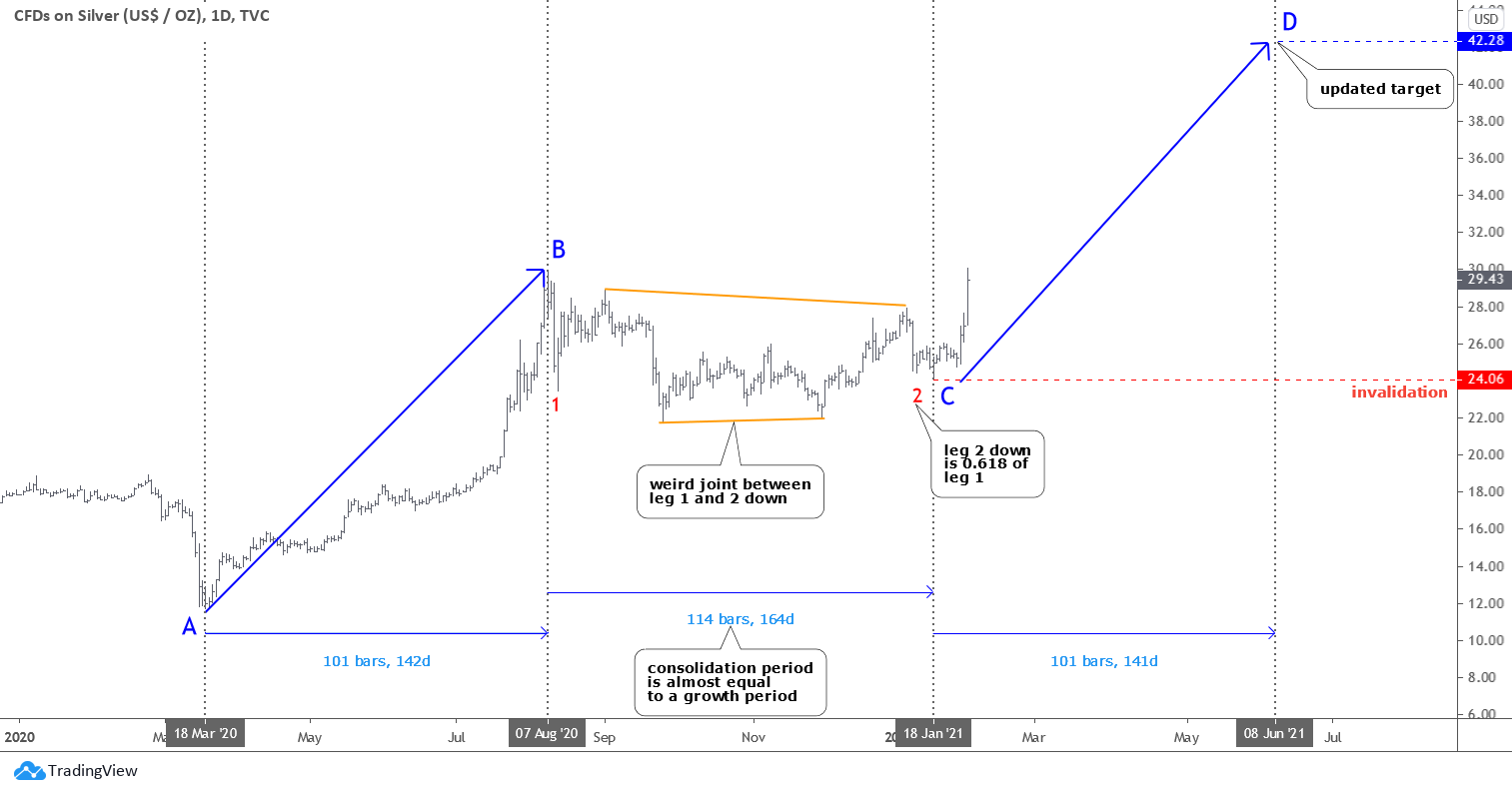
I prepared two silver charts to show you how the retail market force changed the structure and its outcomes.

Silver

There is an optimistic scenario depicted in the chart above. It implies the completion of the entire corrective structure. The red leg 2 down is considered to be done as it traveled only 0.618 of the red leg 1 distance. As you may remember, it is the Fibonacci ratio. The joint between legs 1 and 2 looks weird but is yet possible. Continue reading "The Rebels From Reddit Favor Silver"

Can The Silver Bugs Alter The Macro?

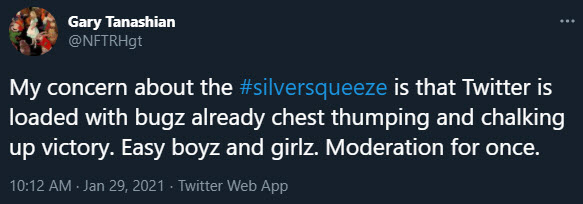
As to the post’s title, they sure are trying. Despite doubts that the stodgy old likes of me may have.

Silver

But for two days at least dem bugz is successfully battlin’ dem boyz on da COMEX. The result is that the Silver/Gold ratio (weekly futures chart) has been rammed to a new high for the post-crash move. If we back completely away from the #silversqueeze punchbowl, this is an indicator guiding the way for forward inflation.

silver gold ratio

So again, can the silver bugs alter the macro? Are the silver bugs altering the macro or is silver just doing what it has been technically capable of doing all along? Since well before #silversqueeze (a ‘me too!’ operation to the famous Reddit plays of late) was promoted by its originator, gold had been trending down vs. silver. Continue reading "Can The Silver Bugs Alter The Macro?"

Post Inauguration And Extended Markets

Best Post Election and Inauguration Lift

The drumbeat of markets becoming more and more over-extended is becoming louder and louder. From the election to the inauguration, the S&P 500 is up 13%, which is the best for any president since 1952. Post-inauguration, all major indices as measured via the Russell 2000 (IWM), Dow Jones (DIA), S&P 500 (SPY), and the Nasdaq (QQQ) hit all-time highs. The broader markets have been propelled higher in an already frothy market as 2021 unfolds. All major markets have been in a raging, nearly uninterrupted bull market with the Nasdaq and S&P 500 up 100% and 75%, respectively, since the pandemic low.

These moves are a function of the vaccine rollout, continued stimulus coming out of Washington, massive fiscal and monetary accommodation from the Federal Reserve, the election cycle being capped off with the presidential inauguration, and new policies aimed at spurring economic growth. Despite these tailwinds, the markets are looking overextended, as assessed by a broad range of historical benchmarks and current indicators investors should heed in the near term.

Historical Measures and Current Indicators

A recent E-Trade survey showed that the majority of investors (91%) with $1 million or more in a brokerage account believe the stock market is in a bubble or close to being in one. From a historical standpoint, markets have exceeded levels reminiscent of the Roaring Twenties and are now approaching the dot-com bubble territory. These historical comparators of options put/call ratios, the broad participation of stocks exceeding their 200-day moving average, and P/E ratios may be potential warning signs of near-term pressures. Current indicators are also suggestive of frothy markets as measured by Bollinger bands and the Relative Strength Index (RSI). Continue reading "Post Inauguration And Extended Markets"