Treasury Default Hysteria Begins

While fights over Supreme Court and Federal Reserve Board nominations come sporadically as vacancies arise, there is one political battle we can almost always count on from year to year, and that is the struggle over extending the federal debt ceiling.

If it’s not increased, we’re told, the U.S. government will default on its obligations, Social Security and other government program beneficiaries will be rendered destitute, Treasury bondholders will see the value of their holdings decimated as they go without their interest payments, our soldiers and other government employees won’t get paid, and the global financial system will grind to a halt.

Most serious-minded adults, however (I hope), have learned to ignore this annual game of chicken that the White House and Congress insist on playing every year, although the financial press and media commentators profess to take it seriously.

Whichever political party controls the White House or the houses of Congress, the drama generally follows the same predictable format, namely the Democrats always favor raising the debt ceiling to avoid the catastrophes described in the first paragraph, while the Republicans express opposition in the name of fiscal responsibility.

Yet no matter how long the drama plays out, the outcome is always the same: the Republicans eventually knuckle under, life goes on and everyone gets their money, until the next debt debacle. Lather, rinse, repeat.

This year, it seems, the play has begun early.

Five whole months before the government allegedly runs out of money without a debt limit increase, Treasury Secretary (and former Fed Chair) Janet Yellen has already sounded the alarm and instructed her troops to put in place “extraordinary measures” to allow the government to keep paying its bills before it hits the current $31.4 trillion debt limit in June.

Yellen wasted no time in using the dreaded D-word to emphasize the supposed seriousness of the situation.

“A failure on the part of the United States to meet any obligation, whether it’s to debtholders, to members of our military or to Social Security recipients, is effectively a default,” she said. Continue reading "Treasury Default Hysteria Begins"

Stock Buyers Beware!

Please enjoy this updated version of weekly commentary from the Reitmeister Total Return newsletter. Steve Reitmeister is the CEO of StockNews.com and Editor of the Reitmeister Total Return.

Click Here to learn more about Reitmeister Total Return


The bull vs. bear tug of war is at another critical juncture as they battle over 4,000. The two previous skirmishes were won by the bears.

I am referring to the big rallies that ran out of steam in mid August and early December. The hawkish Fed was the main catalyst each time to swing things back to the downside.

Will that be the case once again after the February 1st Fed announcement?

That is the topic that most deserves our attention at this time, and will be the focus of this week’s Reitmeister Total Return commentary.

Market Commentary

The boiled down version of today’s commentary can easily be labeled: Stock Buyers Beware!

That’s because price action is saying one thing…but fundamentals are saying another with the final verdict likely coming after the 2/1 Fed announcement.

Now let’s go back to the starting line by evaluating this picture of where we stand now with a possible breakout above the long-term trend line. Also known as the 200 day moving average for the S&P 500 in red below.

Yes, it appears that we have a break out forming at this time. However, see how similar events happened back in late March and late November before the bears took charge once again.

Chartists will also note that this is still quite bearish. First, because we are officially in a bear market. We would need to cross above 4,189 to state that a bull market was in place.

Second, we have a series of lower highs which is a negative trend until it is officially reversed.

To be clear, this could be the forming of the new bull market. And you should never fully ignore the wisdom of the crowd as it appears in price action. Continue reading "Stock Buyers Beware!"

3 Energy Stocks To Load Up On In 2023

While it is broadly expected that the pace of interest rate hikes may be dialed down to 25-basis points, concerns over terminal interest rates being higher than expected and its effect on the U.S. economy have kept markets on edge.

With the likely less aggressive but drawn-out interest rate hikes by the Fed expected to add further stress to subdued corporate performance, the stock market volatility is expected to continue in the foreseeable future.

Hence, it could be wise for investors to increase exposure to instruments and assets whose prospects are robust enough to remain relatively unaffected by the turbulence.

Are embargoes on commodities such as crude oil effective as a political tool?

View Results

Loading ... Loading ...

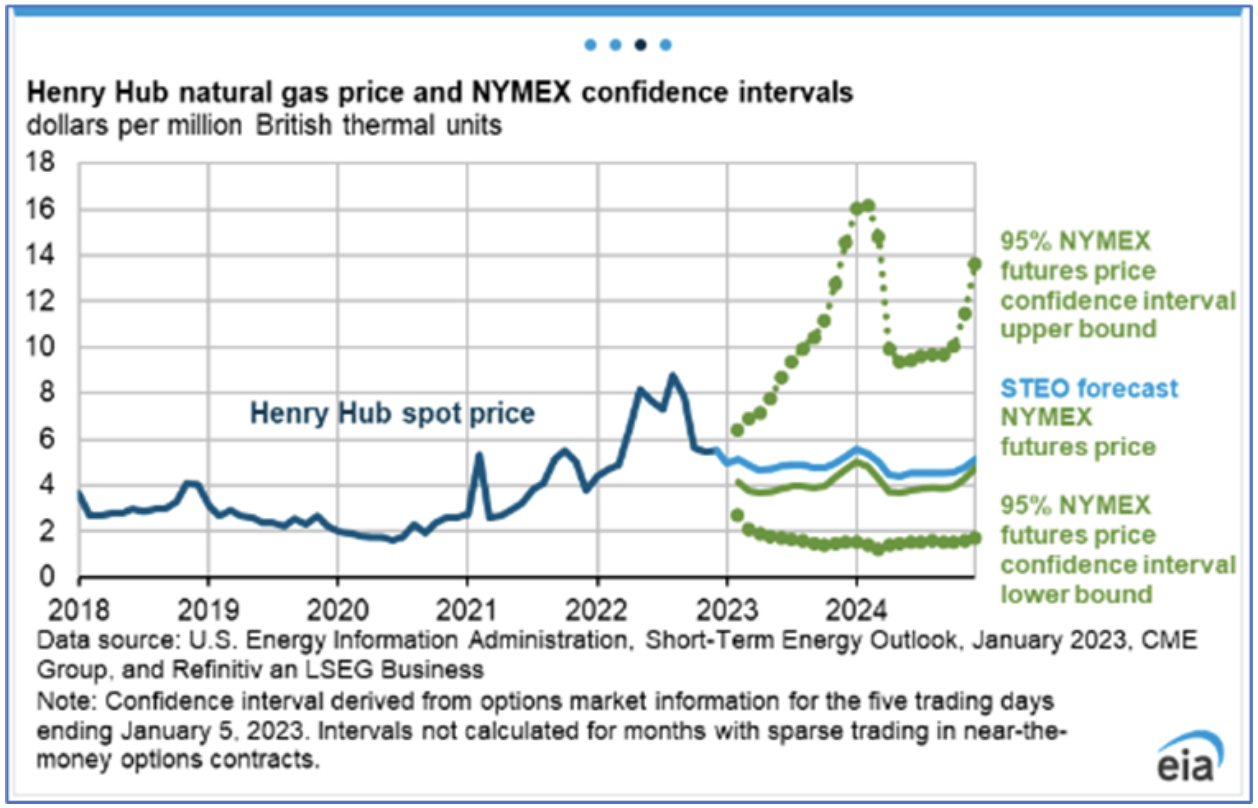
With supply constraints due to turbulent geopolitics and extreme weather events acting to keep demand robust, global energy consumption is expected to grow by 1.3% in 2023 as many countries use fossil fuels to manage their energy transition.

Henry Hub Spot Price

Source: https://www.eia.gov/

Continue reading "3 Energy Stocks To Load Up On In 2023"

Bitcoin VS Gold VS S&P 500

How does gold and its digital competitor Bitcoin relate to each other?

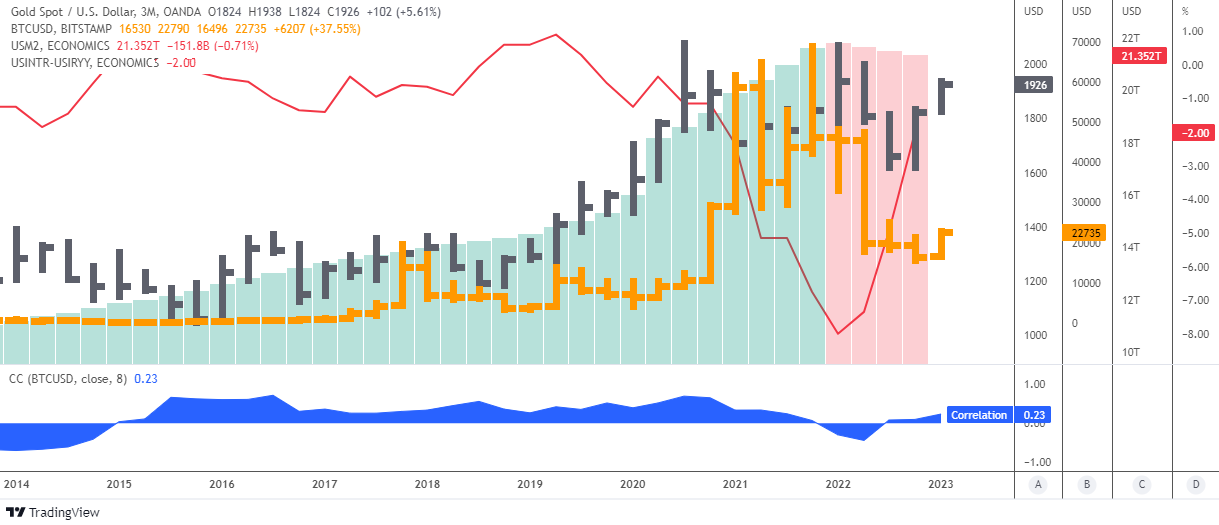
Gold is a traditional store of value, while Bitcoin from a conventional standpoint is highly risky. Even though the latter was nicknamed "digital gold," we can see from the chart below that it does not act like one.

Which opinion do you support?

View Results

Loading ... Loading ...

Gold BTC USM2 Real IR Quarterly

Source: TradingView

In the above quarterly chart, I combined 5 items:

The gold price is in black bars on scale A. The Bitcoin price is in orange bars on scale B. The U.S. money supply indicator M2 (M2) is in histogram on scale C. The red line represents the U.S. real interest rate (RIR) on scale D. There is a 2-year correlation coefficient of Bitcoin to gold (blue) in the sub-chart. Continue reading "Bitcoin VS Gold VS S&P 500"

This Airline Stock is Expecting a Strong 2023

The last few years have been difficult for the airline industry as it was among the biggest losers when the pandemic first hit in early 2020. However, with lesser restrictions on travel, the airline industry has bounced back strongly and is close to surpassing the pre-pandemic performance levels.

Delta Air Lines, Inc.’s (DAL) earnings and revenue exceeded analyst estimates in the fourth quarter.

Its EPS came 11.9% above the consensus estimate, while its revenue beat the estimate by 6.6%. The company’s operating margin came in at 10.9%, while its adjusted operating margin came in at 11.6%.

DAL’s CEO Ed Bastian said, “Delta people rose to the challenges of 2022, delivering industry-leading operational reliability and financial performance, and I’m looking forward to recognizing their achievements with over $500 million in profit-sharing payments next month.”

Glen Hauenstein, DAL’s President, said, “For the year, we delivered $45.60 billion in adjusted revenue, a $19 billion increase over the prior year, with record unit revenue performance expected to sustain a revenue premium to the industry of more than 110%. Momentum continues in 2023 with strong demand trends, and we expect March quarter adjusted revenue to be 14 to 17% higher than 2019 on capacity that is 1 percent lower.”

The company’s revenue passenger miles for the fourth quarter increased 24.9% year-over-year to 50.47 billion. Its passenger revenue per available seat mile increased 30.8% year-over-year to 18.30 cents.

Also, its total revenue per available seat mile (TRASM) increased 23.4% from the prior-year period to 22.58 cents. In addition, its total passenger revenue increased 50.4% year-over-year to $10.89 billion.

For the fiscal first quarter ending March 31, 2023, DAL expects its total revenue to increase 14% to 17% over the same quarter of 2019 and its operating margin to come in between 4% and 6%. Its EPS is expected to come between $0.15 and $0.40. For fiscal 2023, DAL expects its total revenue to increase 15% to 20% and operating margin to rise 10% to 12% over the previous year. Its EPS is expected to come between $5 to $6.

DAL’s CEO Ed Bastian said, “As we move into 2023, the industry backdrop for air travel remains favorable, and Delta is well positioned to deliver significant earnings and free cash flow growth.” Continue reading "This Airline Stock is Expecting a Strong 2023"