My Latest "Prediction" For 2023

Back in March I posited the notion that the S&P 500 would need to fall to about 2,900 before all of the froth that the Federal Reserve had injected into the market through its various monetary stimulus programs dating back to the Great Recession had finally burned off.

On Christmas Eve the S&P closed at 3844, which would put it 19% below its all-time high of 4,766 on December 27, 2021, or about a year to the day.

In recent days some market prognosticators have been warning that the market is poised to fall another 20%, which would put the index at about 3,000, or slightly above my guesstimate.

So do I feel vindicated, if that is the right word? No, and I hope I’m wrong anyway.

First, my guess was not a prediction, just a quick back-of-the-envelope calculation based on my assumption that the Fed was responsible for about half of the stock market’s 600% gain between the March 2009 bottom of 683 and the time I made my comment.

So, if we cut that 600% gain in half, that would reduce the S&P’s gain to a still respectable 300%, or a little below 3,000.

Not an educated estimate, maybe, but I thought a reasonable guess—a worst case scenario, if you will.

Second, we don’t know if these bears will turn out to be right. I hope they’ll be wrong.

I now believe the Fed won’t have to drive the economy into the tank in order to get inflation down to where it wants it to be, probably in the 2.5% to 3% range.

Remember, about two years, in what was considered to be a major policy shift, the Fed said it was willing to let inflation “overshoot” its long-term target of 2% for a time, as it indeed it did.

Now it looks like inflation is dropping a lot faster than most people thought, and the Fed itself is now forecasting that inflation will fall to 3.1% next year before declining in 2024 to 2.5% and 2.1% in 2025, i.e., putting it at its long-term target. Continue reading "My Latest "Prediction" For 2023"
Golden Pattern For Silver, Not Gold

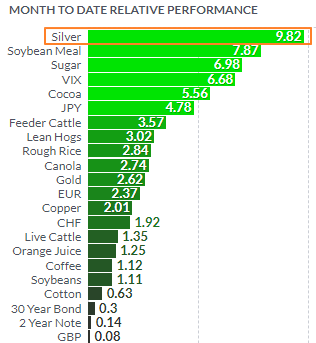
Silver futures continue to maintain leadership not only among metals, but compared to all futures as we can see in the leaderboard below.

MTD Relative Performance

Chart courtesy of finviz.com

The white metal has seen gains of close to ten percent month-to-date. None of the metals come close as copper futures, formerly the number two, has lost its shine lately as I shared the reason last week. When compared to silver futures, gold futures appear pale with gains of 2.62%.   

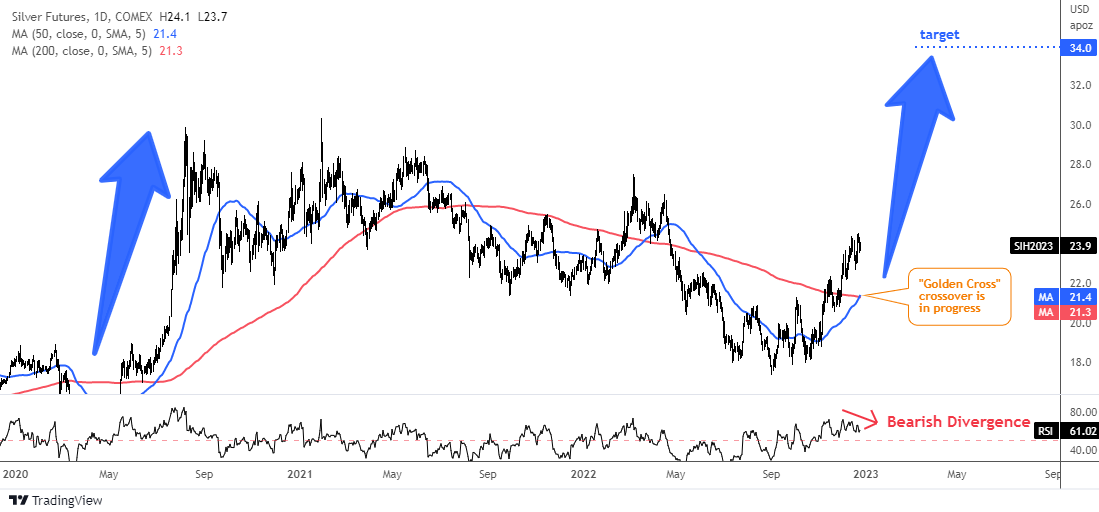
All last week, I observed a pattern in the making, watching to see when it would trigger. As a result, exactly at the end of last week, the expected event happened. Here is a visual representation in the daily chart below.

Silver Futures Daily Golden Cross

Source: TradingView

There are two simple moving averages in the silver daily chart above. The blue line represents a 50-day moving average and the red one is a 200-day moving average. We can see that last week the short-term blue line crossed above the long-term red line. This pattern is called a “Golden Cross”. It is a bullish sign as it indicates a change in the trend to the upside. Continue reading "Golden Pattern For Silver, Not Gold"

2023 Housing Market May Be Different Than Expected

On December 20th, the Commerce Department released data showing that housing prices remain high, renter demand is still strong, and the supply and demand imbalance appears to show no relief.

These economic data points indicate that the housing crash, or pull-back many expected to see with housing prices in 2023, may not be coming.

Let's look at the numbers and then explain why a housing crash doesn't appear to be on the horizon in 2023.

The December housing numbers showed US single-family homebuilding dropped to a two-and-a-half-year low in November 2022. Permits also fell in November by 7.1% for single-family homes and 11.2% for overall building permits. Overall housing 'starts' dropped 0.5% in November, with single-family starts falling 4.1% and multi-family units up 4.8%.

So essentially, we are seeing that construction of new single-family homes is slowing when we are already in a tight supply-demand situation with those types of units. This supply shortfall comes from data showing that from June 2012 to 2021, the US had 12.3 million new households formed, but only 7 million new single-family homes were built.

The pandemic played a role in making this shortfall wider, as it is estimated that in 2019 the US was only short 3.84 million units. But, labor shortages before the pandemic started, which worsened during the pandemic, and costs of materials and land, all pushed housing prices higher.

Higher housing prices make it harder for more people to afford a home. Thus, fewer homes get built. High housing prices were likely one reason we didn't see more homes built in 2021. In 2022, the main reason was increasing interest rates. Again, higher interest rates push the overall cost of ownership higher, resulting in fewer people building homes.

Another interesting data point from December was the Homebuilders' confidence levels also plummeted in December for a record 12th month straight. This data point only adds to the idea that single-family homes will continue to be underbuilt in the near future. Continue reading "2023 Housing Market May Be Different Than Expected"

Merry Christmas From INO.com

Our office will be closed on Monday, December 26th, along with the U.S. exchanges. We'll be back on Tuesday morning.

No matter what you celebrate (if anything at all), our entire team wishes you health and happiness. We hope you get to spend time with family and friends, truly the greatest gifts.

If you haven't joined MarketClub during the MarketClub Holiday Deal, you still have time. This great rate (only available until December 31st) is our gift to you.

Happy holidays to you and we are excited to help you reach your financial goals in 2023.

As always, thank you and best wishes,
The INO.com Team

Gold Miners On The Sale Rack

It’s been a rough year for the major market averages, with the major indexes down roughly 20% in their worst year since 2008.

This poor performance is not surprising after a decade-long bull market that pushed valuations to historic extremes combined with an ultra-hawkish Federal Reserve that has aggressively hiked rates into a recessionary environment.

At the same time that higher rates have dented earnings and resulted in layoffs due to increased interest expense, the outlook for forward earnings is less clear, with consumer spending pulling back and reduced sales leverage for most corporations.

However, one sector stands out and has been trending higher over the past two months: the gold mining sector. In fact, the Gold Miners Index (GDX) has clawed back from a 30% year-to-date loss to just a 13% year-to-date loss, and many gold miners are trading in positive territory year-to-date.

Given that they’ve suffered through a much larger bear market than the Nasdaq (COMPQ) with a ~55% decline, these names are not only undervalued, but they’re long-term oversold, and the sector could have meaningful upside as we head into a strong seasonal period for the GDX.

In this update, we’ll look at two of the more undervalued names in the sector:

Osisko Gold Royalties (OR)

Osisko Gold Royalties (OR) is a $2.23 billion company in the precious metals royalty/streaming space.

This means that It finances developers, producers, and explorers in the commodity sector with a gold/silver focus, providing them capital upfront to build or expand their assets.

In exchange, Osisko Gold Royalties receives either a royalty or stream on the asset over its mine life, with the latter giving it a right to buy a percentage of metal produced at a fixed cost that is well below spot prices.

The result is that royalty/streaming companies have their tentacles in several projects, have their revenue streams spread across several countries, and are inflation-resistant. Hence, they are superior businesses from a margin and risk standpoint vs. most gold producers.

So, what’s so special about Osisko? Continue reading "Gold Miners On The Sale Rack"