This Is Not Your Grandpa's Inflation Problem

The Fed is starting to play catch-up with inflation signals from the bond market as evidenced by the Fed Funds Rate finally being pulled upward by the implications of the rising 3 month T-bill yield, among other more obvious signals like the long since rising 2yr Treasury yield and ongoing inflation headlines we read about every day.

After the June FOMC meeting, an additional .5% hike will be in the bag as CME Group traders are forecasting.

But as noted in this post about the May ISM (manufacturing) and Payrolls, supply chains are ever more involved in the narrative. Captain Obvious wants you to know that an economic drag is being caused by the past and present COVID-19 shutdowns, the war in Ukraine, and increasing global political tensions and saber rattling. Continue reading "This Is Not Your Grandpa's Inflation Problem"
Here's Why Stocks Rallied Last Week

I don't know about you, but right now, I'm breathing a little sigh of relief.

And with good reason. Finally last week, we got some good news out of stock market action. And pretty much across the board, the news was positive. Here’s what I mean:

Stock

Source

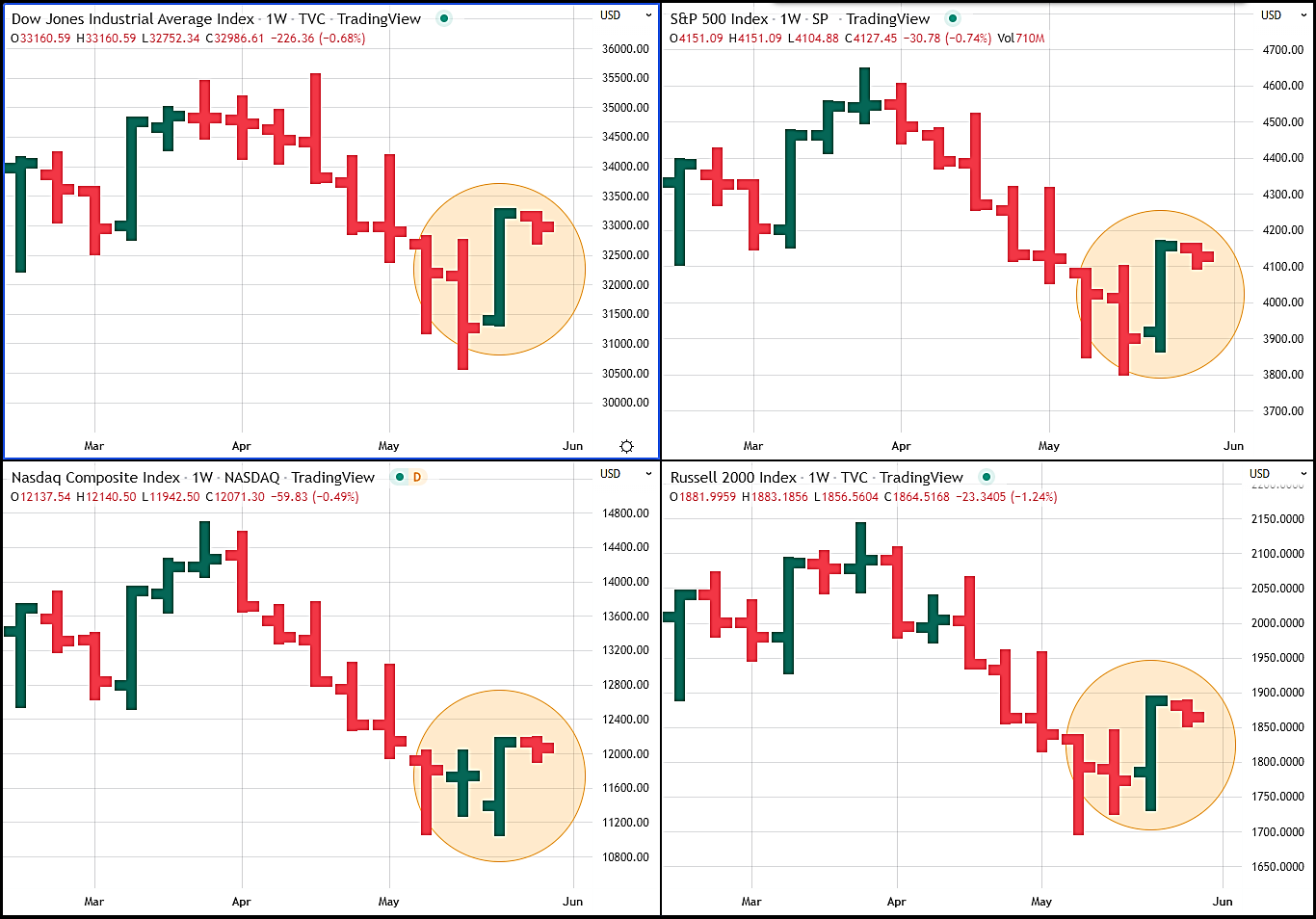
As you can see from this set of multiple weekly charts, stocks booked some decent action last week. In fact, the Dow was up 6.2% for the week. Meanwhile, the S&P 500, a good proxy for the broader stock market, was up 6.6%. Also, last week, the Nasdaq was up 6.8%, and the Russell 2000, a good indicator of what all stocks are doing, was up 6.5%.

You have to admit that's broad positive action across all equity asset classes. And it's welcome news considering what the markets have been up to over the past two months. Continue reading "Here's Why Stocks Rallied Last Week"

Strong Jobs Report Supports Continued Monetary Tightening

A Bloomberg survey of economists indicated that the medium estimate for jobs added in May would show that approximately 318,000 new jobs were added. Additionally, the survey also predicted that the unemployment rate would fall to 3.5%. A Wall Street Journal survey of economists forecasted that employers would add 328,000 jobs in May. The survey also anticipated that the unemployment rate would fall to 3.5%. Both surveys underestimated both the number of jobs added in May 2022 and the unemployment rate.

The U.S. Bureau of Labor Statistics released the latest jobs report, which said, “Total nonfarm payroll employment rose by 390,000 in May, and the unemployment rate remained at 3.6 percent, the U.S. Bureau of Labor Statistics reported today. Notable job gains occurred in leisure and hospitality, in professional and business services, and in transportation and warehousing. Employment in retail trade declined.” Continue reading "Strong Jobs Report Supports Continued Monetary Tightening"

After Respite Stocks Back To Weekly Losses

A week after breaking long weekly losing streaks, the stock market is back to its losing ways, with the DOW falling 348.58 points, or -1.05%, to 32,899.70. The S&P 500 slipped by -1.63% to 4,108.54, and the NASDAQ fell -2.47% to end the week at 12,012.73.

On a weekly level, the DOW lost -0.94; the S&P fell -1.20%, and the NASDAQ wrapped up the weekly losses with a loss of -0.98%.

But why the losses? Continue reading "After Respite Stocks Back To Weekly Losses"

EU Cuts Off Russian Oil Making These ETFs Top Buys

When the European Union voted to cut off Russian crude on May 31st, it was essentially a green light to buy oil stocks and, thus, a number of oil-focused ETFs. But before we dig into a few options that you should look at, let's talk about why this move is good for the oil industry and not necessarily your wallet.

The European Union voted to ban nearly all Russian oil from entering Europe. The details of the agreement essentially cut Russian oil imports into Europe by 90% over the next six months. The 27-country bloc relies on Russian oil for roughly 25% of what they consume. The ban directly applies to Russian oil that is delivered by sea, which means landlocked countries and Hungary, which receive the oil via pipelines, will still be permitted to access the commodity.

The goal of these sanctions is to cripple the Russian economy and force them to stop the war in Ukraine; however, Russia has already stated that they have other buyers of their oil in Asia, particularly China and India. Many believe Russia will be able to sell its oil to other countries but at a discount. Which will hurt Russia but may not have as much of an effect as the EU and other allied countries would like to see. Continue reading "EU Cuts Off Russian Oil Making These ETFs Top Buys"