Week To Forget But A Month To Remember

Sure, this week has been rough for traders and the markets overall, but it was a great month. Weeks like this are reminders to separate yourself from the recent daily volatility and look at the long-term trend. How do you do this? I'll show you in today's video.

As for the overall markets, let's get into it. Friday was as volatile as they come, with the Dow dropping -1.5% or -475 pts. The S&P 500 had lost -2.5% but pushed back strong into the close but fell just short of finishing in the green with a loss of -.48% or -18.49 pts, and while the NASDAQ shed -3.5% early in the day, it also bounced back to post a daily gain of +.56% or +72.91.

The S&P 500 is down -2.45% for the week, on pace for its second negative week in a row. The DOW has fallen -1.8%, and the NASDAQ way underperformed this week with its worst week since October, losing -4.9% on the week.

Now, this is where looking at the long-term trends can give you some sanity. Continue reading "Week To Forget But A Month To Remember"


Bonds And Stimulus Are Driving Big Sector Trends

Falling Bonds and rising yields are creating a condition in the global markets where capital is shifting away from Technology, Communication Services and Discretionary stocks have suddenly fallen out of favor, and Financials, Energy, Real Estate, and Metals/Miners are gaining strength. The rise in yields presents an opportunity for Banks and Lenders to profit from increased yield rates. In addition, historically low-interest rates have pushed the Real Estate sector, including commodities towards new highs.

We also note Miners and Metals have shown strong support recently as the US Dollar and Bonds continue to collapse. The way the markets are shifting right now is suggesting that we may be close to a technology peak, similar to the DOT COM peak, where capital rushes away from recently high-flying technology firms into other sectors (such as Banks, Financials, Real Estate, and Energy).

The deep dive in Bonds and the US Dollar aligns with the research we conducted near the end of 2020, which suggested a market peak may set up in late February. We also suggested the markets may continue to trade in a sideways (rounded top) type of structure until late March or early April 2021. Our tools and research help us to make these predictions nearly 4 to 5+ months before the markets attempt to make these moves.

If our research is correct, we may have started a “capital shift” process in mid-February where declining Bonds, rising yields, and the declining US Dollar push traders to re-evaluate continued profit potential in the hottest sectors over the past 6 to 12+ months. This would mean that Technology, Healthcare, Comm Services, and Discretionary sectors may suddenly find themselves on the “not so hot” list soon. Continue reading "Bonds And Stimulus Are Driving Big Sector Trends"

Get INO.com's Free App

INO.com’s free app is available in the App Store® and Google Play!

With this app, take your portfolio on the go with lightning-fast charts and analysis. You’ll have market data for over 350K symbols in your pocket, access to your custom portfolio, and market commentary and analysis from industry experts.

This app is completely free and is ready to download now!

Download Our App Now

App Features

We've only just begun. You can expect even more tools and custom analysis in the future in addition to these features.

Market Pulse

Check the heartbeat of the futures and stock market. See the day’s biggest movers, new momentum signals, and the latest analysis.

Quotes & Data

Price, open, high, low, close, volume, open interest, delivery dates, and more data for over 350K commodity, futures, forex, ETFs, and U.S. and Canadian stock symbols.

Charts

Clean, easy-to-read charts show price action on numerous timeframes.

Portfolio

Create your custom portfolio that syncs with INO.com for access on all devices.

Blog

Access analysis from our financial contributors covering metals, foreign exchange, commodities, options, energies, Fed moves, stocks, and ETFs.

Our Top 10

What contract prices are on the move? Check out Our Top 10, up-to-the-minute rankings of the strongest trending commodity and futures markets.

The days of sitting at a computer monitoring the markets are long gone.

Download INO.com’s app for access to the most important market data whether you’re sitting on the beach or teeing off on the back nine.

Download on App Store
Download on Google Play

Enjoy,
The INO.com Team


su*****@in*.com


Google Play and the Google Play logo are trademarks of Google LLC. App Store is a registered trademark of Apple Inc.

Your ETFs Are At Risk If US Delist Chinese Stocks

At the beginning of January, the drama of delisting certain Chinese stocks controlled the headlines for a few days. Then, as we all know, other more newsworthy stories occurred, and we all forgot about the delisting of Chinese stocks due to 'national security' concerns.

Several different stocks were being thrown around as possibly being delisted in the future, which could affect you even if you don't own any individual Chinese stocks or Chinese-focused ETFs.

The delisting occurred as a way to 'protect' the national security of the United States against China. So, the main focus of the delisted stocks were those of military importance to the Chinese government. Most of the stocks on this list the average investors would have never heard of before. But, there were three telecommunications companies thrown on the list that some investors may have heard of. However, still very unlikely you would be holding them individually or through a non-Chinese-focused ETF.

However, two Chinese stocks, in particular, are a part of a vast number of popular ETFs in the US. The companies are JD.com (JD) and Alibaba Group Holding (BABA). For whatever reason, these two stocks were and still to an extent being considered as possible additions to the delisting list. Continue reading "Your ETFs Are At Risk If US Delist Chinese Stocks"

Watch Gold, Leave Silver Alone

It is time to update the charts as gold triggered the former valley of $1765 last Friday.

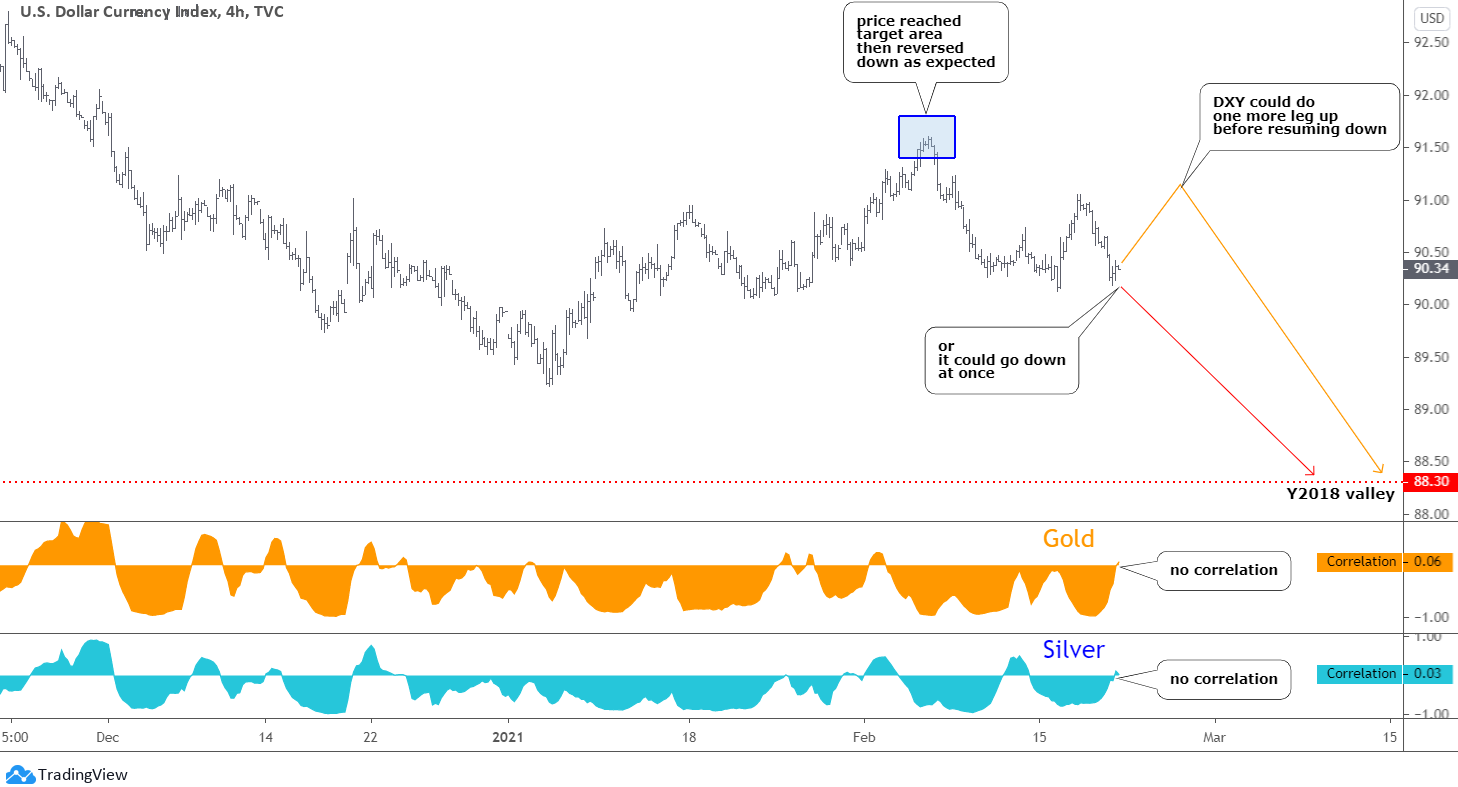
The U.S. dollar index (DXY) opens this post.

Dollar Index

Most of you agreed last month with the plan that the dollar index will extend its consolidation to the upside, making a zigzag first to the downside and then to the upside with the target area between 91.40 and 91.80 (blue box). The former was your favorite goal, and it was hit with a margin as the price reached 91.60 at the top of this month. Continue reading "Watch Gold, Leave Silver Alone"