Will 2021 Prompt A Big Rotation In Sector Trends? - Part 2

In the first part of this research article, we attempted to provide some details to the question of “sector trends in 2021 and what may shift over the next 10 to 12+ months”. In that section of this article, we covered the broad market sector trends and highlighted how the COVID-19 virus event changed the way the global economy functioned for 8+ months. It also highlighted a number of trends that were already taking place in the global market – Technology, Healthcare, Discretionary, and Comm. Services. Quite literally, the past 20+ years have been a digital revolution for most of the world and that is not likely to change.

What will likely change is the demand for Commodities, Raw Materials, Agriculture, and Manufacturing/Distribution related to these core materials. We believe any resurgence of the global economy post-COVID-19 will consist of a resurgence in the demand for commodities and raw/basic materials as consumers extend their normal consumption growth at exceptional rates.

The question in our minds is how will this transition take place and over how much time? Will it happen suddenly as new global policy and restructuring take place? Will it happen more slowly as the global economy re-engages and rebuilds? Will it happen aggressively, disrupting other sector trends? Will it happen in a way that supports continued growth and appreciation of major sector trends? Continue reading "Will 2021 Prompt A Big Rotation In Sector Trends? - Part 2"
General Motors Announcement Changes Everything

We all know Tesla (TSLA) is a run-away train, but what if I told you General Motors (GM) could soon be not only chasing down Elon Musk but maybe passing him?

OK, all of the Tesla fanatics need to take a deep breath and calm down. The thinking that another “car” company could pass Tesla is not a negative comment against Tesla; it’s the reality that we are now living in a world where electric and other alternative energy vehicles are not “pipe” dreams but reality.

The late January announcement from General Motors that they will no longer sell internal combustion engine vehicles in the United States by 2035 is the writing on the wall that gasoline is ending and EV’s will dominate the road. In 2020 Tesla delivered 499,550 vehicles, which shows that we have demand for EVs even now. Perhaps not like the demand that GM still has for gasoline-powered vehicles. GM sold 7.7 million in 2019, down from the 8.3 million it had sold in 2018 and way off its high of just over 10 million in 2016. These are worldwide sales figures, but regardless GM sold 2.5 million vehicles in the US in 2020.

What’s the point of these figures? Continue reading "General Motors Announcement Changes Everything"

Will 2021 Prompt A Big Rotation In Sector Trends?

An interesting question was brought to my research team recently related to sector trends in 2021 and what may shift over the next 10 to 12+ months. We took the effort to consider this question and to consider where trends may change over time.

The one thing my research team and I kept returning to is “how will the global economy function after COVID and how much will we return to normalcy over the next 12 to 24+ months?”

We believe this key question will potentially drive sector trends and expectations in the future.

When COVID-19 hit the globe, in early 2020, a forced transition of working from home and general panic took hold of the general public. Those individuals that were able to continue earning while making this transition moved into a “protectionist mode” of stocking, securing, preparing for, and isolating away from risks. This shift in our economy set up a trend where certain sectors would see benefits of this trend where others would see their economies destroyed. For example, commercial real estate is one sector that has continued to experience extreme downside expectations while technology and Healthcare experienced greater upside expectations.

Longer-Term Sector Trends– What's Next?

When we look at a broad, longer-term, perspective of market sectors, we can see how many sectors have rallied, some are relatively flat, and others are still moderately weak compared to pre-COVID-19 levels. The top row of these charts, the $SPX (S&P500), XLY (Discretionary), XLC (Comm Services), and XLK (Technology) sectors have all shown tremendous rallies after the COVID-19 lows in March 2020. We can also see that XLI (Industrials), XLB (Materials), and XLV (Healthcare) have all started to move higher recently. Continue reading "Will 2021 Prompt A Big Rotation In Sector Trends?"

U.S. Crude Production Rebounds In November

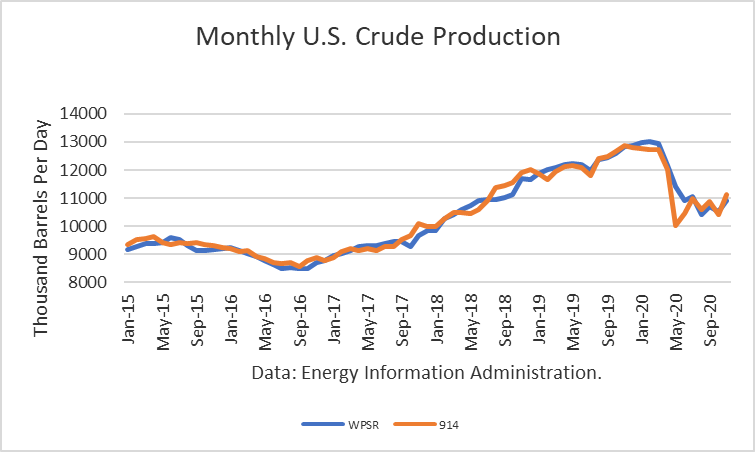
The Energy Information Administration reported that November crude oil production rose by 692,000 barrels per day, averaging 11.124 mmbd, its highest since March. This follows a 438,000 b/d drop in October and a 2 million barrel per day collapse in May. The November 914 figure compares to the EIA’s weekly estimates (interpolated) of 10.910 mmbd, a figure that was 214,000 b/d lower.

Crude

The primary cause of the rebound in production was the return of output in the U.S. Gulf Coast. USG production rose by 645,000 b/d from November, and Oklahoma output rose by 29,000 b/d, while New Mexico rose by 19,000 b/d. Continue reading "U.S. Crude Production Rebounds In November"

Options: Positive Returns Despite Negative Market Returns

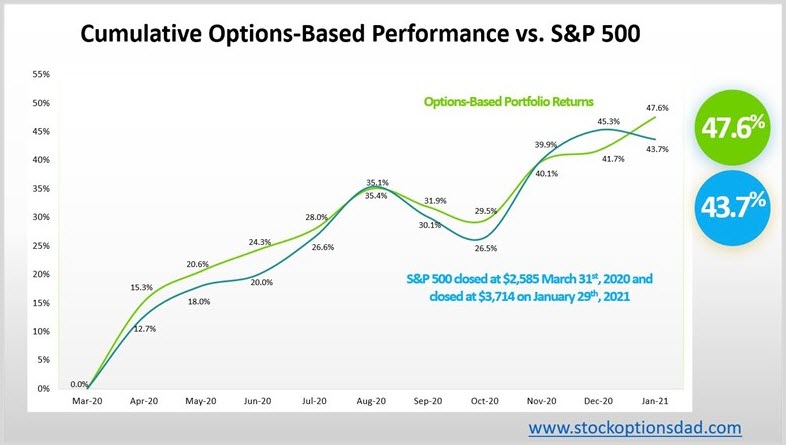
Another positive month for the options-based portfolio despite another negative month for the markets. A positive $3,372 in income was generated for January 2021. Generating consistent monthly income while defining risk, leveraging a minimal amount of capital, and maximizing return on capital is the core of options trading. Options enable smooth and consistent portfolio appreciation without guessing which way the market will move and allow one to generate consistent monthly income in a high probability manner in both bear and bull market scenarios. Over the past 9-plus months (May 2020 – January 2021), 203 trades were placed and closed. A win rate of 98% was achieved with an average ROI per winning trade of 7.8% and an overall option premium capture of 83% while outperforming the S&P 500. The performance of an options-based portfolio demonstrates the durability and resiliency of options trading to drive portfolio results with substantially less risk. The options-based approach circumvented the September, October, and January sell-offs while outperforming the S&P 500, posting returns of 47.6% and 43.7%, respectively (Figures 1, 2, and 3).

Options
Figure 1 – Overall options-based performance compared to the S&P 500 from May 2020 – January 31st, 2021
Continue reading "Options: Positive Returns Despite Negative Market Returns"