CVS: Aetna Acquisition - Desperation or Prudent Acquisition

Noah Kiedrowski - INO.com Contributor - Biotech


Introduction

CVS Health Corporation (NYSE:CVS) is going all in with a $69 billion acquisition of Aetna Inc. (NYSE:AET) to form a colossus bumper-to-bumper healthcare company. This new CVS will combine its existing pharmacy benefits manager (PBM) and retail pharmacies with the second largest diversified healthcare company via the proposed Aetna acquisition. This is a hefty price tag yet may be necessary to compete in the increasingly competitive healthcare space in the face of drug pricing pressures. The $69 billion acquisition will not come cheap and require issuing debt and diluting the share base as this will be funded via a combination of stock and cash. CVS has been in a downward spiral since its all-time highs of $112 in 2015 to lows of $67 in 2017, translating into wiping out 40% of its market cap. Several headwinds have negatively impacted its growth, and the changing marketplace conditions have plagued the stock. Exacerbating this downward movement, Amazon (AMZN) has entered the fray and has resulted in another leg down for the stock. The latter half of 2015 through 2017, the political backdrop was a major headwind for the entire pharmaceutical supply chain from drug manufacturers to pharmacies/pharmacy benefit managers (i.e., CVS and Walgreens (WBA)) and the drug wholesalers in-between (i.e. McKesson (MCK), Cardinal Health (CAH) and AmerisourceBergen (ABC)). Lastly, Amazon’s purchase of Whole Foods and behind the scenes moves in the healthcare space has incited rumors that Amazon is looking to gain entry into the pharmacy space via leveraging the Whole Foods physical footprint. The Amazon threat has become a formidable challenger in this space as it has in the past with other industries with its first real pivot after acquiring Whole Foods with major plans in entering the pharmacy space. I believe CVS will undergo short-term stock pressure but long-term appreciation as this move was a defensive yet necessary acquisition moving into the future.

CVS Health/Aetna

Aetna Acquisition

The Aetna acquisition creates the first through-in-through healthcare company, combining CVS's pharmacies and PBM platform with Aetna's insurance business. Per the agreed terms, Aetna stockholders will receive $207 per share, $145 in cash and $62 in stock. Collectively, the acquisition is valued at $78 billion.

"This combination brings together the expertise of two great companies to remake the consumer healthcare experience." "With the analytics of Aetna and CVS Health's human touch, we will create a healthcare platform built around individuals." CVS President and CEO Larry Merlo said in a statement. Continue reading "CVS: Aetna Acquisition - Desperation or Prudent Acquisition"
Bitcoin Headed For Worst Week Since 2013

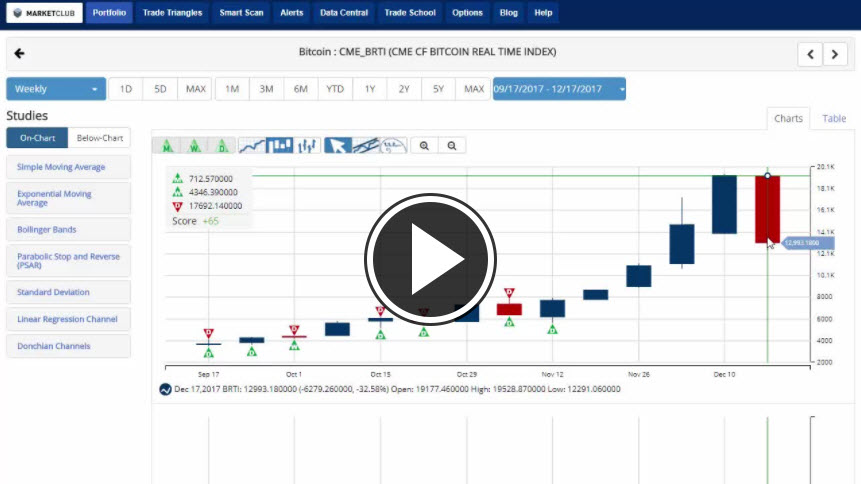
Hello traders everywhere. The darling investment of the month is experiencing a significant sell-off, in fact, the worst sell-off since 2013. Bitcoin (BRTI) opened the week at 19,046.70 and hit a session low of 12,291.06 this morning, a -35% loss, but it has backed off the lows to trade around the 13,000 level.

Coinbase, one of the biggest bitcoin marketplaces, announced at 11 am this morning that all buying and selling is temporarily disabled amid the price rout making it impossible for investors to cash out of their trades. This isn't a new phenomenon for Coinbase, as they have struggled in recent months to keep up with high demand. On Dec. 12, the company temporarily suspended buys and sells of Ethereum twice in one day.

Is this panic selling by new investors or business as usual for Bitcoin? New investors in Bitcoin may not realize how volatile the cryptocurrency has been it's entire life to this point. It's not uncommon to a significant sell-off that can last months, only to see the trend reverse and head higher. Bitcoin itself is exceptionally resilient.

MarketClub's Mid-day Market Report

Key levels to watch next week: Continue reading "Bitcoin Headed For Worst Week Since 2013"

Higher Bond Yields In 2018?

George Yacik - INO.com Contributor - Fed & Interest Rates


As a homeowner in a high-tax Blue state, I’m not sure I have a whole lot to be personally happy about in the Trump tax reform bill. My state’s government, which is already teetering financially, isn’t likely to reduce its own taxes to compensate for the cap on deducting state and local taxes. Nevertheless, I’m happy that the measure passed.

For one thing, it’s heartening to see the Republicans stand fast for a change and actually follow through on something their constituents have demanded and expected from them, rather than caving in the face of criticism from their liberal opponents in Congress and the press. I’m also getting a lot of enjoyment listening to the breathless hyperbole by Nancy “Armageddon” Pelosi, Chuck “Fake Tears” Schumer and the gang denouncing the bill, plus the stories by their allies in the press about the “victims” of tax reform, neglecting to mention the “victims” at AT&T, Wells Fargo and all who are being given immediate raises as a result of the measure.

Not a whole lot has been written or said about one of the more likely consequences of the package, and that’s that interest rates are going to move higher in 2018.

Already, in just a few days leading up to the passage of the bill, the yield on the 10-year Treasury note jumped 15 basis points to 2.50%, its highest level since last March and just 10 or so bps below its high for the year. It’s likely to rise further in 2018. Here’s why. Continue reading "Higher Bond Yields In 2018?"

6 Cannabis Stocks Set to Surge from California's Rec Market

Analysis originally distributed on December 13, 2017 By: Michael Vodicka of Cannabis Stock Trades

Cannabis stocks have a huge event directly on the horizon. In fact, it's the most important event of the last 12 months and I expect it to send a certain group of cannabis stocks soaring.

On January 1 California will become the latest - and largest US state - to legalize recreational cannabis.

This is easily the most important event in the cannabis sector in the last 12 months. And I expect it to be a huge catalyst for cannabis stocks for two reasons.

1. Billions In New Sales:

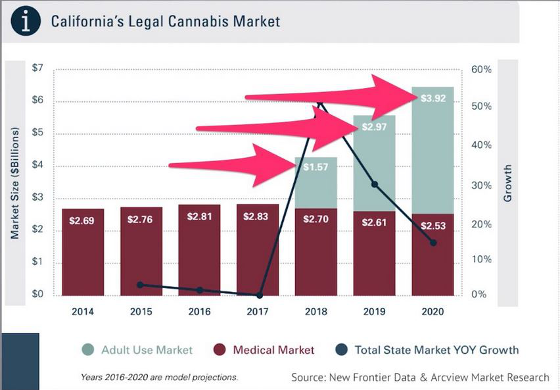
California is already the largest cannabis market in the world - by a long shot. Its legal and illegal cannabis market did around $8 billion in sales in 2016 - with 75% of that from illegal sales. Recreational is expected to quickly chip into illegal sales and grow into a $4 billion annual market within a few years, from basically $0 today. That is a potential revenue and profit windfall for cannabis companies ready to capitalize. I expect this to be a strong tailwind for US cannabis stocks in general and particularly ones operating in California's high -growth market.

California's Legal Cannabis Market
Continue reading "6 Cannabis Stocks Set to Surge from California's Rec Market"

The Fed's 2018 New Year's Resolution

George Yacik - INO.com Contributor - Fed & Interest Rates


In February Jerome Powell takes over as chair of the Federal Reserve, succeeding Janet Yellen. His first order of business should be to get the Fed off its silly, outdated and nonsensical monetary policy target of 2% inflation. He and the other members of the Federal Open Market Committee should at the very least change the inflation target number, or, better yet, find a different measuring stick altogether.

One of the Fed’s mandates, we know, is to keep inflation “stable,” as noted on the Fed’s website, citing the Federal Reserve Act (the other two mandates are achieving maximum employment and moderate long-term interest rates). The current Fed has taken to defining price stability as 2% inflation. Given that the Fed already basically believes it has accomplished the other two objectives, and price inflation has been nothing but rock-solid stable for several years, it’s not clear why it’s still so determined to get inflation up to that 2% target rate, and letting that dictate its monetary policy. If prices are stable at about 1.5%, rather than 2%, doesn’t that meet the mandate, as long as prices are stable?

During the Great Depression of the 1930s the lack of inflation – more accurately, deflation – was a big problem, feeding the downward spiral in the economy for more than ten years. Since then, economists, both on the Fed and elsewhere, have been absolutely terrified of that happening again, even though we haven’t come close to it, not even during the depths of the recent Great Recession. Now that we have seemed to have finally pulled out of the last financial crisis, it’s time to put that deflation obsession to rest. Continue reading "The Fed's 2018 New Year's Resolution"