
Disney Can't Seem To Breakout

Noah Kiedrowski - INO.com Contributor - Biotech


Introduction

The Walt Disney Company (NYSE:DIS) can’t seem to get out of its own way when it comes to breaking out of this chronic stock slump after moving from the $120s in late 2015 to being stuck in the $90 range all throughout 2016. This perpetual slump is almost entirely attributable to the decrease in ESPN subscribers and thus revenue and profit from their Media Networks segment. Excluding ESPN, Disney has been executing well and reporting record numbers throughout its other business segments. Disney has a deep and diversified enough entertainment portfolio to make a compelling case that these ESPN fears are overblown. Disney’s portfolio consists of Marvel Entertainment, Lucasfilm, Pixar, ESPN, ABC, a 32% shareholder in Hulu and of course the core Disney franchise (Disney Studios, Disney consumer products, Parks and Resorts and Disney Cruise Line). The revenue stream from these assets is as diverse as the assets themselves. The ESPN franchise within the Media Networks segment generates revenue/operating income that is disproportionate to the amount of the company’s overall revenue and operating profit. Thus, one can see why investors were spooked after two consecutive significant declines in ESPN numbers in Q4 2015 and Q1 2016. The decreases in revenue within this segment have been arrested and on the rebound due to measures put in place at Disney. As this revenue stream slowly recovers and investors can rest assure, Disney will retrace the $120 level. In the meantime all other segments are performing well and coupled with dividends, share buybacks, a P/E ratio of ~17.0 and currently sitting at a 52-week low (excluding the flash crash in February), I’d be a buyer of the stock at these levels. Continue reading "Disney Can't Seem To Breakout"

Fed Tightening Will Unleash U.S. Growth

Lior Alkalay - INO.com Contributor - Forex


The Federal Reserve, the only central bank in the G7 economies and China to raise rates and the only central bank to lead a tightening cycle, is also the only central bank to get it right. As counter-intuitive as that may sound, higher rates in a world of negative rates and massive monetization is the only viable solution to stimulate growth. To understand the irony, we must delve into credit markets and assess what’s broken.

Cheap Credit Expensive Growth

One of the arguments espoused by critics of monetary stimulus, whether it’s negative interest rates or quantitative easing, is inflation. But in reality the real cost of a ultra-loose monetary policy is the exact opposite—deflation; prices in most of the world and, in fact, in most products are either falling or stagnating. The reason is that when the policy is ultra-loose inefficient sectors of the economy are kept artificially afloat. As long as interest rates are close to zero failing sectors can keep on piling debt and thus contribute less and less to growth while leaving less available capital to the more efficient sectors that really need to grow. Continue reading "Fed Tightening Will Unleash U.S. Growth"

Weekly Futures Recap With Mike Seery

We've asked Michael Seery of SEERYFUTURES.COM to give our INO readers a weekly recap of the Futures market. He has been Senior Analyst for close to 15 years and has extensive knowledge of all of the commodity and option markets.

Michael frequently appears on multiple business networks including Bloomberg news, Fox Business, CNBC Worldwide, CNN Business, and Bloomberg TV. He is also a guest on First Business, which is a national and internationally syndicated business show.

Gold Futures

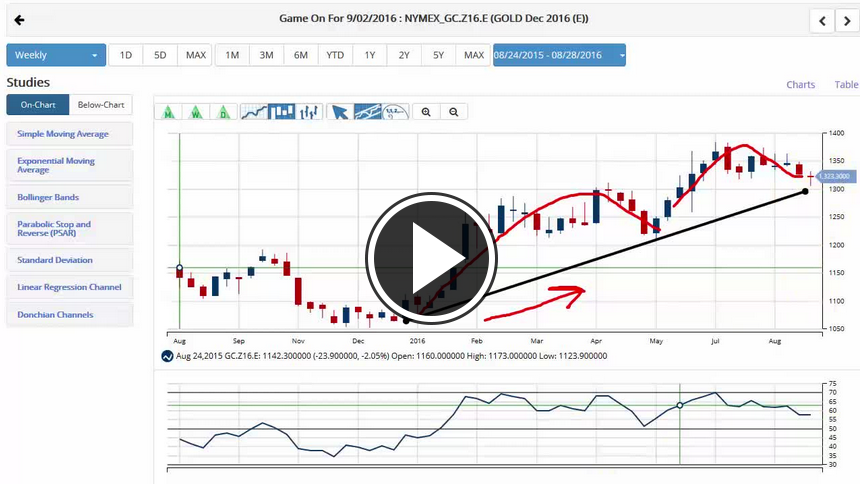
Gold futures in the December contract settled last Friday in New York at 1,326 an ounce while currently trading at 1,322 down slightly for the trading week. I’ve been recommending a short position from the 1,333 level and then adding more contracts around 1,320 as I still remain bearish while placing my stop loss above the 10-day high which stands at 1,346 as the chart structure has improved tremendously this week. Gold prices have hit 1,306 on 3 different occasions, and if that is broken, I do believe the all-out bear market could get ugly to the downside as prices are still trading below their 20 and 100-day moving average telling you that the trend is lower. Gold prices reacted sharply higher off of the construed negative monthly unemployment report adding 150,000 jobs which were slightly below consensus estimates. However, the U.S dollar has reversed as gold prices were about $17 higher, but currently only up about $5 which happened last Friday as well. The chart structure in gold will not improve for another 5 days, so you’re going to have to accept the monetary risk at this point. Continue reading "Weekly Futures Recap With Mike Seery"

And The Big Loser Of The Week Is

Hello MarketClub members everywhere. It's Friday; Labor Day weekend is on the horizon, so it is time to look back on the week. The biggest loser for the week is Crude Oil which is down from last Friday's close of $47.63 as of right now as October crude is trading around $44.39 down over $3 for the week.

MarketClub's Mid-day Market Report

Many of the other markets have seen changes in their intermediate weekly Trade Triangles and I will examine the ramifications of those moves in today's video.

Here is a quick look at the major markets and how things stand right now. Continue reading "And The Big Loser Of The Week Is"

McKesson Pressured Over Drug Pricing Concerns

Noah Kiedrowski - INO.com Contributor - Biotech


Introduction

McKesson Corporation (NYSE:MCK) along with other pharmaceutical distribution companies such as Cardinal Health and AmerisourceBergen have been under tremendous pressure as of late due to political pressures regarding the pharmaceutical supply chain and drug pricing concerns. I recently wrote an article “McKesson Jumps 34% Off Lows – Now What” stating that the easy money had been made from the ~$150 level to the roughly ~$200 level. I also pointed out that greater than 98% of McKesson’s revenues come from pharmaceutical distribution and services domestically and abroad. Thus any impact to this business model will likely have direct negative implications with regard to revenues and EPS. At the closing of that article I stated that currently, McKesson’s P/E ratio sits at the top of its peer cohort and considering the stock has risen over 34% along with the potential erosion of the middle model, I’d be cautious buying at these levels despite additional upside based on its 52-week high of $240. Now enter the latest EpiPen fiasco and subsequent drug price scrutiny being thrusted into the spotlight. Due to a Tweet by Hillary Clinton regarding her distain for Mylan’s price increase, McKesson saw a $7 per share drop or roughly 4% drop in that same session. Since any disruption in this business model will negatively impact McKesson disproportionally compared to the insurance, pharmacy and pharmacy benefit manager (PBM) companies, I’d avoid McKesson especially after the ~30% move to the upside.

McKesson - Pharmaceutical Supply Chain Complexities

The interplay within pharmaceutical supply chain players can be a challenging dynamic to grasp. McKesson positions itself on the distribution side of the network, essentially serving as an intermediary between the drug manufacturer and the pharmacy. McKesson and other middlemen such as Cardinal Health and AmerisourceBergen purchase drugs directly from the manufacturer and then sell them to the pharmacy and capture the spread between the price they pay (to the drug marker) and the price they sell (to the pharmacy) the drugs. Below is a step-by-step breakdown of the pharmaceutical supply chain steps (Figure 1): Continue reading "McKesson Pressured Over Drug Pricing Concerns"