Is It Time To Short Apple?

Is that a sacrilegious thought? Let me say I'm a huge fan of Apple Inc. (NASDAQ:AAPL) and have been since I wrote my book "Right on the Money" on a Mac some 20 plus years ago. But that was when Steve Jobs was changing the world with his WYSIWYG (what you see is what you get) interface and that silly little mouse that now is an ubiquitous part of our lives.

Times have changed and Steve Jobs is no longer with us, but I'm sure he would be happy to see that his company has overtaken Microsoft as the most valuable corporation in the world to the tune of some $750 billion. We all know that since Steve has passed on, the baton was handed to Tim Cook. Tim Cook is a very talented executive and certainly a master of the supply chain. But does Tim Cook have enough imagination to drive innovation forward in creating new and exciting products?

Will you buy Apple’s new smartwatch?

View Results

Loading ... Loading ...

Under Tim's leadership, Apple stock has certainly moved higher, no question about that, but what has Apple done lately? We will find out on Monday the 9th, when Apple will unveil a new product. Apple is rumored to be launching its new Apple watch and some upgrades to existing products.

Let me say I would like to be wowed by the Apple watch, but there is a little company called Pebble that has sold more smart watches than all the other smart watch makers combined and that company didn't even exist two years ago. Pebble is led by a very bright and focused individual much like Steve Jobs, who has a vision of what wearables can be and can do. His name is Eric Migicovsky and at 28 years old is the founder and CEO of Pebble. I'm sure we will be hearing a lot more about him and his company in the future. Could this be a David and Goliath technology story as mighty Apple may be felled by a Pebble? Continue reading "Is It Time To Short Apple?"

Moving America's Economy: The Stealth Food Market

Daniel Cross - INO.com Contributor - Equities


If there's one business that will continue to expand regardless of the state of the economy, it's food production. Agricultural demands go hand-in-hand with the booming global population. As more land becomes necessary to feed the population, the ability to refine the process and make food production more efficient per acre while remaining environmentally and biologically friendly becomes of paramount importance.

Despite the fall in energy costs for the consumer, food prices continue to climb. Agribusiness is generally uncorrelated to the general stock market because of exogenous influences like the weather. Harsher-than-expected winter storms, droughts, and other meteorological phenomena can have a big impact on the final cost of products when they hit the shelf at the grocery store.
Continue reading "Moving America's Economy: The Stealth Food Market"

Weekly Futures Recap With Mike Seery

We've asked Michael Seery of SEERYFUTURES.COM to give our INO readers a weekly recap of the Futures market. He has been Senior Analyst for close to 15 years and has extensive knowledge of all of the commodity and option markets.

Michael frequently appears on multiple business networks including Bloomberg news, Fox Business, CNBC Worldwide, CNN Business, and Bloomberg TV. He is also a guest on First Business, which is a national and internationally syndicated business show.

Gold Futures

Gold futures in the April contract are trading far below their 20 and 100 day moving average telling you that the trend is to the downside after settling last Friday at 1,213 while trading at 1,172 down $22 this Friday afternoon as the monthly unemployment report was construed as bullish sending gold to a 9 week low. The U.S dollar is hitting another contract high up 110 points putting pressure on the precious metals as I'm currently recommending a short position in the mini contract which is $33 for every dollar move while placing your stop above the 10 day high which currently stands 1,223 risking around 50 points or $1800 per contract plus slippage and commission. Continue reading "Weekly Futures Recap With Mike Seery"

A Currency War? Think Again

Lior Alkalay - INO.com Contributor - Forex


More and more of the world's central banks are moving into negative interest rates and/or Quantitative Easing; the Bank of Japan has a massive ¥80 trillion in QE (per year), the European Central Bank with its estimated €1.1 trillion QE and negative deposit rates, the Swiss National Bank recently moving deep into negative territory, setting interest rates at -0.75% and now the Riksbanken, Sweden's central bank, following suit with interest rates set at -0.1%. And as this process escalates, two words dominate the commentaries: currency war. That word combination, so frequently bandied about by economists, financial analysts and media pundits, embodies the attempt by nations to devalue their currencies in order to increase exports and inflate demand. Yet despite headlines outlining how the currency war between nations can escalate inflation, in almost all major economies, inflation continues to plunge. The question is why? The answer might not only surprise you but put a question mark on the so called "currency war."

US and China Already Stopped "Playing"

One of the biggest facts that economists seem to ignore when warning of a currency war is that the world's two main players, the US and China – the two largest economies and arguably the two which started this so-called "war" – have long been out of the game. The US Federal Reserve Bank halted its massive QE program in October and allowed the US dollar to appreciate since then by more than 14% against the Euro and more than 10% against the Yen. Moreover, the Fed is seen as the only central bank that is seriously considering a rate hike, the total opposite of devaluation. China, meanwhile, perhaps the most aggressive currency manipulator in the world (with the US a close second), has not only stopped devaluating its currency but in fact has allowed its currency to appreciate so much that the Yuan has been the best performing currency in the world after the US dollar. The Yuan appreciated more than 8.5% against the Yen and roughly 12% against the Euro since October.

Although both countries aggressively manipulated their currency, their tools were somewhat different. The Federal Reserve used Quantitative Easing, which is essentially ballooning its balance sheet with printed money, a form of currency manipulation by any and all means. The People's Bank of China used to artificially lower the Yuan by purchasing dollars, which of course allowed its foreign reserves to balloon. Those were two very different methodologies, but the outcome was the same: the devaluation of the respective currency. Yet, as seen in the two charts below, China's foreign reserves have plunged by $105.5Bln from its peak and the balance sheet of the Federal Reserve has remained more or less stable, revolving around $4.4 trillion.
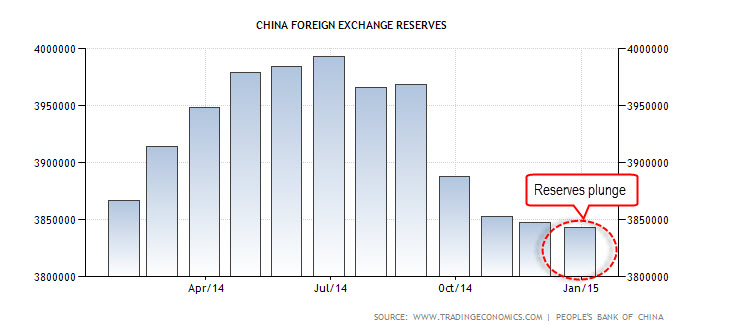

Chart courtesy of Tradingeconomics
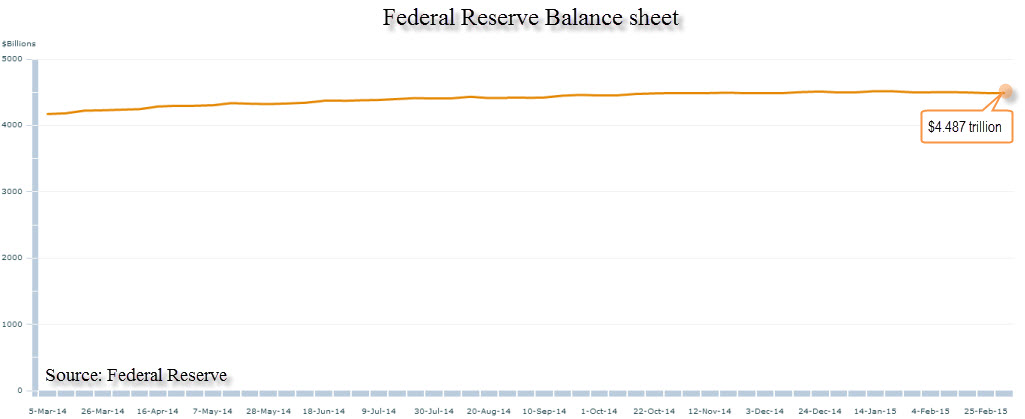

Chart courtesy of the Federal Reserve

Why the War Ended

While the sense of an escalating currency war is looming in fact this war has aggressively de-escalated. Since 2007, the aggregate amount that the US and China injected into their respective economies amounted to a whopping $6.614 Trillion (not including other PBoC programs), an amount that dwarfs the current liquidity injections of the ECB, the BOJ and all the other central banks. One must wonder what is behind this dramatic change of heart which put an end to currency manipulation by the two biggest players. China, the more aggressive manipulator of the two, made a strategic decision; it no longer wants to be known as the "factory" to the rest of the world but rather it wants to become the world's largest consumer. Thus China allowed its currency to strengthen while lowering interest rates to encourage local consumption. In the US, the case was rather simple; the US has always been a consumer-oriented economy, and while it was hoped that US exports would eventually take the lead, it was actually the return of the American consumer that ended the need for devaluing the US currency.

What Could Trigger Another War?

PBoC Governor Zhou Xiaochuan has reiterated that they see no need to devalue the Yuan. As one might expect, it is inflation, yet again. While inflation in the US is stable in China it's taking a plunge, falling to 0.8% as of late. Although with interest rates at 5.35% the PBoC still has plenty of room to maneuver, one thing is clear and that is if things turn ugly in China and inflation turns into deflation, even after a rate cut, then China might go back to the good old tried and tested method of manipulating the currency. With China experiencing a prolonged deleveraging cycle, this risk exists. But until then, while the headlines may scream currency war, understand that it's a scare tactic. If anything, the currency war has dramatically de-escalated and if things don't deteriorate from here, it could mean that the currency war that everyone is busy screaming about has essentially ended.

Look for my post next week.

Best,
Lior Alkalay
INO.com Contributor - Forex

Disclosure: This article is the opinion of the contributor themselves. The contributor does have an interest in the USD/ILS rising as of the date of publication. The above is a matter of opinion provided for general information purposes only and is not intended as investment advice. This contributor is not receiving compensation (other than from INO.com) for their opinion.

20 Years In Business, 20% Off Of MarketClub

Do you remember the Internet before Google? We do, because we were there! Yes, it's hard to imagine, but INO.com launched on March 21, 1995. We are 20 years old this month!

20 years may not seem like very long, but when it comes to the Internet, it's monumental. INO.com survived and thrived despite the dot-com bust, 9/11, the 2007 recession and the ever-changing environment of the web. We are very proud!

We could not be where we are without our INO.com visitors and MarketClub Members. Thank you.

20 Years, 20% Off - Access This Offer!In celebration of our 20 years in business, we thought this was the perfect time to cut our MarketClub Membership rates by 20%. You can still try MarketClub for 30 days for only $8.95. Then if you decide to stay, your MarketClub Membership will be 20% off of our standard rate. This offer is only available to new MarketClub Members or users who have not had a membership in the past 90 days.

INO.com created MarketClub in 2002 and since then, thousands of traders have been using our trading tools to find opportunities and make decisions with ease. Be your own financial advisor! Because truly, no one cares as much about your money and future as you do.

If you find MarketClub isn't right for you, simply contact us and we can walk away friends. However, if you stay, you'll be getting a great deal!

We're celebrating our birthday the whole month of March, but once the month is done, so is our 20 year, 20% off rate!

Access this 20% off offer!

Thank you again for visiting INO.com and helping us thrive for two decades!

Best,
Adam Hewison & David Maher
Owners of INO.com & Co-creators of MarketClub


su*****@in*.com


1-800-538-7424