When Someone Is Desperate To Sell $750 Million Of Stocks

There was a rumor yesterday that one fund or individual decided to dump three-quarters of a billion dollars of U.S. equity market exposure in 1 second. This action created a complete collapse of all liquidity in the S&P 500 e-mini futures contract - the world's most liquid equity exposure vehicle.

That was yesterday's news ….

That negative action in all the equity markets pushed the Dow down 252 points for the year with the S&P 500 and NASDAQ barely changed since last December.

As many of you know who read this blog, we have been on the sidelines for quite some time in most of the markets. And this stems from having a game plan and a sound winning approach to the markets.

So many investors trade based on emotion. Emotional trading is the fastest account killer I know, yet it still reeks havoc on investor's portfolios every year.

One of the easiest ways to avoid emotional trading is to use a well designed and tested portfolio approach. Now, just to be clear, we are not swinging for the fences with some get-rich-quick scheme. No, what I am referring to is MarketClub's Internet portfolio which produced gains in 2013 of 65%.

So far through the third quarter of 2014, this portfolio is in the positive column with a return of 14.6%. This puts MarketClub's Internet portfolio returns for the year ahead of the likes of Carl Icahn, with 10.98%. Warren Buffet with 10.43% and Julian Robertson with a 10.13% return and a host of other well-known billionaire money managers including Edward Lampert whose fund is down -37.5% for the year.

When you compare the returns of our Internet portfolio, to the market and the Billionaire fund managers I think you would agree that our returns have been excellent.

Our Internet portfolio is very easy to track and implement into your trading as there are only five stocks to follow. We share with you the key levels that will make any of the five stocks we track reverse … it's better than real-time! We also share with you sound money management stops we use to protect capital.
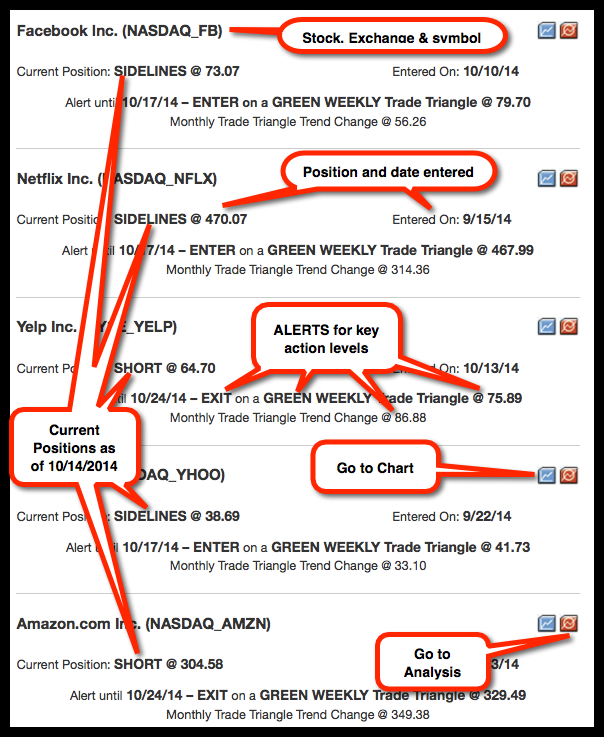
Here are those five stocks in our Internet portfolio:

Amazon.com Inc. (NASDAQ:AMZN)
Facebook Inc. (NASDAQ:FB)
Yelp Inc. (NYSE:YELP)
Yahoo! Inc. (NASDAQ:YHOO)
Netflix Inc. (NASDAQ:NFLX)

The great part about this approach is that you can place the orders yourself with a broker and then go about whatever you enjoy doing most. Whether it is playing golf, tennis, cycling or going to work, you now are afforded the time to do what ever you want. You do not have to watch the market every second of the day and become emotionally invested.

If you'd like to learn more about our Internet portfolio just click here. Here you'll find all the rules you will ever need to be successful using this portfolio.

Q4 promises to be a very interesting quarter lots of opportunities. I sincerely hope that you can take advantage of MarketClub's Internet portfolio signals and see just how it relieves stress of trading from your mind and body.

Every success,
Adam Hewison
President, INO.com
Co-Creator, MarketClub
The One Market Truth You Need To Know

There's no question about it, the markets are a little jittery right now. With the S&P down almost 6% from its September highs, people are beginning to ask themselves, "is this the big one?"

Here is the one market truth you need to know:
No one knows for sure what's going to happen, except the market itself.

The market determines prices and when you are investing, how the market closes directly effects your bottom line. Whether you are in business or in the business of investing, the bottom line is what everyone looks at. You invest or trade to make money and how a market closes determines how much money you're making or losing at that particular point in time.

You can watch all the economists, all the talking heads, read all the blogs you want and you'll come away with 100 different views about what's going to happen to the market.

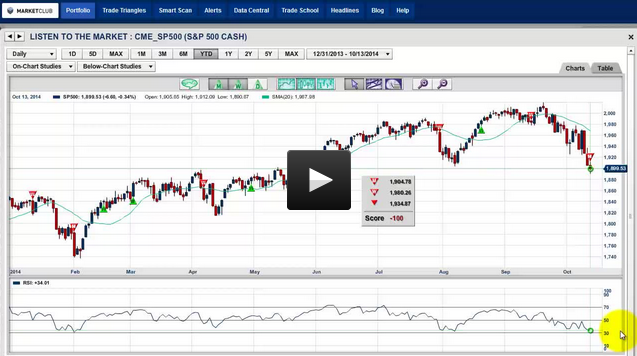
The only voice you really need to pay attention to is the voice of the market. The market itself tells you what it's going to do if you listen carefully. If you been following this blog for any length of time, you know that I have been out of market and on the sidelines since about the middle of September. If you take a look at Gold (FOREX:XAUUSDO), I have been either short or out of the market since July 13th. It is pretty much the same picture with Crude Oil (NYMEX:CL.Z14.E), where I have been either short this market on the sidelines since early July, with the exception of one fake out in late September.

Let the market tell you what it wants to do, rather than guessing or trying to pick a top or bottom.

In today's video, I will be listening to all the major markets. I am also going to share with you how the market actually talks, you won't want to miss that.

Every success,
Adam Hewison
President, INO.com
Co-Creator, MarketClub

The Winners And Losers Of The Perfect Storm Hitting Oil Prices

By: David Sterman of Street Authority

When it comes to commodities, you'll usually find a set of countervailing forces that keep prices at an equilibrium. Yet when it comes to oil, all of the factors behind price swings are heading in the same direction.  As oil prices head lower yet, investors will feel both pain and gain -- depending on the make-up of their portfolios.

A Perfect Storm

For much of the past year, a barrel of West Texas Intermediate Crude fetched around $100 a barrel on the spot market. Yet since late July, a series of factors have conspired to push prices lower:

-- A rally in the dollar, which tends to push all commodity prices lower.

-- A further slowing in the European, Japanese and Chinese economies, which crimps demand.

-- A surge in output in Libya to 800,000 barrels a day, up from 240,000 barrels a day in June amid civil war skirmishes near key oil installations.

-- An oil production surge in Russia, which is back at peak post-Soviet era levels.

-- A rapidly rising output in Kurdistan as new key oil installations come on line.

-- OPEC's recent inability to curtail production as much as the market had hoped, leading to talk that this cartel may be weakening as market share becomes more important than pricing discipline.

Of course, the elephant in the room is the United States, which is single-handedly disrupting the global supply and demand trends on a massive scale. U.S. oil production has already surged from five million barrels a day in 2008 to 8.5 million barrels a day in August 2014, according to the Energy Information Administration. The more we produce, the less oil we import. Analysts at Citigroup note that oil imports are now nine million barrels per day lower than they were in 2007. It’s important to note that some of the reduction is due to a drop in consumption as we now drive more fuel-efficient cars. Continue reading "The Winners And Losers Of The Perfect Storm Hitting Oil Prices"

Don't Get Ruined by These 10 Popular Investment Myths (Part III)

Interest rates, oil prices, earnings, GDP, wars, terrorist attacks, inflation, monetary policy, etc. -- NONE have a reliable effect on the stock market

By Elliott Wave International

You may remember that during the 2008-2009 financial crisis, many called into question traditional economic models. Why did the traditional financial models fail?

And more importantly, will they warn us of a new approaching doomsday, should there be one?

That's a crucial question to your financial well-being. This series gives you a well-researched answer.

Here is Part III; come back soon for Part IV.

Myth #3: "Expanding trade deficit is bad for economy -- and bearish for stocks."

By Robert Prechter (excerpted from the monthly Elliott Wave Theorist; published since 1979)

Over the past 30 years, hundreds of articles -- you can find them on the web -- have featured comments from economists about the worrisome nature of the U.S. trade deficit. It seems to be a reasonable thing to worry about.

But has it been correct to assume throughout this time that an expanding trade deficit impacts the economy negatively?

Figure 8 answers this question in the negative: Continue reading "Don't Get Ruined by These 10 Popular Investment Myths (Part III)"

Weekly Futures Recap With Mike Seery

We've asked Michael Seery of SEERYFUTURES.COM to give our INO readers a weekly recap of the Futures market. He has been Senior Analyst for close to 15 years and has extensive knowledge of all of the commodity and option markets.

Michael frequently appears on multiple business networks including Bloomberg news, Fox Business, CNBC Worldwide, CNN Business, and Bloomberg TV. He is also a guest on First Business, which is a national and internationally syndicated business show.

Silver Futures

Silver futures had a volatile trading week in New York still trading below their 20 and 100 day moving average settling last Friday at 16.83 while trading this afternoon at 17.30 spiking $.50 higher on Wednesday due to the fact that the Federal Reserve basically stated that they will continue to keep interest rates low for the foreseeable future sending the precious metals sharply higher, however they are unable to sustain those levels as silver prices are currently trading lower by 10 cents. If you took the original recommendation selling at 20.44 several months back continue to place your stop above the 10 day high which currently stands at 17.72 which is only about $.40 or $2,000 risk per contract at these price levels as the chart structure has improved dramatically allowing you to place tight stops minimizing monetary risk. Many of the commodity markets continue to move lower, however the U.S dollar reacted negatively to the Federal Reserve statements helping prop up silver prices but I do think the U.S dollar is in a long-term bull trend so I still look for lower silver prices ahead so continue to place the proper stop making sure you risk 2% of your account balance on any given trade.
TREND: LOWER
CHART STRUCTURE: OUTSTANDING
Continue reading "Weekly Futures Recap With Mike Seery"