Weekly Futures Recap With Mike Seery

We've asked Michael Seery of SEERYFUTURES.COM to give our INO readers a weekly recap of the Futures market. He has been Senior Analyst for close to 15 years and has extensive knowledge of all of the commodity and option markets.

Michael frequently appears on multiple business networks including Bloomberg news, Fox Business, CNBC Worldwide, CNN Business, and Bloomberg TV. He is also a guest on First Business, which is a national and internationally syndicated business show.

Crude Oil Futures

Crude oil futures in the November contract had a wild trading week in New York currently trading at $83 a barrel after settling last Friday at 85.82 as prices actually breached the $80 mark before reversing in yesterday’s trade to settle down nearly $3 for the trading week. Crude oil futures are trading below their 20 day and $13 below their 100 day moving average telling you the trend is clearly bearish and if you are short this market place your stop above the 10 day high which currently stands at 90.75 and that stop will be lowered on a daily basis as I missed this market and am currently sitting on the sidelines as the chart structure was awful when the breakout occurred so I’m kicking myself at the current time. I definitely am not recommending any type of long position in crude oil as I think prices will continue to head lower especially with Saudi Arabia coming out stating that they will not cut production as they are looking for lower prices to squeeze U.S output as this market still has further to go in my opinion and 79.78 in yesterday’s trade will be retested once again so continue to take advantage of any rally making sure you place the proper stop loss also maintaining a proper risk management of 2% of your account balance on any given trade. Crude oil prices have dropped from $104 a barrel in late June to today’s price levels dropping over $20 or 20% as consumers will definitely benefit when they hit their local gas stations and that should also help improve the U.S economy. The fundamentals in crude oil are extremely bearish as worldwide supplies are extremely high while supplies here in the United States are at record highs so it’s very difficult to rally as we don’t have the spike up in price like we used to when Middle East conflicts erupted which is a good thing for the United States.
TREND: LOWER
CHART STRUCTURE: POOR
Continue reading "Weekly Futures Recap With Mike Seery"
Our Most Important Poll Ever - We Need Your Input

I feel this is the most important poll that we have ever taken on our website. The reason I say that is that we have never faced uncertain times quite like this. Some of you are going to say, "Adam this is a political posting and not market related." I'm going to respectfully disagree with you as it has everything to do with the markets. What is affecting the minds of investors and the market has, in a large degree, everything to do with Ebola and ISIS. You only have to look at what has happened to the markets in the past two or three weeks. There is not a person I've spoken with in the past two weeks who isn’t concerned about Ebola and what's going on in this country. Forget politics, Ebola doesn’t care if you are a Republican, a Democrat, or an independent. Ebola has no political agenda. Continue reading "Our Most Important Poll Ever - We Need Your Input"

Is This Index Predicting The Future?

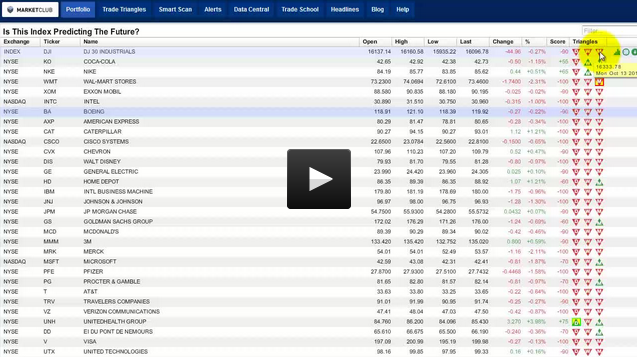
Today I'm going to be looking into the Dow 30 Index. This index is home to some of the biggest and most valuable companies in the world.

Using our Trade Triangle technology, you can quickly see that out of the 30 stocks that make up this index, just three stocks remain in a bullish trend. Out of the remaining 27 stocks, 6 are in a trading range and 21 stocks are in downtrends.

With two-thirds of the stocks in this important index in downtrends, this index is casting a shadow over the general economy.

The 3 stocks that remain in uptrends are rather mundane companies that have been around a long time.

Here are the 3 stocks that are still bullish and I will be looking at in today's video: Continue reading "Is This Index Predicting The Future?"

Did ISIS, Ebola, And The White House Crash The Market?

Exactly 19 days ago, the Dow was trading at a new all-time high. So how did everything become unraveled in less than three weeks?

In my humble opinion, the complacency that was in most investors' minds was overcome with uncertainty and distrust.

It arrived in the form of three waves.

The first wave was ISIS and their rapid takeover of key areas in the Middle East. This uncertainty was exacerbated and emboldened ISIS further when the president of the United States stated on national TV that "we have no strategy" to deal with ISIS. It doesn't matter if you are a Democrat or a Republican - you do not expect to hear the president make a statement like that.

The second wave came with the news that Ebola had reached across West Africa to the shores of the United States. This scary news should not have been a problem, however it became a major problem with the conflicting stories about how a nurse who was in fully dressed in protected clothing contracted this deadly disease. To make matters worse, this morning we hear of another nurse who was diagnosed with Ebola. The Centers for Disease Control (CDC) so far seem ill-prepared. Not leveling with the American people about what is going on just adds another layer of uncertainty and distrust in government. Continue reading "Did ISIS, Ebola, And The White House Crash The Market?"

Dividend Investors Rejoice: Falling Markets Mean Rising Yields

By: David Sterman of Street Authority

In the early stages of the bull market, investors flocked to companies with steady and growing dividends. Yet, since the market began to think about an eventual rise in interest rates back in May 2013, this asset class has lost a bit of luster.

The concerns were quite logical: A steady rise in fixed-income yields naturally reduces the appeal of relatively riskier stocks.

But the emerging economic crisis in Europe changes everything. It's increasingly apparent that European economic troubles are here to stay for quite some time, which is likely to keep a lid on global interest rates. It's a bit of a goldilocks scenario for the U.S. economy, as low rates will help our economic recovery to expand without a rate rise headwind.

You would suspect that the pullback in interest rates would help provide support to dividend-paying stocks, but many of them haven't been able to escape the recent market rout. If you've been tracking divided payers but found their dividend yields to be too skimpy, you're in luck. The market slump pushed many 2% yielders into the 3% range, many 3% yielders into the 4% range, etc. In the context of falling fixed income yields, such dividend yields are now comparatively appealing again. Continue reading "Dividend Investors Rejoice: Falling Markets Mean Rising Yields"