A Depressing Situation

A year and a half before the election, and a little less than a year before the first primary, the Wall Street Journal is already proclaiming that “Another Biden-Trump Presidential Race in 2024 Looks More Likely.”

Doesn’t that get you excited?

It’s pretty sad that out of more than 260 million adults the best the two parties could come up with is the current president, octogenarian Joe Biden, and his predecessor, Donald Trump, who is 76.

And advanced age isn’t their only drawback: both are, shall we say, not very popular.

Yet only a few people, so far, seem to have the guts to stand up and challenge them—no serious Democrats so far and only a handful of Republicans. But it’s early yet, so let’s not lose hope that others will step into the ring.

As Winston Churchill is credited with saying, “Democracy is the worst form of government, except for all the others.”

There are good reasons why the best and brightest people shun politics and have no desire to be president. Politics played at that level is an ugly sport. Few smart and ambitious people want to put themselves or their families through that. It’s a lot more lucrative and less painful to be CEO of a large corporation than to sully your name in politics. It’s also a lot easier to look yourself in the mirror every morning.

If you are willing to mix it up and eventually succeed into the Oval Office, you often have to do things you may not be proud of. In the spirit of “compromise,” you often have to lie and make empty promises—or worse—in order to get a fraction of what you really wanted. So it’s understandable why the government often botches things—we never get the best people or the best policies, so problems just seem to fester and get worse.

Which brings me to my point and how it applies to the Federal Reserve. Continue reading "A Depressing Situation"
Gold Update: Hard Top or Glass Ceiling?

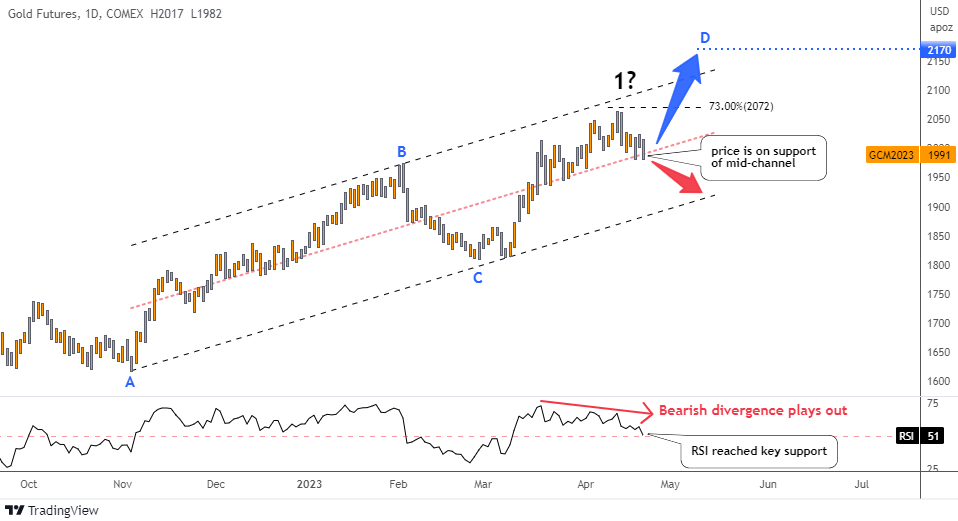
Gold price came very close to hitting the double barrier at $2,070-$2,100 of the black path target and the upper boundary of the bullish trend channel outlined earlier this month. The new 1-year top has been established at $2,063.

You were amazingly accurate this time as most of the votes were for the black path to lead the way. The market has since reversed to the downside, raising the question of whether it was a hard top or a glass ceiling.

To answer this question, let me show you an updated chart below.

Gold Futures Daily

Source: TradingView

The price has slid down to the pink mid-channel support within the black bullish trend channel.

In the RSI sub-chart, we can clearly spot a bearish divergence as the falling peaks didn't confirm the new top in the price chart. This has been playing out, pushing the price down. The indicator's reading has reached the key support of 50, just like the price. Continue reading "Gold Update: Hard Top or Glass Ceiling?"

How Can You Play This Arms Race?

The United Nations and other allied states around the world have been supporting Ukraine with military supplies since the very early days of the war. With the war in Europe still raging more than a year after it began, allied munitions stockpiles and military supplies are starting to get thin.

But, at some point, these countries' reserves will reach a depleted level they are no longer comfortable with and be forced to restock. Let's be honest; that point has already come and gone.

So today, countries in Europe and America are not only still giving Ukranie military aid, but also replacing their arms.

But something similar is also occurring in Asia, as China continues with aggressive talk pertaining to Taiwan. Furthermore, China has been heavily spending on its own military and set its defense spending growth at 7.2% in 2023, in line with where it was in 2022.

Even here in the U.S., the projected 2024 budget for defense spending came in at $842 billion, or $26 billion higher than where it was in 2023 and more than $100 billion higher than in 2022.

Even if the war weren't taking place in Europe today, there would likely be an arms race around the world, and many believe it will only get worse since geopolitical tensions are still brewing in Asia.

So, how can you play this arms race?

Buy Defense and Aerospace Exchange Traded Funds and relax.

Not sure which ones to buy? Let's take a look at a few.

The first ETF I would look at is the iShares U.S. Aerospace & Defense ETF (ITA).

ITA is the largest Defense and Aerospace ETF, with just over $6 billion in assets under management. ITA also has a reasonable expense ratio at 0.39% and has had a solid performance over the last few years. ITA is up 4.32% year-to-date but more than 14.9% annualized over the previous three years. ITA also has 100% of its assets invested in U.S. companies and has 37 holdings. Continue reading "How Can You Play This Arms Race?"

These 2 Restaurant Stocks Could Be Outperformers

It’s been a mixed year thus far for the Restaurant industry group, with several quick-service names rallying near all-time highs while casual dining names have struggled to stay in positive territory for the year.

The underperformance of the latter group can be attributed to weaker traffic trends in the casual dining space relative to quick-service.

This is not surprising given that we are seeing a pullback in spending from some consumers and quick-service is a trade-down option relative to casual dining, with consumers able to treat themselves with convenience with pizzas, burgers, and fries without breaking the bank at a casual dining restaurant where average checks are closer to $20.00.

However, while we’ve seen Yum Brands (YUM) and McDonald’s (MCD) continue to make new highs with both up 15% and 25% from their pre-COVID-19 highs, a couple of names remain well below their all-time highs and continue to trade at attractive valuations.

This is despite these two companies having iconic brands similar to McDonald’s, and KFC, Taco Bell, and Pizza Hut (Yum Brands), and despite them having some of the better growth profiles sector-wide.

In this update, we’ll dig into these two companies and highlight why they could be outperformers after a period of underperformance in Dominos Pizza’s (DPZ) case, and years of underperformance in the case of Restaurant Brands International (QSR).

Restaurant Brands International (QSR)

Restaurant Brands International is a $21.2 billion franchisor in the Restaurant industry group with four iconic brands under its umbrella: Burger King, Popeye’s Chicken, Firehouse Subs, and Tim Hortons.

The three latter brands were acquired by Restaurant Brands International over the past decade and they currently make up roughly one-third of its system-wide stores which are spread across over 100 countries.

The largest of its brands is Burger King with ~19,000 restaurants, with Tim Hortons just behind at ~5,600 restaurants, Popeye’s Chicken having ~4,000 restaurants, and Firehouse Subs, the smallest brand, having roughly 1,200 restaurants and operating solely in North America. Continue reading "These 2 Restaurant Stocks Could Be Outperformers"

Two ETFs Set To Gain The Most In May

Editor’s Note: Our experts here at INO.com cover a lot of investing topics and great stocks every week. To help you make sense of it all, every Wednesday we’re going to pick one of those stocks and use Magnifi Personal to compare it with its peers or competitors. Here we go…


It was an outstanding month for inflows into exchange traded funds (ETFs) in March.

Flows into ETFs almost tripled to $62.1 billion last month—with the bulk of the money heading into safe assets like government debt—as investors sought shelter from the recent banking crisis.

Developed market government bond ETFs soaked up a record $33.2 billion of the money, eclipsing the previous monthly peak of $27.4 billion set in May 2022, according to data from BlackRock.

Todd Rosenbluth, head of research at consultancy VettaFi, told the Financial Times, “In March, while net inflows to ETFs were strong, nearly all of the money U.S. ETFs gathered was in fixed income ETFs, led by Treasury products, as investors sought safety amid the banking crisis and the uncertainty of the Federal Reserve’s next move.”

It was interesting to note how expectations of two interest rate cuts by the Federal Reserve that might come later in 2023 affected the ETF flows. Investors betting on this would gravitate toward longer-term Treasuries versus those (like me) that prefer the safety of shorter-term Treasuries.

The $28.6 billion of net inflows into U.S. Treasury bond ETFs was divided almost equally between those focused on the short end, middle, and long end of the yield curve.

This divergence in views was visible in iShares 7-10 Year Treasury ETF (IEF), which gathered $6.1 billion in March. Meanwhile, at the other end of the maturity scale the SPDR Bloomberg 1-3 Month T-Bill ETF (BIL) pulled in $3.8 billion according to VettaFi data. And the iShares US Treasury Bond ETF (GOVT), with an effective duration of 6.3 years, was just behind at $3.7 billion.

Let's do a comparison of the two ETFs on the two duration ends of the yield curve - BIL and GOVT - over the past very volatile year. The quick and easy way to do this to ask Magnifi Personal to run the comparison for us. It’s as simple as asking this investing AI to “Compare BIL to GOVT.”

Not surprisingly, BIL is vastly superior. Not only is it less volatile, but the return was superior. Continue reading "Two ETFs Set To Gain The Most In May"