Dimon Says: Get ready for 5% 10-year yield

If you don’t believe me, believe Jamie Dimon.

“I think rates should be 4% today,” the JPMorgan Chase CEO said this week, referring to the yield on the benchmark 10-year Treasury note. And if that wasn’t strong enough, he added, “you better be prepared to deal with rates 5% or higher — it's a higher probability than most people think.”

The question shouldn’t be, “Is he right?” Instead, it should be: “Why aren’t rates that high already?”

The 10-year yield ended last week at 2.95%, about unchanged from the previous week, although it did cross over into 3.0% territory for about a day before falling back. It started this week at 2.93% -- after Dimon made his comments.

Just about every Federal Reserve comment and economic and supply-and-demand figure screams that the yield on the 10-year should be at least 100 basis points higher than it is today. Yet the yield remains stubbornly at or below 3%. Continue reading "Dimon Says: Get ready for 5% 10-year yield"
Buying Call Options - Defining Risk, Optimizing Time Value and Realizing Gains

Options can provide an alternative approach to the traditional buy and hold strategy. Buying call options can add value to one’s portfolio via leveraging a small amount of cash while defining risk with unlimited upside potential. Simply put, buying a call option is bullish in nature as the buyer is positioning the trade with the thesis that the underlying shares will increase in value. When one buys a call option, she is buying the right to purchase shares at a specific price on a specific date in the future for a nominal price. In this scenario, the buyer thinks the shares are undervalued hence why she is willing to buy the option now to secure the right to purchase shares in the future at a higher price. If the shares approach the specific price or rise above the specific price before the expiration date, then the underlying option becomes more valuable. This more valuable option can now be sold higher than when she purchased the contact to realize gains. Regarding percent, call options can be very profitable and scaled as needed. The risk in buying call options is capped based on the amount of the option itself thus downside risk is defined, and upside potential is great. Here, I’ll discuss buying call options along with my approach, strategy and real-world outcomes.

Anatomy of Buying Calls

I rarely buy call options however in opportunistic scenarios the risk-reward is very favorable given a decent time horizon. Nominal amounts of cash can be deployed in opportunistic scenarios to capitalize on sell-offs in high-quality stocks. Buying calls can be implemented as a means to leverage cash on hand without committing to purchasing the underlying shares of the company with the end goal of capitalizing on share appreciation via the option contract. The option price is determined by two variables, time and intrinsic value. The amount of time until expiration of the contract determines the time value, the longer the contract will translate into more time value in the contract (Figure 1). Generally speaking, if the underlying stock falls in value (moving away from the strike price), then the option will decrease as a function of time value. Alternatively, if the underlying stock appreciates (moving towards the strike price), then the option will increase in value as a function of time value. As the stock moves away or towards the strike price, the underlying stock is less likely (decrease in option value) and more likely (increase in option value) to reach the strike price, respectively hence the change in option value.

Intrinsic value isn’t applicable here until the underlying security breaks through the agreed upon price (strike price) before expiration. Every penny that the stock appreciates beyond the strike price is a penny of intrinsic value that increases the value of the contract. Any increase in the stock price will result in an increase in the option value regardless. Continue reading "Buying Call Options - Defining Risk, Optimizing Time Value and Realizing Gains"

U.S. Crude Oil Production Slowed in May

The Energy Information Administration reported that May U.S. crude oil production averaged 10.442 million barrels per day (mmbd), off 30,000 b/d from April’s all-time record high of 10.472 mmbd.

However, May’s production was also lower than 10.461 mmbd posted for March. From December through March, production had spiked by 423,000 b/d.

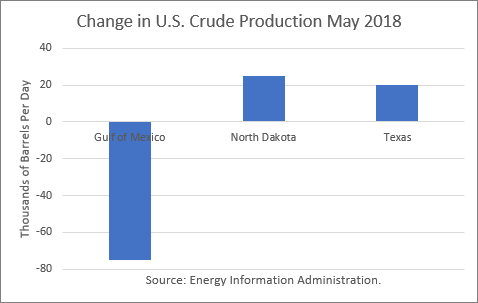
Part of the explanation for the lack of continued growth is the unplanned maintenance in the Gulf of Mexico. Last month, GOM production dropped by 75,000 b/d. In April, it had declined by 99,000 b/d. In EIA’s Short-Term Energy Outlook, May’s GOM production was forecast to increase by 200,000 b/d from April.

Otherwise, increases in North Dakota (25,000 b/d) and in Texas (20,000 b/d) were also relatively modest.

U.S. Crude Oil Production

The EIA-914 Petroleum Supply Monthly (PSM) figure was 304,000 b/d lower than the weekly data reported by EIA in the Weekly Petroleum Supply Report (WPSR), averaged over the month, of 10.706 mmbd. EIA’s most recent weekly estimate for the week ending July 27th was 11.0 mmbd. Continue reading "U.S. Crude Oil Production Slowed in May"

Winklevoss Bitcoin ETF Rejected Again

In March of 2017 the Winklevoss twins had their first Bitcoin ETF proposal rejected and now the second Winklevoss Bitcoin ETF proposal was dismissed in July of 2018 by the Securities and Exchange Commission. The reason all of this matter is because the Winklevoss twins where the first to have the SEC rule on a Bitcoin ETF back in 2017, and now that their proposal has been rejected for a second time things are starting to look a little bleak for investors who want a Bitcoin ETF.

First and foremost, the Securities and Exchange Commission that made the ruling expressed concern about Bitcoin’s trading reliability and security; two significant issues which don’t appear to be easy fixes anytime soon. The commission went on to say “The record before the commission indicates that a substantial majority of bitcoin trading occurs on unregulated venues overseas that are relatively new and that, generally, appear to trade only digital assets.” The commission stated that more then 75% of Bitcoin trading happens on unregulated foreign exchanges.

But, the commission did note that regulated Bitcoin markets are in their early stages of development and that if they further grow, the commission would then review the idea of allowing a Bitcoin ETF based on SEC requirements. Continue reading "Winklevoss Bitcoin ETF Rejected Again"

Hedging Energy Sector Oil Price Risk

Volatility in oil prices makes investing in the energy sector a risky proposition. The collapse in oil prices following the OPEC meeting in November 2014, at which Saudi Arabia announced its intent to flood the market to put American shale oil producers out-of-business, resulted in a rout in energy equities prices.

The Energy Select SPDR ETF (XLE) fell by 37 percent from November 26, 2014, to January 20, 2016. For many investors, the drop had become too large to sustain, and they closed their positions, locking-in a substantial loss.

XLE has recovered its loss, and as of July 27th, the price was nearly identical to its value on November 26th, 2014. But the recovery in oil prices, due to heightened geopolitical risks, also makes them vulnerable to another downward correction.

Citicorp, for example, issued a forecast proclaiming that “the bull argument is based on a faulty analysis,” and that oil prices “will fall back into a band between US$45 and US$65 in just over a year.”This raises the question of whether investing in the energy sector represents an attractive risk-reward opportunity. Continue reading "Hedging Energy Sector Oil Price Risk"