Is Dollar's Dominance Over?

Last September, the Congressional Research Service published an "In Focus" report. They had already attempted to address speculation about the dollar's dominance in the face of global economic and geopolitical changes at the time.

Three major threats were addressed in that document.

China and its currency have risen to sixth place, accounting for 1.66% of global payments.

The next source of concern was US financial sanctions, as the share of Russian exports to Brazil, China, India, and South Africa in US dollars fell from 85% in Q2 2018 to 36% in Q4 2021.

Digital currencies, which include cryptocurrencies and digital currencies issued by central banks, have completed the list.

“Some policymakers have expressed concerns about an international race to create a digital currency with widespread adoption, arguing that the United States should create a U.S. digital currency to maintain the dollar’s prominence in international payments.”

"To date, there is no evidence of a shift away from the US dollar as the dominant reserve currency," the study concluded.

Back in October, I shared my most recent update for the dollar index, as it hit the first target with a fresh outlook.

At the time, I proposed two paths for the dollar: a continuation to the next target of $121 on an aggressively hawkish Fed, or a consolidation before resuming to the upside. The majority of readers supported both paths, with the consolidation option coming out on top.

The question of the dollar's dominance is resurfacing these days, as its value has plummeted dramatically. It is too early to tell whether this is a consolidation or a global reversal.

One thing is certain: the path of unending growth has been abandoned.

In my charts, I see a clash of perspectives. The technical chart is about to give a strong bearish signal. The chart comparing fundamental factors, on the other hand, supports the king currency's continued strength.

Let me show you each of them one by one, beginning with the emerging bearish alert. Continue reading "Is Dollar's Dominance Over?"
A New Bull Market In Gold?

We continue to think precious metals are one of the best risk vs. reward opportunities right now.

Last week, we shared the Gold to $5K Report with you from our friends over at All Star Charts.

You can check it out here, in case you missed it. The report outlines all of the reasons why Gold could hit $5,000/oz. sooner than the crowd expects.

Today we want to reiterate that it's not just Gold that looks attractive here. Silver is also poised to move higher.

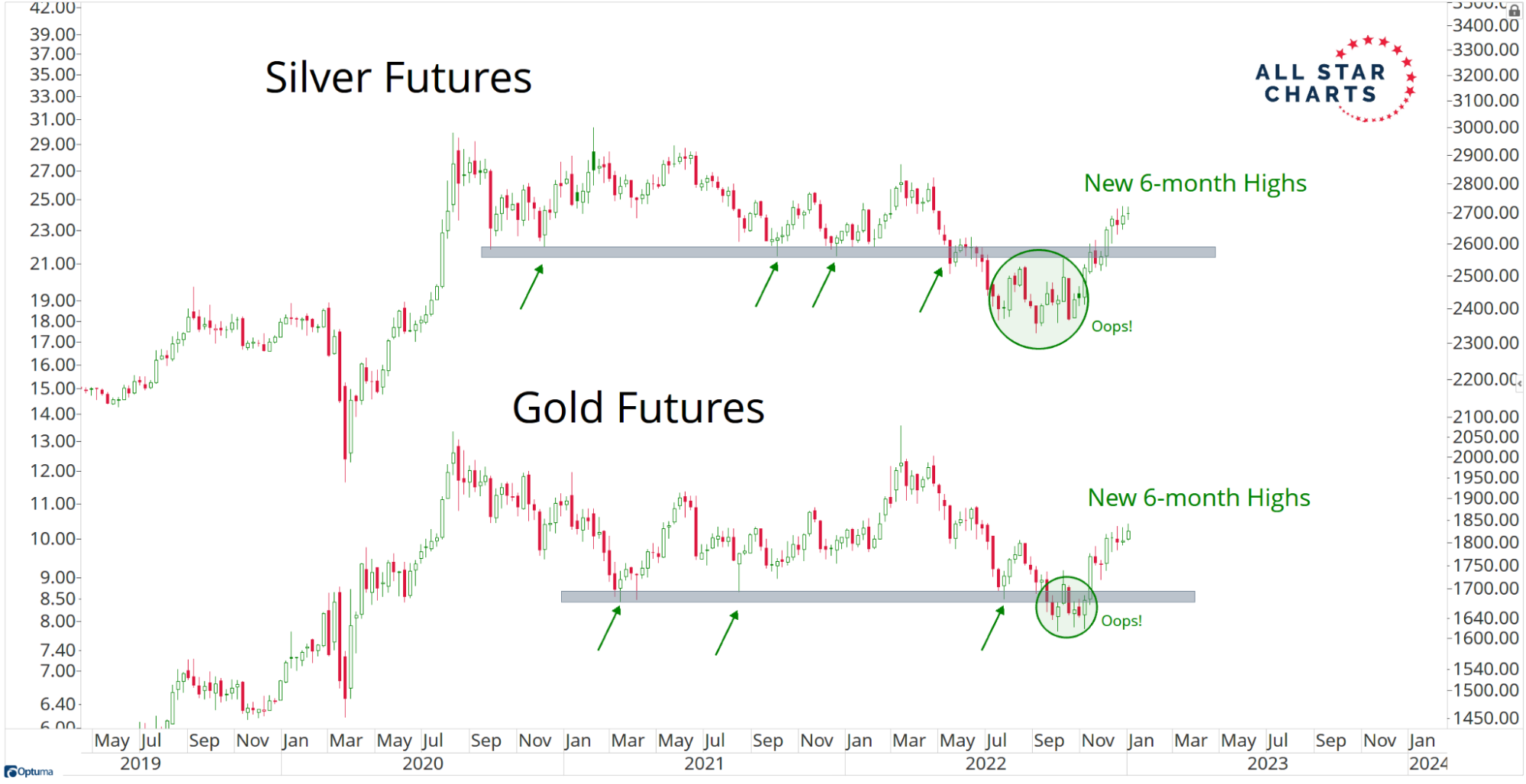
Gold and Silver Futures Chart

As you can see above, Gold & Silver are confirming one another by hitting 6-month highs together.

The current leg higher began a couple of months ago after both metals formed a failed breakdown at support. As you might know, failed breakdowns often lead to fast moves higher, and we're starting to see that play out.

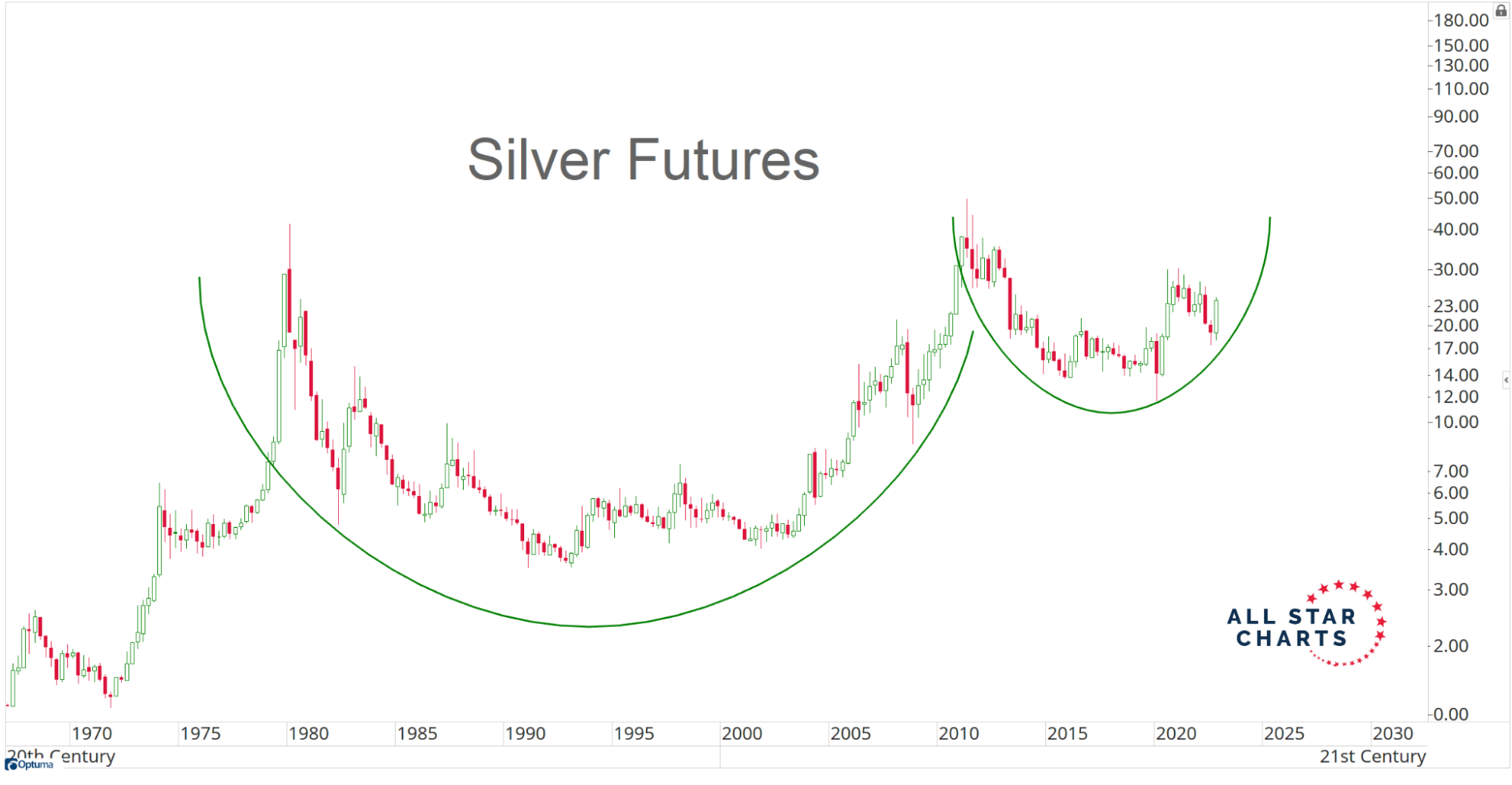
Silver Futures Chart

When you zoom out and look at a long-term chart of Silver, you'll notice it's in the process of forming a massive Cup & Handle pattern that dates back to 1980.

The next long-term objective for Silver is around $50, which is the all-time highs from 1980/2011. That's more than 100% higher here!

Be sure to download this free report to learn how to profit from this potentially historic move.

Enjoy,
The INO.com Team

Best Performing ETFs in 2022

2022 was a very tough year for investors, both big and small. All three of the major indexes ended the year down substantially. The Dow Jones Industrial Average fell the least, just 8.8%. The S&P 500 dropped 19.4%, while the technology-heavy NASDAQ sank 33.1%.

2022 was the first year in four that the major industries ended the year lower. Inflation and aggressive interest rate hikes by the Federal Reserve to combat persistent inflation weighed on the market as a whole but had a more damaging effect on technology stocks.

Out of the top-performing Exchange Traded Funds in 2022, two of the top five were ETFs that are short technology stocks, while two others were short Treasury Bonds.

It's not very often that the best performing Exchange Traded Funds are ones that had bet against an asset class or specific industries, but that was the type of year we had in 2022.

Let's look at the top five performing ETFs of the year and see what they had in common and if there is anything we can learn that will make us better investors in 2023 and beyond.

As mentioned, two of the top five best-performing ETFs were short, US Treasury bonds.

The best-performing ETF of 2022 was ProShares UltraPro Short 20+ Year Treasury (TTT) which rose 150.17%.

The third best-performing ETF was the ProShares UltraShort 20+ Year Treasury ETF (TBT), which increased by 93.29%.

Both funds were "short" or betting that they would decline in value, Treasury bonds that have 20 or more years until maturity.

The TTT was leveraged three times short Treasury bills. That means if a Treasury bill fell $1 and the TTT triple short leveraged fund had bet against it, TTT would be up $3. So for every $1 move lower Treasury bonds went, TTT was moving $3 higher.

The TBT fund was also short-leveraged, but it was only short two times. So if it were short a bond that fell $1, it would go higher by $2, not $3 like TTT. This also means that TBT carried lower risk than TTT, and still performed well in 2022. Continue reading "Best Performing ETFs in 2022"

1 Energy Stock to Fuel Your Portfolio This Winter

Amid macroeconomic and geopolitical headwinds, energy stocks have fared better than the broader market this year.

The war between Ukraine and Russia had led to a significant rise in prices of crude oil and natural gas as the world feared a shortage of these essential commodities with widespread sanctions on Russia, a major oil and gas producer. This led to investors’ focus shifting to energy stocks.

Oil and gas major TotalEnergies SE (TTE) has gained 29.8% in price year-to-date and 27% over the past year to close the last trading session at $63.13. Courbevoie, a France-based company, announced a solid third-quarter performance.

The company’s iGRP segment reported a record adjusted net operating income of $3.60 billion in the quarter, rising $1.10 billion sequentially, and cash flow of $2.70 billion, driven by increase in average LNG selling price.

TTE’s CEO Patrick Pouyanné said, “In a context marked by an average Brent price of $100/b and an increase in gas prices exacerbated by Russia’s military aggression in Ukraine, TotalEnergies leveraged its integrated model, particularly LNG, to generate results in line with previous quarters.”

TTE announced that it had obtained a 9.375% participating interest in the 16 million ton per annum (Mtpa) North Field South (NFS) LNG project in Qatar to fuel its growth further.

After combining its participating interest in North Field East (NFE) with NFS, TTE will add LNG production of 3.5 Mtpa to its worldwide LNG portfolio by 2028, which is in line with its goal to increase natural gas in its sales mix to 50% by 2030.

During the previous quarter, the company also announced that production had started at the Ikike field in Nigeria. The project is expected to deliver peak production of 50,000 barrels of oil equivalent per day by the end of this year.

TTE also launched the Begonia project in Angola and the Fenix project in Argentina, which is expected to produce 10 million cubic meters per day of natural gas after the expected operations in early 2025.

Moreover, the company’s partner Eni announced in August that it had made a significant gas discovery in the Cronos-1 well in Cyprus, with initial estimates indicating 2.5 TCF of gas. Continue reading "1 Energy Stock to Fuel Your Portfolio This Winter"

Gold Miners Index Starting The Year Strong

2022 was a year to forget for most sectors and certainly the major market averages, with the S&P 500 (SPY) declining 19% for the year and the Nasdaq Composite suffering an even more disappointing 33% loss.

While most investors certainly didn’t have the Gold Miners Index (GDX) in their cards to be an outperformer in 2022 after it found itself down 30% for the year in October with one quarter to go, the sector managed to recover and has started off the new year strong as well.

The strength in GDX can be attributed to the rally in gold prices ($1,650/oz → $1,850/oz) but also sentiment being the worst in years as of Q3, with many names trading at their cheapest valuations since 2015.

This gave the sector the fuel to significantly outperform gold if we saw any positive change in sentiment, and this is exactly what we’ve seen with the gold price back above key support at $1,800/oz.

While this rebound in the GDX is certainly positive from a momentum standpoint, it has made things a little more difficult from a stock-picking standpoint.

This is because many miners have already made 40-50% moves off their lows, and it can be dangerous to chase the lower-quality miners or sector laggards with them hovering well above key support levels.

In this update, we’ll look at two of the better buy-the-dip candidates sector-wide and highlight why these two names have the potential to outperform in 2023, making them attractive names to keep near the top of one’s watchlist if we see further weakness.

I-80 Gold (IAUX)

I-80 Gold (IAUX) is a $730MM company in the gold sector with multiple projects in the state of Nevada, including its Ruby Hill, Granite Creek, and McCoy-Cove projects. The company also has a processing facility with over $1.0BB in sunk costs in northern Nevada.

The company plans to employ a Hub & Spoke model and feed material from its three mines to its central “hub” or processing facility at Lone Tree. Continue reading "Gold Miners Index Starting The Year Strong"