The Dollar Has Hit The First Target

The king currency has finally hit the first long-term target of $114 that was set in the summer of a distant 2019 when it traded around $96.

That aim wasn’t clear then as the dollar index (DX) looked weak in the chart. The short-term structure was similar to a pullback after a heavy drop.

The majority of readers did not believe the DX would ever raise its head as you can see in the 2019 ballot results below.
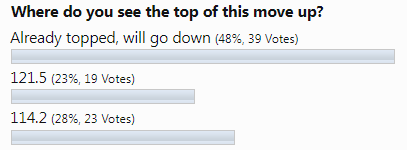
Ballot Votes

However, I had found a bullish hint in a very big map, and I warned you “Don't Get Trapped By Recent Dollar Weakness”.

Back in August, you had already been more bullish on the dollar as you voted the most for the target of $121.3 in the earlier post. This confidence is due to the certain position of the Fed, which resolutely fights the inflation, lifting the rate aggressively round by round.

Let me update the visualization of the real interest rate comparison below to see if the dollar still has fuel to keep unstoppable.
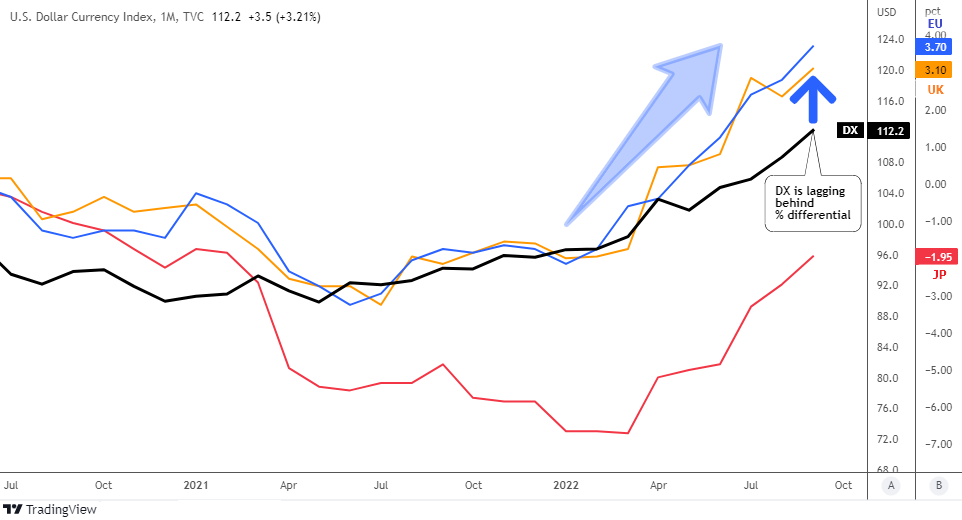
DX Monthly vs Real IR

Source: TradingView

The real interest rate differentials are shown on the scale B: blue line for U.S. - Eurozone, orange line for U.S. – U.K. and the red line for U.S. – Japan. Continue reading "The Dollar Has Hit The First Target"

Sugar-Coating the Likelihood of a Recession

Does anyone remember when then President Donald Trump told the American population that the Covid-19 lockdowns and spread of the virus that caused the pandemic would all be over by Easter? Or when referring to Covid-19, that it was “the flu”?

During the first few weeks of the pandemic, President Donald Trump downplayed the severity of the virus to not panic the American population. In hindsight, perhaps the early days, especially when the country was in lockdown, it would have been more beneficial to not sugar-coat the virus and the timeline of when the government would lift the lockdown restrictions.

Had President Donald Trump told people the virus would kill hundreds of thousands of people, perhaps we could have stopped the virus from spreading during the lockdowns.

If President Trump hadn’t given a timeline for the lockdowns and the pandemic seeing brighter days, perhaps the government wouldn’t have lost its creditability with so many Americans during the summer of 2020 and its continued response to the pandemic.

Our current situation with the Federal Reserve and its chairman Jerome Powell, is very reminiscent of the early days of the Covid-19 pandemic.

Back in the winter and early spring, Powell told us that inflation was “transitory” and wouldn’t last. He even said current inflation wouldn’t need aggressive monetary policy changes to fall. Then, even when Powell began to raise interest rates, he told Americans that there was a high probability of a soft landing, referring to the idea that the Fed could bring down inflation slowly and gently.

Powell continued to tell us this summer that raising interest rates gradually and methodically would lower inflation but not put the economy in a recession.

Fast forward to just a week ago, and Powell tells us that the “chances of a soft landing are likely to diminish.” Inflation has hardly moved even though the Fed has raised interest rates five times, starting in March 2022. At that time, the Fed increased rates by 0.25%, 0.50% in May, then a 0.75% bump in June, July, and September.

Powell also said at the most recent Fed press conference following its announcement of the September rate hike that “we have to get inflation behind us. I wish there were a painless way to do that. There isn’t." Continue reading "Sugar-Coating the Likelihood of a Recession"

2 Apparel Stocks Bucking The Trend

It’s been a rough past month for the S&P-500 (SPY), with the index down 15% in less than 30 trading before Wednesday’s rally.

The continued weakness can be attributed to the view that a 4.0% terminal rate for the Federal Funds Rate may not be enough to bring inflation to its knees, given how sticky inflation has been to date and with supply chain issues remaining in place.

Higher rates result in growth stocks becoming less attractive, given that higher discount rates must be used to discount future cash flows. At the same time, there is a greater risk of a hard landing, which does not paint a rosy picture of 2023 earnings for S&P-500 companies.

However, while many stocks are seeing declining earnings with pressure on profit margins, quite a few companies are bucking the trend, and given the general market weakness, they’ve found themselves trading at extremely attractive valuations.

Two names that stand out are Capri Holdings (CPRI) and Deckers (DECK), which both hail from the apparel industry group and are on track to grow annual earnings per share at double-digit levels this year.

Just as importantly, they’re expected to see new all-time highs in annual earnings per share next year as well. Let’s take a closer look below:

Capri Holdings (CPRI)

Capri Holdings is a global fashion company with three iconic brands: Versace, Jimmy Choo, and Michael Kors. While luxury brands might be considered the last thing that one is shopping for in a recessionary environment, they benefit from a very affluent customer base that’s seeing much less pressure than lower-income consumers to their discretionary budgets.

Meanwhile, from an industry standpoint, the personal luxury goods market continues to grow at an impressive rate. Based on recent research, sales are expected to grow 10% from FY2019 levels this year and are forecasted to increase another 20% from FY2022 to FY2025.

Given that Capri owns some of the strongest brands, it’s in great shape to capture some of this growth. In fact, its long-term goal is to increase total revenue to more than $8.0BB, up from FY2023 estimates of $5.85BB. This is expected to be driven by the following: Continue reading "2 Apparel Stocks Bucking The Trend"

3 Stocks to Leave Out of Your Retirement Portfolio

The Fed announced its third consecutive 75-bps interest rate hike last week, which has caused the benchmark indices to plunge. The S&P 500 has lost 5.2% over the past week and 23.3% year-to-date. Moreover, Goldman Sachs slashed its 2022 year-end S&P 500 target to 3600, down 16.3% from 4300.

According to Chris Zaccarelli, Chief Investment Officer, Independent Advisor Alliance, Charlotte, NC, “The Fed is going to raise rates until inflation comes back down, and they will cause a recession in the process.”

Also, Steve Hanke, a professor of applied economics at Johns Hopkins University, said, “The probability of recession, I think it’s much higher than 50% — I think it’s about 80%.”

Given the uncertain economic outlook, fundamentally weak stocks Uber Technologies, Inc. (UBER), Workhorse Group Inc. (WKHS), and AppHarvest, Inc. (APPH) might be best avoided for your retirement portfolio. These stocks do not pay dividends, which is the key requirement for a stock to be added to a retirement portfolio.

Uber Technologies, Inc. (UBER)

UBER develops and operates proprietary technology applications in the United States, Canada, Latin America, Europe, the Middle East, Africa, and the Asia Pacific. The company operates through three segments: Mobility; Delivery; and Freight.

On September 25, 2022, Pomerantz LLP announced the filing of a class action lawsuit against UBER and some of its officers, alleging violations of federal securities laws. The suit is on behalf of a class of all persons and entities except Defendants that purchased or acquired UBER common stock between May 31, 2019, and July 8, 2022.

UBER’s revenue came in at $8.07 billion for the second quarter that ended June 30, 2022, up 105.5% year-over-year. However, its net loss came in at $2.60 billion compared to an income of $1.14 billion in the year-ago period. Moreover, its loss per share came in at $1.33, compared to an EPS of $0.58 in the prior-year period.

UBER’s EPS is expected to decline 367% year-over-year to negative $4.67 in 2022. Its EPS is estimated to remain negative in 2023. It missed EPS estimates in three of the four trailing quarters. Over the past year, the stock has lost 42.3% to close the last trading session at $26.89. Continue reading "3 Stocks to Leave Out of Your Retirement Portfolio"

See Mentor in Action and Get 50% Off

Join Magnifi Tuesday, Wednesday, or Thursday this week and see how Mentor can help you build a financial portfolio and take your investing to the next level.

What you'll see from Mentor:

  • How to build your financial portfolio
  • Understanding personalized portfolio updates
  • Analysis and market alerts
  • Q&A: Answering the most common Mentor questions

And you can still lock in Mentor for $7 / month - this offer will be expiring soon!


Tuesday 4:00PM ET / 1:00PM PT

See how Mentor's personalized portfolio alerts and interactive charts and graphs help you understand your portfolio.


Wednesday 2:00PM ET / 11:00AM PDT

Learn how Mentor helps you identify stocks and ETFs you’d like to invest in—with no account minimums or commissions.


Thursday 12:00PM ET / 9:00AM PT

Mentor can steer you through portfolio design based on your investing needs.

Continue reading "See Mentor in Action and Get 50% Off"