Reduce Your SPAC Risk With SPAC Focused ETFs

A lot of wild things happened in 2020, but from an investor’s perspective, the rise of the SPAC or Special Purpose Acquisition Company may be one of the longer-lasting events. The SPAC was all the rave in 2020 as investors were flooded with SPAC’s, SPAC mergers, and SPAC-related rumors about who was going to merge with whom.

From some perspectives, the SPAC is a very good thing; maybe not so much from others. Still, regardless the SPAC for a lot of companies, the SPAC was an easy, cheaper way to go public and raise funds for their organization without having to jump through the traditional IPO or initial public offering process.

Similar to the number of IPO Exchange Traded Funds, like the First Trust U.S. Equity Opportunities ETF (FPX) or the Renaissance IPO ETF (IPO), which offer investors a way to play recently IPO’d stocks, without having to purchase these stocks so after going public themselves. Investors also have a few ways to play SPAC’s without following them intently and tracking which mergers occurred and which ones have yet to close.

The first SPAC ETF that came to market was the Continue reading "Reduce Your SPAC Risk With SPAC Focused ETFs"
NASDAQ and S&P 500 Hit Record Closes

The U.S. stock market rose on Friday, with the NASDAQ and S&P 500 adding to their records for the week when both indexes closed at record highs. The NASDAQ closed up on the day with a gain of +0.81% or 116.95 points to close at 14,639.33, an all-time high. Not to be outdone, the S&P 500 closed that day up +0.75% or +32.45 points to close at 4,325.34, an all-time high. In fact, it rose for a 7th straight day after a strong jobs report, marking its best winning streak in 10 months. The DOW missed out on the record run this week, but it did finish the day up +0.44% or +152.82 points to close at 34,786.35.

On a weekly level, the NASDAQ rose +2%, while the S&P 500 and Dow climbed 1.7% and 1.1%, respectively. Continue reading "NASDAQ and S&P 500 Hit Record Closes"

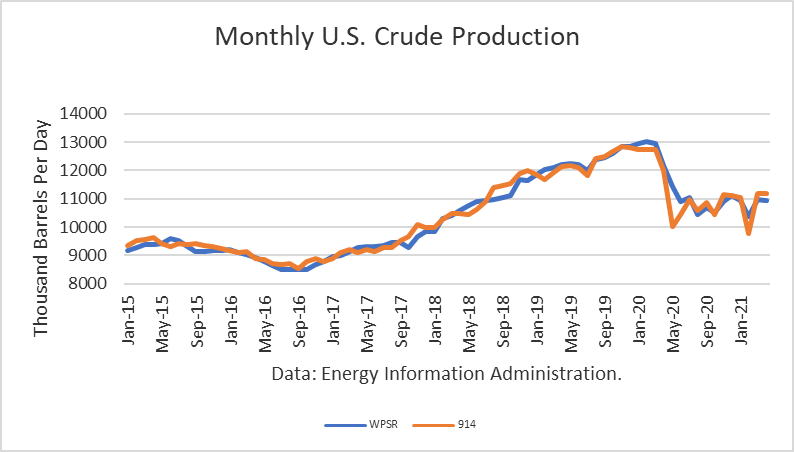
U.S. Crude Production Off In April 2021

The Energy Information Administration reported that April crude oil production dipped 19,000 barrels per day, averaging 11.169 mmbd. This follows a gain of 1.415 mmb/d in March as production returned after the freeze in Texas. In addition, the April 914 figure compares to the EIA’s weekly estimates (interpolated) of 10.947 mmbd, a figure that was 222,000 lower than the actual 914 monthly estimate.

Monthly US Crude Production

A large decline in the Gulf of Mexico (92,000 b/d) caused a dip in U.S. production. However, that drop was largely offset by gains in Colorado (31,000 b/d), Texas (28,000), and New Mexico (17,000).

Given the huge reduction in May 2020, production dropped by 841,000 b/d over the past 12 months. This number only includes crude oil. Continue reading "U.S. Crude Production Off In April 2021"

A Few New ETFs That You Need To Know About

New ETFs are constantly popping up; 32 new ETFs hit the markets in May 2021 alone. But, of course, not all months are quite that busy, and most of the news ETFs in the month didn't really represent "new" opportunities for investors since most of the new ETFs were similar to what is already available to investors, just by a new issuer.

However, a few ETFs introduced in May are a little different from the run-of-the-mill option and may be worth considering for your own portfolio. So let's take a look and see if any of them interest you.

The first one is something we all suffer from, from time to time, FOMO ETF (FOMO). This ETF is an actively managed fund that seeks long-term capital appreciation by holding all size equities, SPAC's, fixed income, volatility, and inverse volatility ETFs and ETNs. The fund managers will decide what to own based on the "fear of missing out" concept of buying what is currently "in favor" with retail, individual, and institutional investors. As a result, the fund managers have a wide range of where and how they can invest and complete control over investment timeframes. This fund will likely have high churn and potentially be rather volatile, but time will tell. FOMO has an expense ratio of 0.90%.

Next, we have the Bitwise Crypto Industry Innovators ETF (BITQ). This ETF invests in a modified market-cap-weighted index of global companies that support the crypto-asset-enabled decentralized economy. This fund is passively managed but still has an expense ratio of 0.85%. The ETF does not hold cryptocurrency itself, just a group of 30 companies worldwide that operate in that crypto industry in one form or fashion. Many would consider this ETF a back-door investment into the land of crypto-currency investing because it's likely that if crypto's rise in value, these companies will also see an increase in their share price. Continue reading "A Few New ETFs That You Need To Know About"

The Best Price Action Swing Trading Strategy

Ok, “best” is subjective. But this is my favorite swing trading strategy, mainly because it captures some explosive stock trades. There is a common price pattern that tends to occur before many stocks rally sharply. This pattern can be used as a strategy because it provides:

    • A defined entry point.
    • A stop loss that can often be placed within several percent of the entry point, keeping risk on the trade small.
    • A favorable reward-to-risk opportunity, in that we only take trades where the likely profit is much bigger than our risk.

In this article, I will lay out how this all works, what the pattern is, how to trade it, and how to find it.

I have also noticed that the Trade Triangles can be used in conjunction with this strategy, providing alternative entry points and signaling when to take profit off the table. Therefore, you can continue to use the MarketClub Trade Triangles, or you can add them to the strategy to aid with your trade selection. Continue reading "The Best Price Action Swing Trading Strategy"