Options: Outperformance Despite Choppy Markets

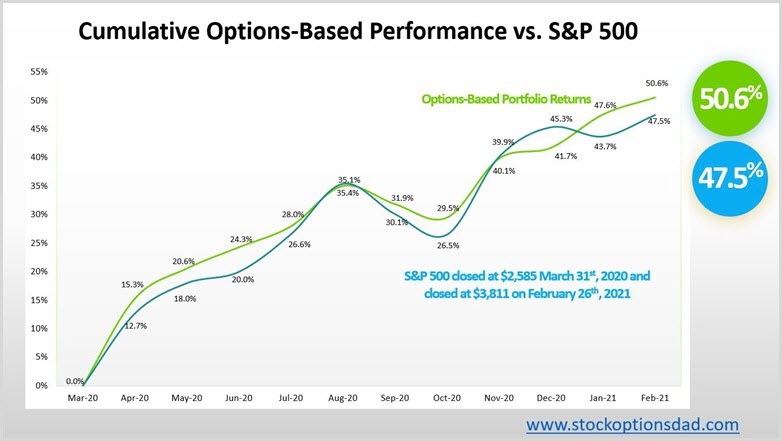
An agile options-based approach is essential to navigating these choppy markets that we have witnessed thus far in 2021. Generating consistent monthly income while defining risk, leveraging a minimal amount of capital, and maximizing return on capital is the core of options trading. Options enable smooth and consistent portfolio appreciation without guessing which way the market will move. Options allow one to generate consistent monthly income in a high probability manner in all market scenarios. Over the past 10-plus months (May 2020 – March 2021), 225 trades were placed and closed. A win rate of 98% was achieved with an average ROI per winning trade of 7.5% and an overall option premium capture of 84% while outperforming the S&P 500. The performance of an options-based portfolio demonstrates the durability and resiliency of options trading to drive portfolio results with substantially less risk. This approach circumvented the September 2020, October 2020, and January 2021 sell-offs while outperforming the S&P 500, posting returns of 50.6% and 47.5%, respectively (Figures 1, 2, and 3).
Options
Figure 1 – Overall options-based performance compared to the S&P 500 from May 2020 – February 2021 Continue reading "Options: Outperformance Despite Choppy Markets"
Coinbase IPO Raises Concern About Bitcoin Long-Term

While the price of Bitcoin has been nothing more than incredible over the past year and completely blown me away, (and certainly proven me wrong a number of times when I have in the past stated that I did not think Bitcoin or any cryptocurrency was a "wise" investment), a new warning sign has made waves in the cryptocurrency industry and markets.

The warning comes from Coinbase prior to its upcoming initial direct listing, a different version of an initial public offering. In the report released by Coinbase for potential investors, the company listed several potential risks to its business. This is very common with public companies, even well past the time they have gone public. However, this is the first time we have seen these warnings from Coinbase, which generates the vast majority of its revenue from the trading of Bitcoin and Ethereum.

These risk factors include "disruptions, hacks, splits in the underlying network also known as 'forks,'" as well as developments in quantum computing and regulation that affect cryptocurrencies.

"The future development and growth of crypto is subject to a variety of factors that are difficult to predict and evaluate," the filing read.

Furthermore, the filing also mentioned "the identification of Satoshi Nakamoto, the pseudonymous person or persons who developed bitcoin," as a potential risk factor. It mentioned the transfer of Nakamoto's bitcoins, which some believe is worth around $30 billion. Bitcoin bulls fear that if Nakamoto is identified, it could harm bitcoin's decentralized nature, reputation, and overall security. Continue reading "Coinbase IPO Raises Concern About Bitcoin Long-Term"

Which Way Will The Fed Blow?

Let’s see if I have this straight. For the past dozen years or so, dating back to the 2008 financial crisis, the Federal Reserve and other major central banks have been trying to raise inflation and thereby generate economic growth. (I’ve never quite understood that thinking; I always thought economic growth generated inflation, not the other way around. But that’s just me.)

So now it finally appears that inflation is about to rear its head, or so the bond market thinks, on the prospects of a nascent economic boom fueled by pent-up demand, fiscal stimulus, a decline in Covid-19 cases, and a vast rollout of vaccines. And what is the market’s reaction? Total panic. Sell bonds and tech stocks that have soared during the pandemic. And beg Jerome Powell and the Fed to save them from losses once again.

Let’s see which Powell responds—the one who has told us over and over again that the Fed will be “patient” and be pleased to let inflation run hotter and longer if it means boosting the employment market; or the one who repeatedly rides to the rescue whenever investors start to lose money and beg for relief.

On the surface, it should be the first one. Over the past month or so, bond yields have risen sharply on fears of rising inflation. Rather than a cause for worry, this should please Powell and the rest of the Fed. After all, they’ve been preaching for months that this is what they want, so this should come as no surprise to anyone. Plus, it’s a good thing – rising rates signal economic growth. Yet, the market’s reaction is shock and dismay. Continue reading "Which Way Will The Fed Blow?"

U.S. Crude Oil Production Steady In December

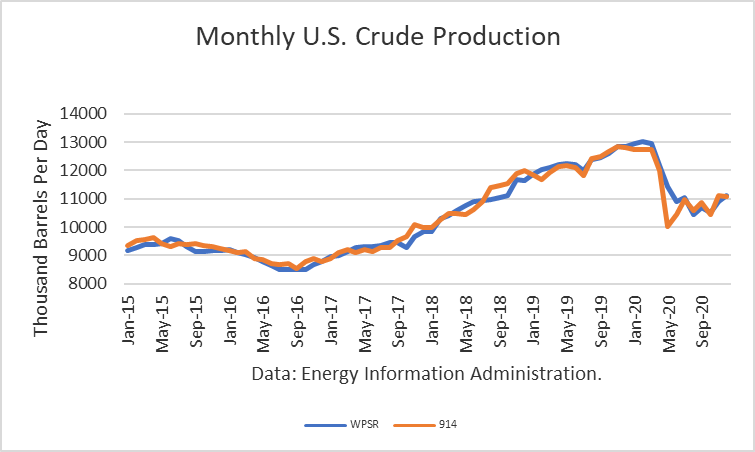
The Energy Information Administration reported that December crude oil production fell by 58,000 barrels per day, averaging 11.063 mmbd. This follows a 682,000 b/d rise in November. The December 914 figure compares to the EIA’s weekly estimates (interpolated) of 11.100 mmbd, a figure that was 37,000 b/d higher.

Crude Oil Production

Drops in production were experienced in New Mexico (42,000 b/d), North Dakota (38,000 b/d), and Texas (34,000 b/d). But output in the US Gulf Coast rose by 70,000 b/d.

Given the huge reduction in May, oil production dropped by 1.7 mmb/d over the past 12 months. This number only includes crude oil. Continue reading "U.S. Crude Oil Production Steady In December"

DOW Rallies 570 Points In Big Turnaround

The DOW climbed 572.16 points or +1.9%, to 31,496.30 after losing as much as 150 points in earlier trading. The S&P 500 ended the wild trading session +2% at 3,841.94 after shedding -1% earlier and the NASDAQ advanced +1.6% to 12,920.15 after dropping -2.6% early in the trading session.

On a weekly level, the NASDAQ fell more than -2% this week and briefly turned negative on the year. The S&P 500 gained +0.8% this week, snapping a two-week losing streak. The DOW outperformed with a +1.8% weekly gain. Both the DOW and S&P 500 joined the NASDAQ mid-week by triggering new red weekly Trade Triangles indicating that overall, the market could be in a sidelines mode.

The indexes bounced off their lows as bond yields retreated from their session highs. The 10-year Treasury yield eased back to 1.55% after popping above 1.6% to touch a 2021 high following data showing a surge in jobs growth. Continue reading "DOW Rallies 570 Points In Big Turnaround"