Consumer Sentiment Falls Unexpectedly In July

U.S. consumer sentiment fell unexpectedly dipping in the early part of July amid a continuing rise in new coronavirus cases. The University of Michigan's consumer sentiment index came in at 73.2 for July, a decline from 78.1 in June, snapping a two-month uptrend. Economists who had been polled by the Dow Jones were expecting a small rise to 79.

Falling consumer sentiment shouldn't be a shock with coronavirus cases spiking in several states across the country, including massive spikes in the stares of Florida, Texas, Arizona, and California. The stock market seems to agree with today's muted moves to end the week. As we head into the Friday close, the major indexes are mixed on the day matching their theme for the week.

The DOW will end the week with a positive gain of roughly +2%, which is a bit higher than the S&P 500's gain of +1%. However, the NASDAQ will post a weekly loss of approximately -1% as the tech sector was hit hard to end the week, most notably with Netflix losing over -6% on the day and -10 for the week. Continue reading "Consumer Sentiment Falls Unexpectedly In July"
Why It's Different This Time

The other day I completed a survey for my brokerage company, and one of the questions they asked was, "Is the current crisis worse than the 2008 financial crisis?" A couple of months ago, when our state and region were mostly in lockdown, I would have answered with a resounding and unhesitating, "Yes!"

Now I'm not so sure. Admittedly, I don't live in one of those states where the virus is now spiking, and things here are close to back to normal, so maybe my vantage point is too subjective. Nevertheless, I would have to say this crisis is far from as bad as the previous one, which may explain why the stock market has behaved the way it has, namely prices are off only a little from where they began the crisis, with only that short, sharp drop in February and March.

One reason, of course, is that the economy, as a whole, has rebounded strongly over the past couple of months as most of the country has reopened, at least to some degree, even as millions of people continue to work remotely. But the main reason is that that the lessons we learned from 2008 have been brought to bear in this crisis, namely that the government and the Federal Reserve have thrown much more money and resources at the problem than they did 12 years ago, which has mitigated the damage to a great degree.

As we've seen in the second-quarter earnings reports released so far by the big banks, the measures taken after 2008 to make sure they've built up enough capital to withstand another global crisis have paid off. Other than Wells Fargo (WFC) – which is still in the Fed penalty box, forbidden to grow assets – which reported a big loss, the other big banks reported flat Goldman Sachs (GS) or reduced JPMorgan Chase (JPM), Citigroup (C), and Bank of America (BAC) earnings compared to a year ago. It could have been a lot worse. Who would have thought they'd be able to pull that off three or four months ago? Let's give the Dodd-Frank Act and Fed capital requirements the props they deserve. Continue reading "Why It's Different This Time"

An Industry That Could Be A "Savior"

A few years ago, the investing world was enthralled with the idea that the marijuana industry was going to be the ‘next big investing trend.’ Unfortunately, for most who bought into the hype, the investments in the industry have not lived up to their promises. However, that may soon be changing.

The big marijuana players and their investors have all suffered over the years for several reasons. First, the industry is simply too fragmented for a single or handful of players to dominate the landscape. This is an issue because while competition is good, too much competition doesn’t allow individual companies in the industry to experience the power of ‘scale.’

What that means is, let’s say a marijuana company opens a farm. The farm may be large enough to produce 100 pounds, which is enough to cover the costs of the farm and the farmer. However, that 100 pounds aren’t enough to cover the cost of the transportation of the product from the farm, the distribution center, the security for the farm and distribution center, or the research and development so that the farmer can become more efficient and offer different strains. The fragmentation of the industry also hurts pricing power. The more competition means people trying to push product, perhaps simply to cover costs, means prices hit near rock bottom.

Another reason the industry has suffered is the very slow progress of legalizing marijuana both in most US States and the vast majority of countries around the world. With only a handful of states in the US having legalized the plant and the Federal Government still considering it a controlled substance, adoption rates around the country have been sluggish. When the industry was expecting to grow due to increasing numbers of legalized States rapidly, investors were pouring money into them. However, that money has begun drying up, which is now causing problems on balance sheets and debt levels. Continue reading "An Industry That Could Be A "Savior""

World Oil Supply And Price Outlook, July 2020

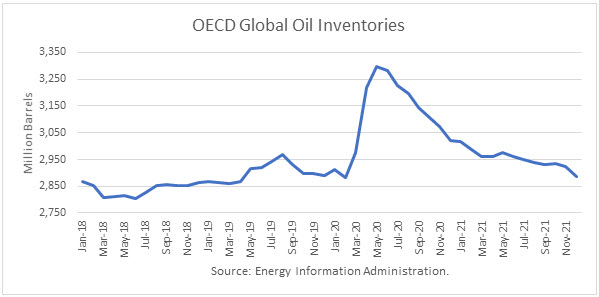
The Energy Information Administration released its Short-Term Energy Outlook for July, and it shows that OECD oil inventories likely bottomed in this cycle in June 2018 at 2.804 billion barrels. It estimated stocks dropped by 14 million barrels in June to end at 3.283 billion, 362 million barrels higher than a year ago. It estimates that inventories peaked in May 2020 at 3.297 billion.

The EIA estimated global oil production at 87.59 million barrels per day (mmbd) for June, compared to global oil consumption of 89.47 mmbd. That implies an undersupply of 1.87 mmbd or 56 million barrels for the month. However, that is still a small figure compared to the size of the build from February, which was 399 million barrels.

For 2020, OECD inventories are projected to build by 132 million barrels to 3.022 billion. For 2021 it forecasts that stocks will draw by 137 million barrels to end the year at 2.855 billion.

Oil

The EIA forecast was made to incorporate the OPEC+ decision to cut production and exports. According to OPEC’s press release: Continue reading "World Oil Supply And Price Outlook, July 2020"

The Financial Cohort and COVID-19 Dynamics

COVID-19 ushered in the real possibility of widespread loan defaults, liquidity issues, ballooning credit card debt (as banks hold the liability), and stressed mortgages. To exacerbate these COVID-19 impacts, a delicate balance between interest rates, Federal Reserve actions, potential yield curve inversion, and liquidity must be reached. The customer side of the business continues to be worrisome as the duration of this crisis continues to drag on with no signs of slowing. A segment of the consumer base is faced with lost wages and the real possibility of not being able to meet their financial obligations (i.e., car payments, mortgage payments, etc.), which will unquestionably have a negative impact on revenue and earnings for banks. The financial cohort is in a difficult space as the broader economic backdrop continues to dictate whether these stocks can appreciate higher. The initial shock of the COVID-19 pandemic resulted in the market capitalizations of many large banks to be cut by ~50%. Some of the largest banking institutions such as Citi (C), Goldman Sachs (GS), JPMorgan (JPM), and Bank of America (BAC) were sold off in the most aggressive manner since the Financial Crisis a decade earlier. As COVID-19 continues to drag in both spread and duration, share buybacks have now been halted, and dividend payouts arrested. The stability of dividend payouts is now in question as uncertainty continues to cloud this sector. Moving forward, how durable are the major financial names at these depressed levels, are the banks investable in light of the COVID-19 backdrop?

Recent Federal Reserve Stress Tests

The Federal Reserve put new restrictions on the banking sector after the results from the annual stress test found that several banks could get too close to minimum capital levels in potential scenarios tied to the COVID-19 pandemic. The largest banking institutions will be required to suspend share buybacks and arrest dividend payments at their current level for Q3 of 2020. For the first time in the 10 year history of these stress tests, banks are now required to resubmit their payout plans again later this year. This move is indicative of the unique and unprecedented landscape of the COVID-19 pandemic. Continue reading "The Financial Cohort and COVID-19 Dynamics"