Options Based Portfolio Outperformance - Keys To Success

A year-long case study running an options-based portfolio was conducted to demonstrate the effectiveness of this strategy against the traditional stock-picking approach. Options are a great way to manage and mitigate risk while circumventing market swings. Selling options allows you to collect premium income in a high-probability manner while generating consistent income for steady portfolio appreciation regardless of market conditions. Of course, this is all done without predicting which way the market will move since options are a bet on where stocks won’t go, not where they will go.

Primarily sticking with dividend-paying large-cap stocks across a diversity of tickers that are liquid in the options market is a great way to generate superior returns with less volatility over the long term. Over the past 12 months, 298 trades have been made with a win rate of 86% and premium capture of 57% across 69 different tickers. Moreover, when stacked up against the S&P 500, an options strategy generated a return of 6.9% compared to the S&P 500 index, which returned 2.2% over the same period. These returns demonstrate the resilience of this high probability options trading in both bear and bull markets.

This outperformance and high win rate was achieved by following a set of options-based fundamentals. Specifically, position-sizing, sector allocation, maximizing the number of trade occurrences, and risk-defined strategies are some notable areas that traders need to heed for long-term successful options trading.

Essential Options Trading Fundamentals

To effectively and successfully run an options-based portfolio over the long term, the following options trading fundamentals must be exercised in each and every trade. Violating any of these fundamentals will jeopardize this strategy and possibly negate the effectiveness of this approach on the whole. Continue reading "Options Based Portfolio Outperformance - Keys To Success"
China Weighs On Stock Market

Hello traders everywhere. China's economic growth sank to its lowest level in almost 30 years as the trade war with Washington deepened a slump that is weighing on the global economy. Growth in the world's second-largest economy slipped to 6% in the three months ending in September, down from the previous quarter's 6.2%, data showed Friday. It was the weakest level since China started reporting data by quarters in 1993.

Last week President Trump agreed to delay a tariff hike on Chinese goods and said Beijing promised to buy up to $50 billion of American farm goods. That announcement brought about an initial burst of enthusiasm, but that soon faded after Beijing failed to confirm the scale of possible purchases, and officials said the two sides still were working out details. The slowdown and weakening consumer demand add to headaches for Chinese leaders as they fight a 15-month-old tariff war with the U.S. that has sapped China's exports.

Stocks traded lower Friday but remained on track to post solid weekly gains after the release of better-than-expected earnings. The Dow traded 100 points lower, while the S&P 500 pulled back -0.32% and the Nasdaq shed -0.8%. The DOW was up +0.5% for the week heading into afternoon trading. The S&P 500 and NASDAQ were up +.80% and +.79%, respectively, for the week. The major indexes will end the week within striking distance of their record highs. Continue reading "China Weighs On Stock Market"

Bitcoin And Cryptos Tank After Futures Trading Begins

During the last week of September, the major cryptocurrencies got crushed. Bitcoin fell more than 20% from September 21st through September 26th and then slightly rebounded on the 27th by a little less than 2%. A 20% drop for the most well-known cryptocurrency is not uncommon these days, as it fell that much back in July. However, that doesn’t make it an easy pill to swallow when it happens.

But while Bitcoin fell 10% on September 24th, it's closet rivals, Ethereum, Ripple, Litecoin, and bitcoin cash fell even more, somewhere between 15% and 20% respectively. The likely cause was the lack of interest from institutional investors after the highly anticipated Bakkt crypto platform began trading its “physically” settled bitcoin futures contracts.

The Bakkt platform was announced more than a year ago and had partnerships with Microsoft and Starbucks and was being touted as a way for institutional investors to get involved with cryptocurrencies. The platform allows futures trading of crypto’s but settles the order with physical coins, not cash like other crypto futures platforms currently offer. The thinking was that because the futures contracts had to be settled with actual coins, this would increase the demand for the different crypto’s being traded through the futures contracts.

However, during the first hour, the platform was live, only five contracts were traded, and even after ten hours, only 28 contracts had traded hands. Many industry experts, both who follow the crypto markets and general futures contracts actually have come out and stated this sort of activity is normal for the first few days of a new commodity being offered through regulated futures contracts. They claim some brokers aren’t ready to clear it, while others want to wait and see how things go, while others may not even have the tickers populated on their risk systems. Continue reading "Bitcoin And Cryptos Tank After Futures Trading Begins"

World Oil Supply And Price Outlook, October 2019

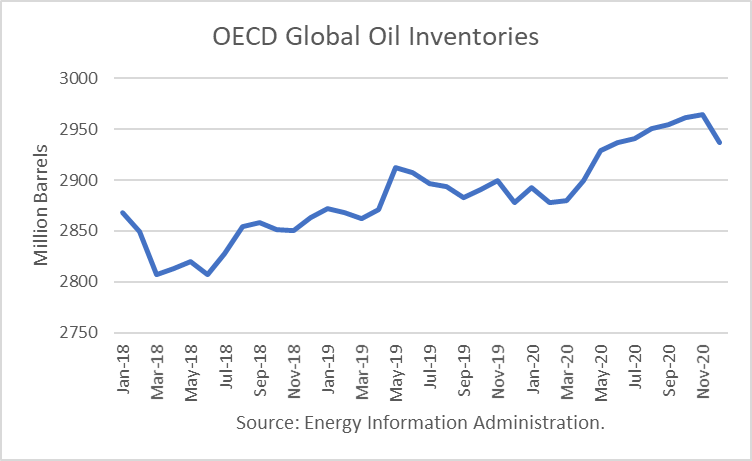
The Energy Information Administration released its Short-Term Energy Outlook for October, and it shows that OECD oil inventories likely bottomed last June 2018 at 2.807 billion barrels. It estimated stocks dropped by 11 million barrels in September to 2.882 billion, 24 million barrels higher than a year ago.

For the balance of 2019, OECD inventories are projected to rise, on balance. The third quarter seasonal stock draw was 26 million barrels. And stocks are projected to rise by 6 million in the fourth quarter, ending the year at 2.878 billion barrels, 15 million more than at the end of 2018. For 2020, EIA projects that stocks will build by 59 million barrels to end the year at 2.937 billion.

Oil

The EIA estimated that OPEC production fell by 1.55 million barrels per day in September, most of which was in Saudi Arabia due to the attack on its oil facilities. It is estimating that OPEC production will average about 29.69 million in October, due to the rebound by Aramco. For 2020, it estimates that OPEC production will average about 29.62 million, above the call (demand) for OPEC oil in 2020. Continue reading "World Oil Supply And Price Outlook, October 2019"

Indexes Retest Critical Price Channel Resistance

News, again, drives the US stock market and major indexes higher as optimism of a US/China trade agreement floods the news wires. As we’ve been suggesting, the global markets continue to be news-driven and are seeking any positive news related to easing trade tensions and capital markets. We believe any US/China trade deal would be received as very positive news by the global capital markets – yet we understand the process of achieving the components of the “deal” would likely still be 6 to 24 months away.

Still, with the strength of the US economy and the potential that some deal could be reached before the end of 2019 setting positive expectations, the US stock market and major indexes rallied last Thursday and Friday (October 10 and 11). As the long holiday weekend sets up with no trading on Monday, it will be interesting to see what is potentially resolved between President Trump and the Chinese before the markets start to react on Sunday and Monday nights. Make sure up opt-in to our free-market trend signals newsletter.

Our research team wanted to highlight some very key elements related to technical price theory and technical analysis. These weekly charts highlight what we believe is “key resistance” in the US major indexes and share our research team’s concern that the markets may be reacting to news more than relying on fundamental economic and earnings valuations. In past articles, we’ve highlighted how a “capital shift” is continuing to take place where foreign capital is actively seeking safety and security for future returns. This leads to a shift in how capital is being deployed throughout the globe. Continue reading "Indexes Retest Critical Price Channel Resistance"