Are We Better Off Today Than Two Years Ago?

Two weeks from now Americans will head to the polls to vote in what has been billed as “the most important election of our lifetime.” That may be a bit of hyperbole, but it will no doubt be one of the most important – maybe not as important as the previous one in 2016, but certainly a close second.

Since then, there have been some huge changes in the financial markets and the economy, nearly all of them wildly – and demonstrably – positive. CNBC was nice enough to quantify them the other day in this chart, and the numbers are startling.

I’ll just mention a few:

  • S&P 500: Up 32% since the 2016 election.
  • Average hourly earnings: Up 5%, to $27.24 from $25.88.
  • Nonfarm payrolls: up 4.4 million, to 149.5 million from 145.1 million.
  • Unemployment rate: 3.7%, down from 4.9%.
  • Consumer confidence: up 37 points, to 138 from 101.
  • Corporate tax rate: 21%, down from 35%.
  • Assets held by the Federal Reserve: down 6%, to $4.22 trillion from $4.52 trillion.

Needless to say, there have been some negatives: Continue reading "Are We Better Off Today Than Two Years Ago?"
All For Naught When It Comes To Stock Market

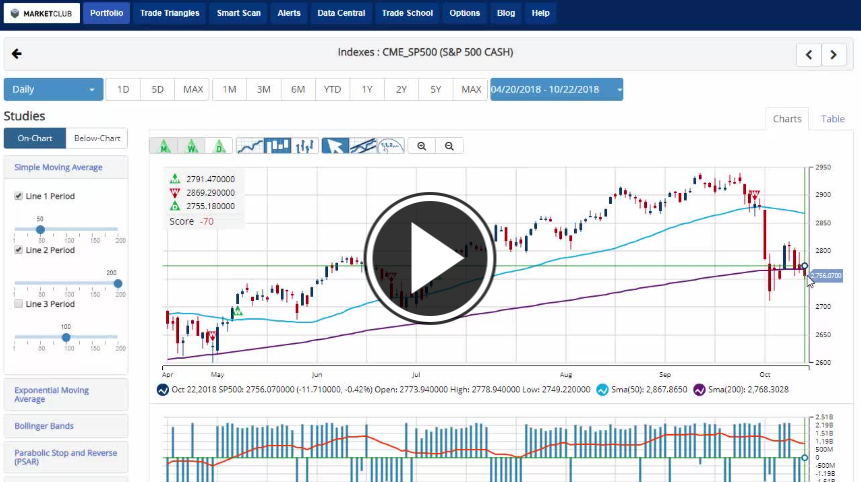
Hello traders everywhere. As the slide to lower levels continued on Wednesday, I couldn't help but notice that these current levels looked familiar to me, so I did some investigating. I started by looking at yearly charts for the three main indexes, and it became quite clear as to why those levels looked familiar. As it stands, the S&P 500 is only 19 pts away from the opening of trading on Jan. 2, 2018 where it opened at 2,683.73, currently trading around the 2700.00 level. The DOW is only 180 pts away for it's yearly open at 24,809.35, currently trading around the 25,000 level. Meanwhile, the NASDAQ has quite a bit more room between its current trading levels at the 7,200 range and its yearly open of 6,937.65 or 332 pts. But the way it's been getting hammered lately case in point today, it won't take long for it to reach that level if the slide continues.

Does this mean that all of the record highs that we've seen this year are all for naught?

yearly open

Key Levels To Watch This Week:

Continue reading "All For Naught When It Comes To Stock Market"

Natural Gas ETFs Took A Wild Swing In September

In September, the price of natural gas fluctuated more than we had seen since February of this year and it's likely that while some investors made vast sums of money, others lost just as much, if not more. But what made September so crazy was that natural gas made a significant reversal right in the middle of the month.

The price of the United State Natural Gas ETF (UNG) ended the month of August at $23.95 and closed at $24.83 on the last trading day of September. That move represents a 3.6% increase, not an insignificant amount but also not making anyone piles of money. But, while the price of natural gas started the month at $23.95, its lowest closing price for the month came on September 14, where it bottomed out at $22.69. Had you been watching the price, recognized this was the bottom and bought on September 14 or 15, you could have made yourself a nice 9.4% gain (the gain would be higher if you continued to hold for a few days at the beginning of October).

Again though, a 9% gain is a good return, but not necessarily what I would call “rolling in the dough.”

In order to make that kind of money, you would have had to use leverage. If you had purchased shares of the VelocityShares 3X Long Natural Gas ETN (UGAZ) at the close of September 14 and sold them at the close on September 28, you would have made a sweet profit of 30%. (Again, this would have been even larger, upwards of 50% if you held onto your UGAZ the first few days of October.)

Why did UGAZ perform so much better than UNG? Well, that is because UGAZ is three times leveraged natural gas fund, meaning it gives your three times the return of natural gas if the commodity moves higher. The flip side of that is you can lose three times the amount of money if natural gas prices fall while you hold the shares. Continue reading "Natural Gas ETFs Took A Wild Swing In September"

Copper On Big Time Frame Charts: $0.6 or $6?

There is an age-old question asking: How do you determine if a trader is biased? Show him a chart and ask where he thinks the market would go and then show him the same, but reversed chart and if the answer is the same, then this trader is indeed biased. We call such a trader a Perma-Bull or a Perma-Bear. The market sentiment is often split even as there are a lot of biased traders and market is then trapped within a range as there is no dominant opinion among the participants.

Every day I see how the trading community spreads opposite signals in any instrument creating an overwhelming sea of information where it’s hard for novice traders to focus and make a trading decision. Different levels of experience and fantasy generate the diversity of chart patterns and models. People change time frames and squeeze or expand charts; all of this affects the perception and therefore, the final decision.

Let’s perform an educational experiment with two patterns that I found on different time frames for the same instrument, copper. I will add two separate charts with those patterns followed by explanations. I am eager to see what you think about the outlook for this instrument after reading and voting on the pole at the end of the article. Continue reading "Copper On Big Time Frame Charts: $0.6 or $6?"

Stocks Waver Ahead Of Earnings

Hello traders everywhere. The stock market opened in positive territory Monday morning riding the coattails of a rising Chinese market only to slip into negative territory shortly after the open once corporate earnings started rolling in.

The Shanghai Composite Index rose more than 4% to score its best day since March 2, 2016. The quick move higher comes after Chinese authorities pledged to support China's economy and offset the negative impact of U.S. tariffs. They made that pledge after reporting weaker-than-expected economic growth for the second quarter. Despite the big daily move, Chinese stocks are still down sharply for the year. The Shanghai Composite Index has fallen about 20% in 2018 and is down over 21.4% in the last twelve months.

Earnings

Some disappointing earnings reports have not helped the market's mood ahead of what is expected to be the heaviest earnings week this season. Investors are nervous about the outlook for future growth due to concerns over trade and tariff's, rising costs and other factors. Continue reading "Stocks Waver Ahead Of Earnings"