An All-Time High is Within Reach For The S&P 500

Hello traders everywhere. For the first time this year, the S&P 500 posted its fifth straight weekly gain as traders shrugged off worries about the trade war between the U.S. and China. Strong corporate earnings have helped to push the index near its all-time of $2,872.87.

Berkshire Hathaway and Tyson Foods are helping to propel the S&P 500 higher after a weak opening. Berkshire Hathaway Inc (BRK.B) rose +3.7% after reporting a +67% surge in quarterly operating profit while Tyson Foods Inc. (TSN) gained +3.8% after the meat processor beat analysts' quarterly profit estimates due to strong demand for beef.

Of the 413 S&P 500 companies that have reported earnings so far, 79.2% have topped earnings estimates. That is well above the average of 72% for the past four quarters.
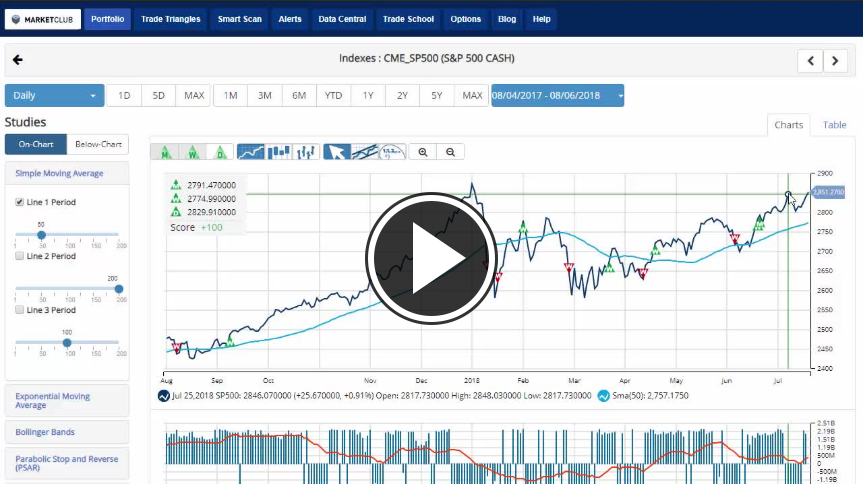
S&P 500

Facebook Inc. (FB) and PepsiCo Inc. (PEP) have led the NASDAQ into positive territory after opening lower on the day. Facebook gained +3.7% after the Wall Street Journal reported the company had asked large U.S. banks to share detailed financial information about their customers, as part of an effort to offer new services to users. PepsiCo rose +1.5% after the company said Ramon Laguarta, a company veteran with experience in international markets, would succeed Indra Nooyi as the chief executive officer. Continue reading "An All-Time High is Within Reach For The S&P 500"
Weekly Futures Recap With Mike Seery

We've asked Michael Seery of SEERYFUTURES.COM to give our INO readers a weekly recap of the Futures market. He has been Senior Analyst for close to 15 years and has extensive knowledge of all of the commodity and option markets.

Michael frequently appears on multiple business networks including Bloomberg news, Fox Business, CNBC Worldwide, CNN Business, and Bloomberg TV. He is also a guest on First Business, which is a national and internationally syndicated business show.

Gold Futures

Gold futures settled last Friday in New York at 1,232 an ounce while currently trading at 1,224 down about $8 for the trading week while also hitting a fresh contract low earlier in the trading session today all the way down to 1,212 as this market remains bearish, but rallied off of a somewhat negative U.S. unemployment number. Gold prices are still trading under their 20 and 100-day moving average as this trend is to the downside and if you have read any of my previous blogs you understand that I am bearish gold and the precious metals across the board. If you're short, a futures contract continue to place the stop loss above the 10-day high which stands at 1,245 on the closing basis only as I still think the 1,200 level is broken possibly next week. The U.S. stock market is higher once again today as that is where money flows are headed and out of the precious metals. I see no reason to own gold as I still think historically speaking prices look expensive and I think we can trade down to the 1,125 level in the coming months ahead so stay short and continue to place the proper stop loss as today's slight gains were based on profit-taking only. Large hedge funds are short a record amount of gold contracts as they still believe lower prices are ahead as the volatility remains relatively low. However, I don't think that will last much longer.
TREND: LOWER
CHART STRUCTURE: SOLID
VOLATILITY: LOW

Continue reading "Weekly Futures Recap With Mike Seery"

Buying Call Options - Defining Risk, Optimizing Time Value and Realizing Gains

Options can provide an alternative approach to the traditional buy and hold strategy. Buying call options can add value to one’s portfolio via leveraging a small amount of cash while defining risk with unlimited upside potential. Simply put, buying a call option is bullish in nature as the buyer is positioning the trade with the thesis that the underlying shares will increase in value. When one buys a call option, she is buying the right to purchase shares at a specific price on a specific date in the future for a nominal price. In this scenario, the buyer thinks the shares are undervalued hence why she is willing to buy the option now to secure the right to purchase shares in the future at a higher price. If the shares approach the specific price or rise above the specific price before the expiration date, then the underlying option becomes more valuable. This more valuable option can now be sold higher than when she purchased the contact to realize gains. Regarding percent, call options can be very profitable and scaled as needed. The risk in buying call options is capped based on the amount of the option itself thus downside risk is defined, and upside potential is great. Here, I’ll discuss buying call options along with my approach, strategy and real-world outcomes.

Anatomy of Buying Calls

I rarely buy call options however in opportunistic scenarios the risk-reward is very favorable given a decent time horizon. Nominal amounts of cash can be deployed in opportunistic scenarios to capitalize on sell-offs in high-quality stocks. Buying calls can be implemented as a means to leverage cash on hand without committing to purchasing the underlying shares of the company with the end goal of capitalizing on share appreciation via the option contract. The option price is determined by two variables, time and intrinsic value. The amount of time until expiration of the contract determines the time value, the longer the contract will translate into more time value in the contract (Figure 1). Generally speaking, if the underlying stock falls in value (moving away from the strike price), then the option will decrease as a function of time value. Alternatively, if the underlying stock appreciates (moving towards the strike price), then the option will increase in value as a function of time value. As the stock moves away or towards the strike price, the underlying stock is less likely (decrease in option value) and more likely (increase in option value) to reach the strike price, respectively hence the change in option value.

Intrinsic value isn’t applicable here until the underlying security breaks through the agreed upon price (strike price) before expiration. Every penny that the stock appreciates beyond the strike price is a penny of intrinsic value that increases the value of the contract. Any increase in the stock price will result in an increase in the option value regardless. Continue reading "Buying Call Options - Defining Risk, Optimizing Time Value and Realizing Gains"

Lackluster Jobs Report and Rising Trade Tensions

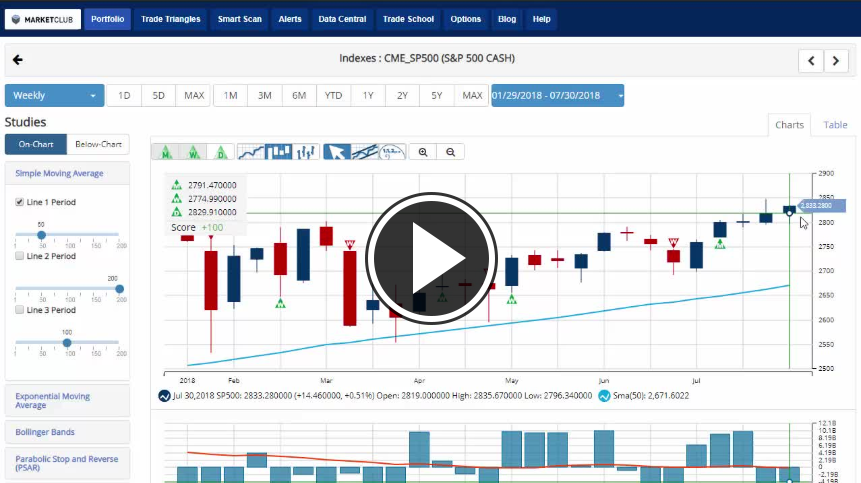
Hello traders everywhere. The stock market is ending the week just like it has spent most of the week, mixed. The NASDAQ is down on the day but will end the week in positive territory overall having bounced off support by way of the 50-day moving average and eeking out a gain of +.66%. The S&P 500 is following suit by gaining +.44%, and the DOW has fallen just short posting a weekly loss of -.23%.

Jobs Report

The Labor Department announced that The U.S. economy added 157,000 jobs last month vs. an expected gain of 190,000. While the headline jobs growth number for July missed expectations, June's figures were revised substantially higher up to 248,000 from 213,000. Plus, wage growth met expectations growing by +2.7% in July on a year-over-year basis. Continue reading "Lackluster Jobs Report and Rising Trade Tensions"

U.S. Crude Oil Production Slowed in May

The Energy Information Administration reported that May U.S. crude oil production averaged 10.442 million barrels per day (mmbd), off 30,000 b/d from April’s all-time record high of 10.472 mmbd.

However, May’s production was also lower than 10.461 mmbd posted for March. From December through March, production had spiked by 423,000 b/d.

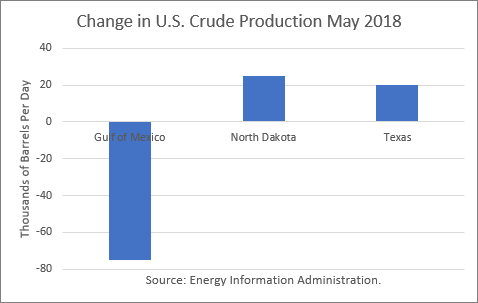
Part of the explanation for the lack of continued growth is the unplanned maintenance in the Gulf of Mexico. Last month, GOM production dropped by 75,000 b/d. In April, it had declined by 99,000 b/d. In EIA’s Short-Term Energy Outlook, May’s GOM production was forecast to increase by 200,000 b/d from April.

Otherwise, increases in North Dakota (25,000 b/d) and in Texas (20,000 b/d) were also relatively modest.

U.S. Crude Oil Production

The EIA-914 Petroleum Supply Monthly (PSM) figure was 304,000 b/d lower than the weekly data reported by EIA in the Weekly Petroleum Supply Report (WPSR), averaged over the month, of 10.706 mmbd. EIA’s most recent weekly estimate for the week ending July 27th was 11.0 mmbd. Continue reading "U.S. Crude Oil Production Slowed in May"