A Valued Trading Ritual

Hello traders and MarketClub members everywhere! Here we are at the end of the week, the end of the month and anticipating a full moon this weekend. It has been quite a week and quite a month and I will be covering that in today's video.
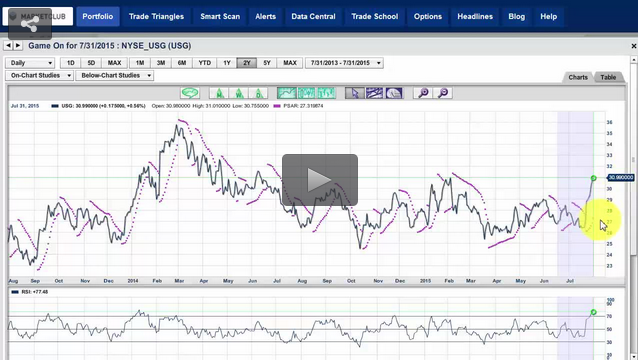
One of my trading rituals that I do every week is look at how the markets have performed for the week. I don't mean that I look at every up and down movement, but I want to see if the market closed on a positive or negative note. I also do this on a monthly basis, at the end of every month or the last day of trading for the month, to see how a market has performed during the month. Much like my weekly ritual, I want to see if the markets I am following gained points or lost ground for the month.

I find this sort of exercise very refreshing as it takes out a lot of the clutter that surrounds the markets during the day. When you expand that exercise to a monthly time frame, you get to see a much clearer view of where a market is heading. Continue reading "A Valued Trading Ritual"

3 ETF's That Focus on Share Buybacks

Matt Thalman - INO.com Contributor - ETFs


Some investors love large dividends. Some like to see strong revenue growth quarter over quarter. Others look for management teams they believe in. There are a hundred different metrics or indicators investors look for in a company or throughout the economy that makes them believe one stock will before better than another.

One that I haven't mentioned, but is very important to some investors, is share buybacks. While this form of returning capital to shareholders, the other being dividends, is questioned by many as whether it is the best use of company capital, in a lot of cases it’s a better use of capital than letting it just sit in the bank or even worse wasting it on risky acquisitions.

Regardless though of your stance on share buybacks, the fact remains they are a huge part of investing. They affect per share earnings, a company's ability to offer a higher dividend, and while, in most cases very small, they give investors a larger piece of the pie. Continue reading "3 ETF's That Focus on Share Buybacks"

How Many Rate Hikes Can The U.S. Handle?

Lior Alkalay - INO.com Contributor - Forex


The FOMC meeting ended yesterday as many had expected. Besides some marginal tweaks in the language, the message remained the same; data will determine our rate policy. Now, hours after the latest US GDP figures hit the newswires, it seems that Dollar Bulls are gearing up towards a September rate hike. Part of their rationale is because the data is good enough to sustain a rate hike. And that’s essentially true. With wages growing annually at 2%, Core Inflation at 1.7%, unemployment at 1.8% and now GDP bouncing back, indeed, a rate hike is warranted. At the same time, there are essentially no signs that the US economy is overheating. Rather, we’re seeing notable signs of stabilization. This, then, begs the question: How many rate hikes can the US handle in the upcoming year?

No Escape Velocity in GDP

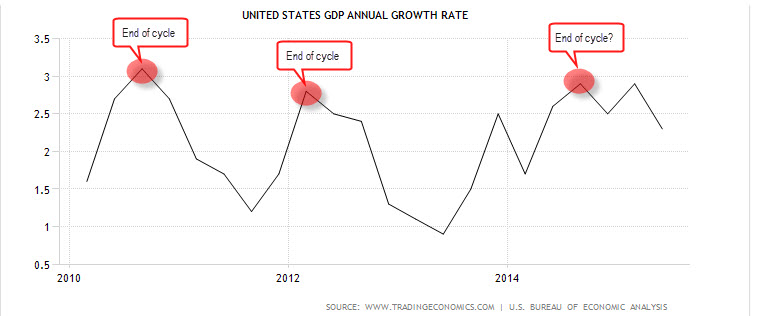
When we examine the dynamics of GDP growth, it’s evident that the US GDP growth rate is not breaking the range. Instead, it has the same cycles that tend to end around the 3% growth rate. After that, the US economy tends to decelerate, only to regain momentum later. But this range of growth has not been broken. This means that there’s no evidence that US GDP is at escape velocity, a pace which would require several rate hikes a year.

United States GDP Annual Growth Rate
Chart courtesy of Tradingeconomics.com

No Escape Velocity in Inflation

When we examine US Core Inflation, a similar picture emerges. US inflation is within the Fed’s 2% range and is showing no signs of overheating, i.e. escaping the Fed’s target. Rather, every time it reaches the 2% range, it tends to cool and then slide slightly lower. Continue reading "How Many Rate Hikes Can The U.S. Handle?"

Six Miners Dundee's Joseph Fazzini Believes Will Weather the Storm

The Gold Report: Many of the people we interview have a theory about why gold is performing poorly this summer despite so much global uncertainty, especially in China and Greece. What's your theory?

Joseph Fazzini: Gold typically plays numerous roles, including being a hedge against inflation, devaluation and economic turmoil, but it's still a commodity. Most commodities typically come under pressure in a recessionary environment. Right now, the global economic landscape isn't all that promising, inflation remains minimal and investors prefer other safe-haven investments (i.e., U.S. dollar). As a result, we expect gold to continue performing in-line with most other commodities and remain under pressure.

TGR: How low can gold go? Continue reading "Six Miners Dundee's Joseph Fazzini Believes Will Weather the Storm"

Beware Of The New Moon, It Could Cost You!

Yes, I know it sounds crazy but the reality is the phases of the moon do affect the way we feel. There has been a lot written about how the moon affects people, which in turn would affect the market.

I first learned about this phenomenon in a little-known booklet titled, "The Great Wheat Secret". This tiny booklet was written and I suspect illustrated by a gentleman named Burton H. Pugh some time back in the 30s. In what turned out to be a series of booklets, Mr. Pugh went on to explain how a full moon created optimism and in turn pushed wheat prices to move higher. In his booklets he showed examples of the prices of wheat moving up at the Chicago Board of Trade during a series of moon cycles.

It probably sounds a little crazy to you, but the moon cycles are really no different from market cycles. Many market cycles have been well documented in the marketplace for many years.

That brings us to 2015 which is proving to be a very exacting year for many traders, as the market really hasn't gone anywhere except up and down.

We are very close to seeing a full moon in just a couple of days on the 31st. That should bring some optimism into the general markets. What was also interesting to me was seeing how a new moon was affecting the markets. Here it seemed as though we had a clear cycle that could be tracked and linked to the lunar cycle.

Now I don't want you to get carried away and think Adam's gone crazy, but take a look at the rhythm of the market and these dates.

New moon date(s) and close in the S&P500 that day. Continue reading "Beware Of The New Moon, It Could Cost You!"