Don't Get Ruined by These 10 Popular Investment Myths (Part I)

By: Elliott Wave International

You may remember that during the 2008-2009 financial crisis, many called into question traditional economic models. Why did the traditional financial models fail?

And more importantly, will they warn us of a new approaching doomsday, should there be one?

That's a crucial question to your financial well-being. This series gives you a well-researched answer. Here is Part I; come back soon for Part II.

The Fundamental Flaw in Conventional Financial and Macroeconomic Theory

By Robert Prechter (excerpted from the monthly Elliott Wave Theorist; published since 1979)

Every time there is a recession, observers grumble about economists' methods. The deeper the recession carries, the louder the grumbling. The reason that widespread complaints occur only in recessions is that economic forecasters as a group never, ever anticipate macroeconomic changes. Their tools don't work, but consumers of their commentary do not notice it until recessions occur, because that is the only time when everyone can see that the methods failed. The rest of the time, when expansion is the norm, no one notices or cares.

The recent/ongoing economic contraction is the deepest since the 1930s, so the complaints about economists' ideas are the most strident since that time. Figure 1 shows how one publication expressed this feeling following four quarters of negative GDP.

Figure 1

Ironically, once the economy begins expanding again, everyone forgets about their old complaints. The media resume quoting economists, despite their flawed methods, and they are once again satisfied that their ideas make perfect sense.

Conventional financial theory relies upon the seemingly sensible ideas of exogenous cause and rational reaction. Papers are packed with discussions of "exogenous shocks," "fundamentals," "input," "catalysts" and "triggers." Stunningly, as far as I can determine, no evidence supports these ideas, as the discussion below will show. Continue reading "Don't Get Ruined by These 10 Popular Investment Myths (Part I)"
Weekly Futures Recap With Mike Seery

We've asked Michael Seery of SEERYFUTURES.COM to give our INO readers a weekly recap of the Futures market. He has been Senior Analyst for close to 15 years and has extensive knowledge of all of the commodity and option markets.

Michael frequently appears on multiple business networks including Bloomberg news, Fox Business, CNBC Worldwide, CNN Business, and Bloomberg TV. He is also a guest on First Business, which is a national and internationally syndicated business show.

Silver Futures

Silver futures are trading far below their 20 and 100 day moving average settling last Friday at 17.84 going out this Friday in New York around 17.55 finishing down about $.30 hitting a 4 1/2 year low as the U.S dollar continues to pressure silver and the rest of the precious metal complex. If you took my original recommendation several months back when prices broke 20.44 which was the 4 week low continue to place your stop above the 10 day high which currently stands at 18.85 and that will start to improve late next week as the chart structure will tighten up, but I still believe prices look vulnerable even at these multi-year lows. The trend is your friend in the commodity markets and the trend in the U.S dollar is clearly higher and that’s pessimistic all commodity prices, but if you have missed this trend sit on the sidelines as you have missed the boat as you do not want to chase markets that is why I like to find the trend as early as possible as my rule states a 4 week high or a 4 week low has to occur before entering.
TREND: LOWER
CHART STRUCTURE: IMPROVING
Continue reading "Weekly Futures Recap With Mike Seery"

5 Stocks That Avoided Yesterday's Implosion And Made 52-Week Highs

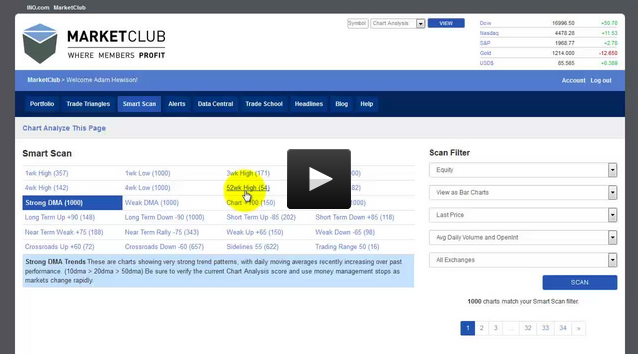
One thing I like to do on Friday is look at markets that are strong going into the weekend. After yesterday's implosion in the marketplace, I thought that was going to be a hard thing to do. Thanks to MarketClub's Smart Scan technology, I was able to find five socks that bucked yesterday's downturn and are looking very good.

Now you may remember the rules I have talked about for "The 52-Week New Highs on Friday" weekend trade, but just in case you don't know what they are, here they are again.

Rule #1: On a new 52-week high, when the market closes at or near its high on a Friday, buy long and go home for the weekend.

Rule #2: Exit the long position on the opening the following Tuesday.

Rule #3: If the market opens lower on Monday, exit this position immediately.

These are the only three rules you need to trade "The 52-Week New Highs on Friday" successfully.

I invite you to watch the video and look at the five stocks I found using Smart Scan. Then 10 to 15 minutes before the market closes today you can see which stocks are closing at or near their highs for the day.

Have a great weekend everyone,
Adam Hewison
President, INO.com
Co-Creator, MarketClub

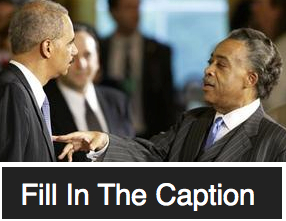
Fill In The Caption - Eric Holder & Al Sharpton

What do you think would be the "perfect caption" for this photograph of Attorney General, Eric Holder and Al Sharpton?

Here's my caption:
"Eric, you don’t get it. I want your job!"

Leave a comment with your caption and have the opportunity to win a three month MarketClub subscription. Enter as many captions as you wish and have fun! Team MarketClub will pick out the top three captions for the prizes. Good luck!

For a good chuckle, be sure to read some of the captions from previous Fill In The Caption pictures.

This Could Get Very Ugly

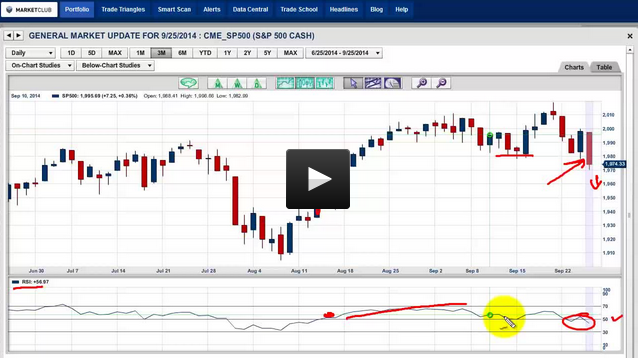
All this week I been talking about how the indices were having problems. It started off with the Russell 2000 index creating a "death cross." A "death cross" occurs when the 50-day moving average crosses below the 200-day moving average.

I also discussed on Monday that negative divergences were forming on many of these indices. That means prices are going higher, but are not being followed by momentum. This can be an early warning sign that a correction is coming.

So today's action comes as no surprise, as I was looking for this market to be on the defensive. The question is, how far can these markets fall?

To answer that question, we can use our Fibonacci tool to help us measure some of the key areas that will lend support to the indices. Judging by today’s market action and the fact that tomorrow is Friday, you may want to fasten your seat-belts. As a trader once told me, "they slide faster than they glide."

Every success with MarketClub,
Adam Hewison
President, INO.com
Co-Creator, MarketClub