World Oil Supply And Price Outlook, October 2020

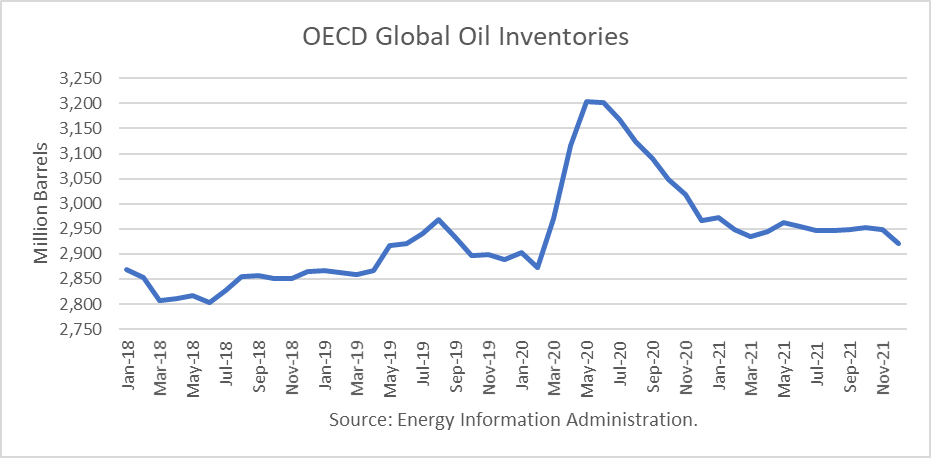
The Energy Information Administration released its Short-Term Energy Outlook for September, and it shows that OECD oil inventories likely bottomed in this cycle in June 2018 at 2.804 billion barrels. Stocks peaked at 3.204 billion in May 2020. In September 2020, it estimated stocks dropped by 34 million barrels to end at 3.090 billion, 123 million barrels higher than a year ago.

The EIA estimated global oil production at 91.70 million barrels per day (mmbd) for September, compared to global oil consumption of 95.26 mmbd. That implies an undersupply of 3.56 mmbd or 110 million barrels for the month. About 76 million barrels of the draw for September is attributable to non-OECD stocks.

For 2020, OECD inventories are now projected to build by a net 87 million barrels to 2.967 billion. For 2021 it forecasts that stocks will draw by 46 million barrels to end the year at 2.921 billion.
Crude Oil

The EIA forecast was made incorporates the OPEC+ decision to cut production and exports. According to OPEC’s press release: Continue reading "World Oil Supply And Price Outlook, October 2020"

The Copper/Gold Ratio Would Change The Macro

The Copper/Gold ratio is saying something. That something is that a cyclical, pro-inflation and thus pro-economic reflation metal shown earlier, remaining nominally positive on a down market day has, in relation to gold, taken out two important moving averages (daily SMA 50 & SMA 200) and is currently riding the short-term EMA 20 upward. RSI and MACD are positive.

Copper: Pro-cyclical inflation, pro-reflation, pro-economy.

Gold: Counter-cyclical, monetary, with inflationary utility.

Given the right circumstances (like desperate monetary and fiscal policy), which are in play on the wider macro, gold will probably do quite well moving forward. But maybe – for a while – not as well as some commodities if the Copper/Gold ratio really is up to something positive here.

copper/gold ratio

Side note: the Palladium/Gold ratio is on the verge of going positive as well and of course the daddy of inter-metal ratios, the Gold/Silver ratio is still on a big picture breakdown (Silver/Gold has broken above a key long-term resistance marker). So you might want to look at these three metallic indicators together (along with more traditional non-metallic inflation indicators) in gauging the process toward inflation. Continue reading "The Copper/Gold Ratio Would Change The Macro"

3 Interesting ETFs To Take Closer Look At

New ETFs are continually being brought to market as new niche ideas of capitalizing on an industry are being developed daily. But, not only are new ETFs the only ones that are worth looking at, older, more established ETFs which you may have forgotten about are also good to follow up on and even add to your watchlist. With that in mind, from time to time, I like to point out new and old ETFs that I come across which interest me and may intrigue others.

Today, let us look at one new ETF, one old ETF, and one ETF that is not yet trading but will soon be available for purchase.

The new Exchange Traded Fund is the AdvisorShares Pure US Cannabis ETF (MSOS). I know what you are thinking, just another marijuana ETF. Well, yes and no. This is a marijuana ETF; however, unlike all the other marijuana ETFs available before this one, all U.S. ETFs is the first. The others had, in large part, Canadian cannabis companies. This ETF only holds U.S. based firms. This ETF debuted on September 1st, 2020. It has an expense ratio of 0.74%, which is not cheap, but also not terribly outrageous. It currently has just $11 million in assets, but that should grow with time. We have no performance history on the ETF since it is so new, but the marijuana industry has struggled over the last few years. With that being said, this is a new ETF, so it comes with a clean slate, but we shouldn't expect it to boom in the short term unless we have major progress in the industry, as in more states passing marijuana as a legal substance. With that said, now would be a good time to get involved with this type of investment, as we are expected to have more states legalizing the drug in the next few years. Continue reading "3 Interesting ETFs To Take Closer Look At"

Federal Reserve: Trick or Treat

Want to guess who Federal Reserve Chairman Jerome Powell is going as for Halloween? Based on his most recent speech on the economy, it’s got to be the Grim Reaper.

Even as reports continue to show the economy recovering pretty quickly following the government-mandated shutdown of the spring and summer – which several of his Federal Reserve colleagues have cited – Powell continues to paint the direst picture of the American economy. However, this time, he has gone beyond the bounds of the Fed’s independence, publicly politicking for a new federal fiscal stimulus package. If one doesn’t arrive soon, he warned, it will be “tragic” and “lead to a weak recovery, creating unnecessary hardship.”

“The recovery will be stronger and move faster if monetary policy and fiscal policy continue to work side by side to provide support to the economy until it is clearly out of the woods,” Powell said in a speech last week to the National Association for Business Economics.

I had been under the impression that the Fed was supposed to be “independent” of the government, or at least that’s what we were told repeatedly when President Trump went off on Powell for not doing what he wanted. However, it seems to be ok if Powell cedes that independence voluntarily and takes sides on a political debate.

This isn’t so much an example of charter creep, which just about every government agency and leader does, as much as a charter leap, with the Fed not only taking over more and more of the economy and financial markets but publicly lobbying for government action to make it so. Continue reading "Federal Reserve: Trick or Treat"

98% Options Win Rate Despite September Correction

Options trading, at its core, is defining risk, leveraging a minimal amount of capital, and maximizing return on investment. Options trading in combination with broad-based index funds and cash-on-hand provides portfolio agility in the face of market corrections and volatility expansion. Although options trading provides a margin of downside protection and a statistical edge, no portfolio is completely immune from sharp double-digit declines when a correction occurs. A liquidity position provides portfolio agility to contend with and rapidly adjust when faced with extreme market conditions such as the September market correction.

An agile options based portfolio is essential to navigate pockets of volatility. The recent September correction was a prime example of why maintaining liquidity is one of the many keys to an effective long term options strategy. Over the past six months (May, June, July, August, September, and thus far in October), 127 trades were placed and closed. An options win rate of 98% was achieved with an average ROI per trade of 7.4% and an overall option premium capture of 91% while outperforming the broader market despite the September downturn. Along with these metrics, three losses were suffered in September. Analyzing these three losses via self-reflecting and learning will enable traders to make positive future adjustments to their trading strategy.

Despite September Sell-Off – Positive Returns

Since March, the September sell-off was the worst technology rout, while the Dow and S&P 500 posted four-week losing streaks, their longest losing stretches since August 2019. The Nasdaq had its first weekly gain in four weeks at the tail end of September. All the major indices sold off double-digits and into correction territory throughout September. This recent September correction provides a great opportunity to demonstrate the durability and resiliency of an options-based portfolio. Continue reading "98% Options Win Rate Despite September Correction"