
U.S. Crude Production Eased In December

Robert Boslego - INO.com Contributor - Energies - U.S. Crude Production


The Energy Information Administration (EIA) reported that December U.S. crude production averaged 9.949 million barrels per day (mmbd) in December, off 108,000 b/d from November. The primary cause of the decline was unexpected seasonal factors, which caused production in the Gulf of Mexico (GOM) to drop by 131,000 b/d and output in North Dakota to dip by 15,000 b/d. The EIA had expected a 30,000 b/d dip in GOM production. Meanwhile, production in Texas and New Mexico reached new historically-high levels of 3.933 mmbd and 556,000 b/d, rising 36,000 b/d and 26,000 b/d, respectively.

It is worth noting that EIA also revised its November estimate up by 19,000 b/d to 10.057 mmbd. As a result, November 2017 broke the November 1970 production record of 10.044 mmbd.

Even with December’s seasonal drop, the EIA-914 Petroleum Supply Monthly (PSM) figure was still 193,000 b/d higher than the week data reported by EIA in the Weekly Petroleum Supply Report (WPSR), averaged for the month, of 9.756 mmbd. EIA’s model failed to forecast the surge in production which began in August and totaled 846,000 b/d through November. Continue reading "U.S. Crude Production Eased In December"

The Ultimate Buzz Word ETF

Matt Thalman - INO.com Contributor - ETFs - Buzz Word ETF


On January 30th the team at Exchange Traded Concepts, an Exchange Traded Fund issuer, released the "Ultimate Buzz Word" ETF, the Innovation Shares NextGen Protocol ETF (KOIN). Alright, I’ll admit, the name may not be loaded with buzz words. But the fund’s concept is loaded with recently popular buzz words such as “Blockchain” and “Artificial Intelligence.”

The KOIN ETF is a fund that tracks an index that uses artificial intelligence to pick global stocks which have current or future interests in blockchain technology. On the surface, this ETF just feels like someone trying to take advantage of today’s hot investing buzz words.

Even after Bitcoin rose from under $1,000 to above $19,000 in less than a year, most retail investors didn’t fully understand what blockchain technology was. But they knew that while a lot of big-name investors and economist were skeptical of Bitcoin and other cryptocurrencies’, the one thing most people would agree on was that blockchain technology was great. Continue reading "The Ultimate Buzz Word ETF"

Hasbro: Positive Earnings and Growth Ahead

Noah Kiedrowski - INO.com Contributor - Biotech - Hasbro Inc.


Introduction and Backdrop:

Hasbro Inc. (NASDAQ:HAS) just released earnings, and the stock shot up from $94 to $103 or 9.5% as a result of navigating the challenging retail landscape and positive commentary on the conference call for future growth avenues. In mid-summer of 2017, Hasbro had witnessed a two-leg sell-off from its 52-week high of $116 to $88 or a 24% slide. The first leg down was from $116 to $95 followed by a second leg down from $95 to $88. These sell-offs were primarily due to retail softness and lowered guidance due to the Toys R Us bankruptcy filing which drove the stock down to $88. Hasbro was faced with a challenging environment and had to lower its guidance through the holiday season. The stock has been trading erratically since mid-summer of 2017 with 10% swings in the stock price. Ostensibly, Hasbro looks to be turning the corner and effectively managing this challenging backdrop and forging ahead with many current and future growth catalysts.

Hasbro has many current and future growth catalysts with major movie franchises, specifically with Marvel and Star Wars. Thor: Ragnarok and Star Wars: The Last Jedi rounded out 2017, posting worldwide box office gross of $854 million and $1.33 billion, respectively. Black Panther posted record-breaking numbers in its debut with $235 million domestic opening at the box office over the Presidents Day weekend. Upcoming Marvel and Star Wars movies include Avengers: Infinity War, Star Wars Han Solo and Ant-Man and The Wasp to highlight a few major films. Taking into account Hasbro’s growth, the potential acquisition of Mattel, Q1-Q2 2018 catalysts, trading at a P/E of ~20, boasting a 2.4% dividend yield and initiatives within Hasbro Studios to propel growth further presents a compelling long-term buy. Continue reading "Hasbro: Positive Earnings and Growth Ahead"

Disney: Black Panther Setting The Pace

Noah Kiedrowski - INO.com Contributor - Biotech


Setting The Pace and FY2018:

The Walt Disney Company (NYSE:DIS) is fresh off reporting its first quarter for FY2018 and has set the stage for a strong year ahead. The studio segment is off to a great start with record-breaking movie releases such as Thor: Ragnarok, Star Wars: The Last Jedi and Coco surpassing $854 million, $1.33 billion and $715 million in worldwide box office receipts, respectively. Black Panther entered the fray with a record-breaking President’s Day weekend opening of $185 million in domestic box office sales. Disney has one of its biggest movie slates for FY2018 with Ant Man and The Wasp, The Avengers: Infinity War, Solo: A Star Wars Story, The Incredibles 2 and Mulan (live-action film) around the corner. Parks and Resorts are posting strong growth where revenues grew 13% year-over-year in Q1, and operating income now surpasses its Media Networks segment income, bringing in $1.35 billion vs. $1.19 billion, respectively. Disney is aggressively trying to shore up its stalling Media Networks segment with a confluence of growth catalysts via streaming with Hulu (30% stake and will likely be expanded to a majority 60% stake after the Fox acquisition), BAMTech, Sling, ESPN streaming service and a Disney branded service coming in 2019. Disney is evolving to address the deteriorating Media Networks business segment with major streaming initiatives. Disney offers a compelling long-term investment opportunity considering the growth, Fox acquisition, pipeline, Media Networks remediation plan, diversity of its portfolio, tax reform, share repurchase program and dividend growth.
Continue reading "Disney: Black Panther Setting The Pace"

What Inventory Level Should OPEC Target?

Robert Boslego - INO.com Contributor - Energies - OPEC


On November 30, 2016, OPEC’s press release announcing the supply target of 32.5 million barrels per day included the following reference to inventories:

“The numbers underscore that the market rebalancing is underway, but the Conference stressed that OECD and non-OECD inventories still stand well above the five-year average. The Conference said it was vital that stock levels were drawn down to normal levels.”

Since the middle of 2017, OPEC has compared the OECD inventories to the five-year average, which had been 2010 to 2015. At some point in 2017, OPEC adjusted the five-year average to include 2011 to 2016. In doing so, it included two-and-a-half years of glutted (not normal) inventory levels. The effect was to make current levels appear to be closer to “normal” levels.

Given that OECD inventories are approaching the elevated five-year average, Saudi Energy Minister Khalid al-Falih has recently questioned that yardstick.

"Do we need to adjust for rising demand and look at forward day cover? How do we deal with non-OECD inventory? (It's) less transparent and reliable,” Falih said. “We have to think of the global market, the center of demand has shifted from OECD to non-OECD.”

Analytical Findings

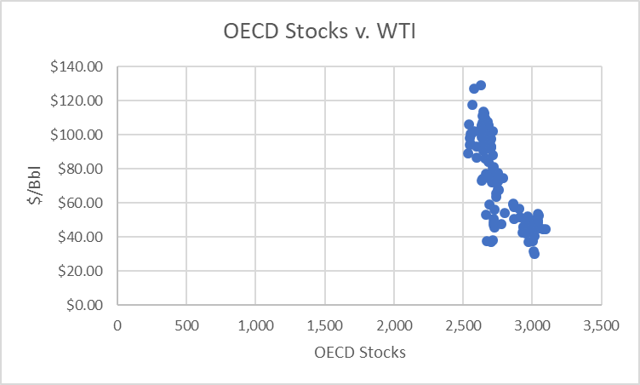
Using historical supply-demand data and prices, I found a correlation between stocks and prices over time, but it is far from precise. That makes sense because price behavior is much more complex than using one measurement to define it. Market sentiment and positioning tend to cause prices to overshoot and undershoot equilibrium prices. To paraphrase the Noble Prize-winning economist Robert Shiller, prices are more volatile than the fundamentals imply.

Using monthly data from January 2008 through December 2017 (a full 10-year period), I found a -79% correlation. The Cartesian coordinate graph is depicted below:
OPEC

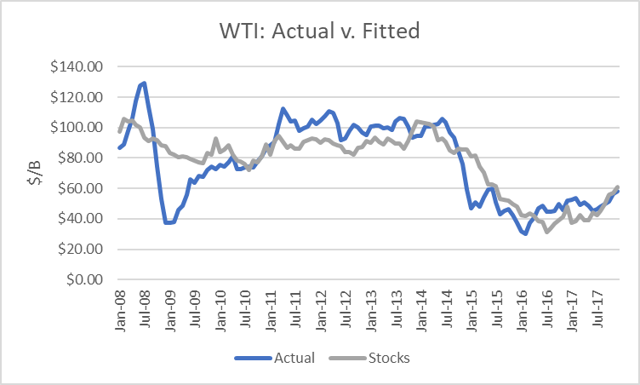
I developed a simple linear regression to fit prices, given the inventory level, and graphed the actual prices with fitted prices:
OPEC

This illustrates how far prices can travel from an equilibrium price, especially in 2008-09. On the other hand, the fitted prices do match up with actual prices over time. And the December 2017 fitted price ($61) is quite close to the actual price ($58).

This historical analysis begs the question, where are prices likely to go in 2018 and 2019? It also serves as a guide for understanding what stock level OPEC+ needs to achieve by withholding supplies.

Conclusions

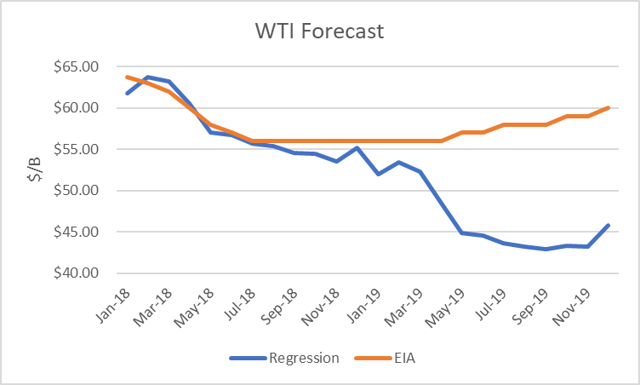
To answer the first question, I used EIA’s STEO forecast of OECD stocks for 2018 and 2019. The forecast shows stocks bottoming in February, which would correspond to a topping of prices at $63.76, using this methodology. It implies that the $66.66 reached in January is likely to be the peak for 2018 and 2019, with prices dropping back into the lower $40s next year.
OPEC

I also included EIA’s own price forecast on the graph for comparison. It shows similar expectations for the first half of 2018, but that prices will hold above $55 for the forecast period.

Regarding OPEC’s target, the regression shows that if inventories remain right about where they were at end-December (2.870 billion), the WTI price would remain at $60/b. If it wants $70/b, it needs to get OECD stocks to drop to about 2.800 billion. By the way, the latest 5-year monthly moving average is at 2.830 billion.

This model is very simplistic and does not include the impact of trader positioning and sentiment, which I believe are highly influential to the price. For example, the large drop in prices during the first week of February illustrated that factor. I use my Vertical Risk Management model to assess sentiment for positioning.

The other qualification is that the marginal cost of production and the timing of supply response have changed greatly due to the shale oil revolution. The large inventory of DUCs and much faster response of short-cycle oil has changed the market. For those reasons, lower inventories are required to support the same price. On the other hand, there is much more demand at the same price than compared to five to ten years ago. On balance, those two factors may be doing a good job canceling each other out since my regression using forward cover, instead of stocks, produced a lower correlation.

Check back to see my next post!

Best,
Robert Boslego
INO.com Contributor - Energies

Disclosure: This contributor does not own any stocks mentioned in this article. This article is the opinion of the contributor themselves. The above is a matter of opinion provided for general information purposes only and is not intended as investment advice. This contributor is not receiving compensation (other than from INO.com) for their opinion.