Failure To launch

Can everybody just chill a little? Yes, the Fed is “indicating” it’s moving to a less accommodative stance, no more government bond purchases, higher interest rates, maybe a decrease in its massive $9 trillion balance sheet, but it’s decidedly not going away. It simply can’t. Tightening? Hardly.

Indeed, as the results of its January 25-26 monetary policy meeting show, the Fed is basically being dragged kicking and screaming into stopping its asset purchases and raising interest rates to fight inflation, neither of which it actually announced at the conclusion of the meeting. Rather, it said it would buy “at least” another $20 billion of Treasury securities and $10 billion of mortgage-backed securities before ending the purchases “in early March.” It also didn’t raise interest rates, instead saying, “it will soon be appropriate to raise the target range for the federal funds rate.” Whenever that is, although everyone seems to believe it means its next meeting, which is set for March 15-16 (there’s no meeting in February). But again, the Fed didn’t say that.

If inflation is so darn dangerous to our nation’s economic health, why is the Fed willing to let it run another month or two before it starts acting instead of, to use Jerome Powell’s famous phrase, simply “talking about talking about” it? Continue reading "Failure To launch"
Worst Performing ETFs Of 2021

As we look back at yet another pandemic year and yet another tough 12 months for many reasons, overall, the markets have learned to deal with the pandemic and the headline news stories about new variants and new covid restrictions. This is proven by the fact that the major indexes all performed very well in terms of a historical perspective. The S&P 500 (SP500) ended the year up 26.89%, the Dow Jones Industrial Average (DJI) rose 18.73%, and the NASDAQ (COMP) increased by 21.39% in 2021.

Two of the three, the S&P 500 and the Dow Jones, outperformed their 2020 results in 2021, while the NASDAQ did well in 2021, but about half as well as it did in 2020. With those sorts of results, people may wonder how anyone could have lost money over the past 12 months, but depending on where and how you invested, you may be one of the unfortunate individuals who find yourself in that situation.

The start of a new year is a good time to review your investing thesis and try to pinpoint why some investments didn’t turn out the way you imagined they would. With that thinking in mind, let’s take a look at the top five worst performing ETFs of 2021 in a number of different categories that the average investor could have chosen from in 2021 to see if you owned any of them or if there was some sort of trend that we can learn from. Continue reading "Worst Performing ETFs Of 2021"

Extreme Volatility: Options-Based Portfolio Approach

Cash is a critical component to any portfolio strategy to reduce volatility, seize opportunities, lower cost basis of a long position and avoid full exposure to the equity markets. Controlling portfolio volatility is essential as the broader markets continue to undergo a sea change from high beta/richly valued technology stocks and into value names. The past four-month stretch from September 2021 - January 2022 serves as a prime example of extreme market volatility. The markets pushed to new all-time highs early in September 2021, then suffered a significant selloff in the same month where the Dow Jones was down as much as 6%. October 2021 saw a bounce back into positive territory with new all-time highs set. Then the November/December 2021 stretch saw a sharp dichotomy between the tech-heavy Nasdaq and the Dow Jones, with these indices experiencing relentless selling and heavy buying, respectively.

Amid the bifurcated market, entire sectors have been decimated, and some companies have lost swaths of market capitalizations. Even many well-established, profitable large-cap companies have seen their market capitalizations reduced in a meaningful way. Entire sectors of the market have been wiped out, specifically the fintech space and some pure stay-at-home plays. Given the market backdrop, the cash portion of the portfolio can come in handy to seize unique opportunities to bolster a portfolio. In addition to cash, a conservative options strategy can offer additional mitigation against these pockets of extreme volatility.

A Holistic Approach

Proper portfolio construction and optimal risk management is essential when engaging in options trading to drive portfolio results (Figure 1). Managing a long-term successful options-based portfolio requires a risk tolerance balance between cash, long equity, and options. Ideally, an options-based portfolio should be broken out into the below structure (This is an example breakdown, and percentages can be modified): Continue reading "Extreme Volatility: Options-Based Portfolio Approach"

Palladium Update: Contradiction

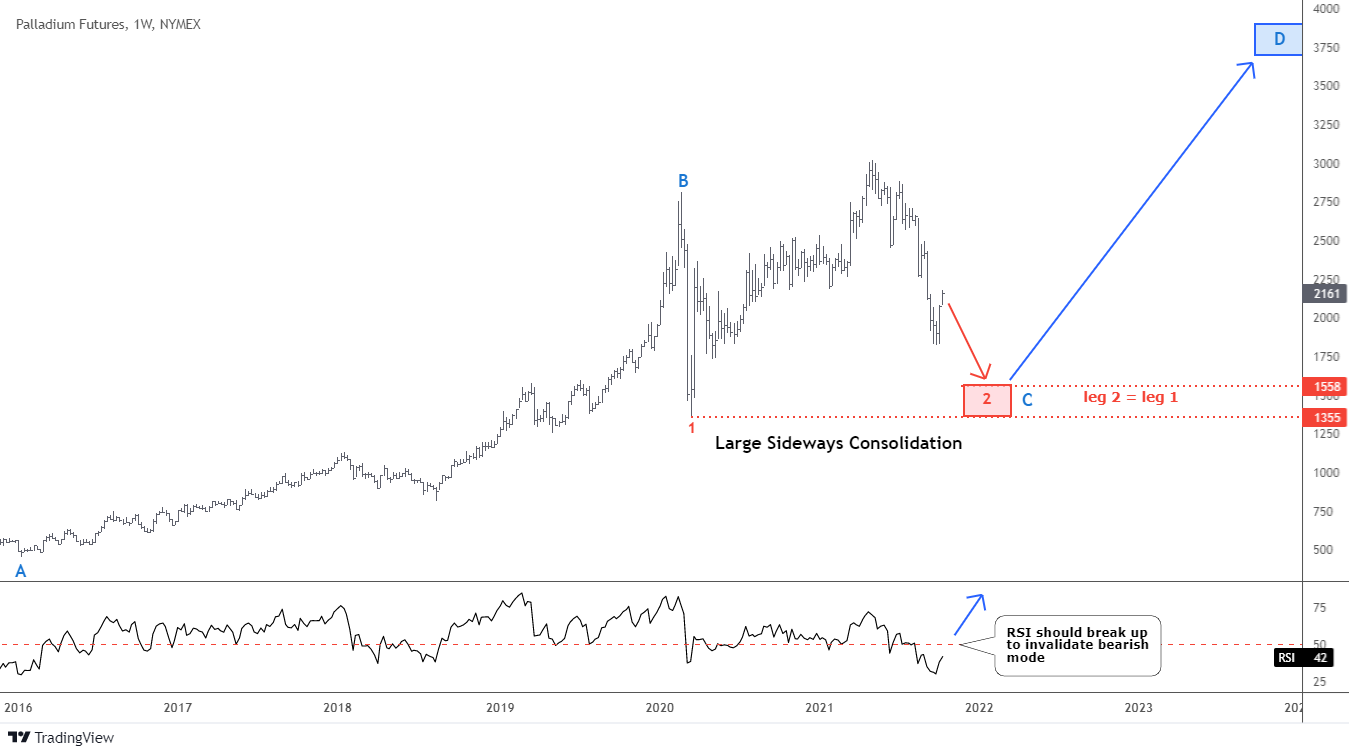
In October 2021, I shared with you my technical outlook for palladium futures.

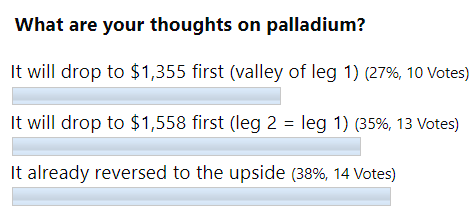
The chart structure was clear; therefore, I was confident of further collapse of palladium price. The results of your ballot are in the graph below.

Palladium

Most of you voted for a bullish trend to resume. The second popular bet turned out to be the most accurate as the price has pierced the upper side of the preset bearish target area at $1,558.

The next step after two-leg consolidation was going to be a huge growth of the metal’s price. However, the industry fundamentals do not support that bold plan. Continue reading "Palladium Update: Contradiction"

Nothing Good Happens Below 200-Day MA

On Friday, the stock market fell again, closing out another losing week and continuing its rough start to 2022. Again, the NASDAQ was hit the hardest with Friday's selloff sending the tech-heavy index to its worst week since March 2020.

The NASDAQ declined -2.72% to close at 13,768.92. The DOW fell 450.02 points or -1.30% to 34,265.37, and the S&P 500 slid -1.89% to end the day at 4,397.94.

The Nasdaq posted a -7.6% loss for the week and now sits more than 14% below its November record close. The DOW and S&P 500 closed out their third straight week of losses of -4.58% and -5.68%, their worst weeks since 2020. The S&P 500 is off more than 8% from its record close. Continue reading "Nothing Good Happens Below 200-Day MA"