Will 2021 Be The Year For Cannabis Stocks?

Great progress in terms of legalization was made for the Cannabis/Marijuana sector in 2020 that will. The 2020 elections resulted in a number of US states engaging in new Cannabis friendly policies and laws being approved by voters. This suggests a new rally in the Cannabis sector may be setting up in 2021 and beyond for traders. Our BAN – Best Asset Now – trading strategy is always looking out for the next sector to make a trade, and the Cannabis sector is certainly one we are keeping our eyes on! Make sure you sign up for my FREE webinar to find and trade the Best Assets Now just like me.

Weekly MJ Price Flag Setup

My research and I team believe the recent longer-term bottom in the MJ ETF, the Alternative Harvest ETF, suggests a broad bottom is setting up in the Cannabis/Marijuana sector. If this bottom in the Cannabis sector continues to profit support for the entire sector, then we may see price appreciation across many individual Cannabis stocks over the next 12+ months. Additionally, this price appreciation may prompt quite a bit of consolidation across the entire Cannabis/Marijuana sector.

The global use and demand for CBD & THC related products may continue to expand as medical and personal use expands across the US and into other nations. We are still near the infancy of understanding the true medicinal benefits of this all-natural product. A new upward price trend in this sector may prompt a global expansion/consolidation event where the Cannabis/Marijuana industry attempts to restructure into true global power companies. Continue reading "Will 2021 Be The Year For Cannabis Stocks?"
Another Day Another Record High For Bitcoin

Bitcoin (BITSTAMPUSD) hit a new record high of $42,000 Friday afternoon, surpassing the previous all-time high of $40,123 that it reached on Thursday. Year-to-date gains are now over 40% making Bitcoin the strongest mover in 2021 by far. In typical bull market euphoria, Bitcoin's price has more than doubled in less than a month as new investors rush in, making sure they don't miss out. You know, FOMO, "fear of missing out," but is it too late?

Mutual fund titan Bill Miller told CNBC that "One of the things that's interesting about bitcoin is that it gets less risky the higher it goes, that's the opposite of what happens with most stocks."

He went on to say, "For those people who are waiting for the pullback, they got it in the first quarter. You could have bought bitcoin and $4,000 in the first quarter," Miller noted, referencing bitcoin's nearly 50% intraday crash in March 2020.

"But amid bitcoin's more than 300% rally in 2020 extended by an additional 40% gain already in 2021, Miller said, the price of these returns is the asset's volatility." Continue reading "Another Day Another Record High For Bitcoin"

U.S. Crude Oil Production Fell In December

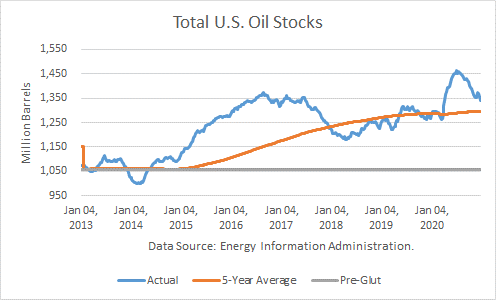
According to the Energy Information Administration, U.S. oil inventories (excluding SPR) fell by 14.9 million barrels last week to 1.342 billion, and SPR stocks were unchanged last week. Total stocks stand 47 mmb above the rising, rolling 5-year average and about 81.0 mmb higher than a year ago. Comparing total inventories to the pre-glut average (end-2014), stocks are 283 mmb above that average.

Oil

Crude Production

Production averaged 11.0 mmbd last week, unchanged from the prior week. It averaged 11.025 mmbd over the past 4 weeks, off 14.25 % v. a year ago. In the year-to-date, crude production averaged 11.504 mmbd, off 6.5 % v. last year, over 600,000 b/d lower. Continue reading "U.S. Crude Oil Production Fell In December"

The Problem With Bond ETFs Right Now

One of the first things an early or new investor is typically told is that bonds are safer than stocks but will offer lower capital appreciation than stocks. Or in simpler terms, bonds are less risky, and, therefore, they offer a lower reward. But in reality, these things we are taught about a bond's risks are not always true, depending on how you are invested in the bond, bonds, or a bond ETF.

Most people speak of the risk profile when they are talking about low risk. Low reward bonds is a scenario when the investor holds the individual bond themselves. Like stock ownership, a bond investor can buy individual bonds and hold them in their portfolio.

Let's quickly look at how and why bond prices change before we go any further. Say you buy a 1-year bond for $980.00, and when it matures in a year, it will be worth $1,000, meaning the bond you bought is yielding a 2% rate of return. Now let's say you hold the bond for the full year; you will make your 2% or $20 and be happy. Your only risk in this scenario is that whoever sold you the bond defaults on it, which for this example, is probably not likely. (The higher the interest rate on the bond at the initial time of sale typically indicates how risky the bond is and how likely the bond seller is to default. 2% is a very low risk in normal market conditions.)

If you plan to hold and ride the bond to mature, bonds are very low risk, as we have all been taught. However, if you plan to sell the bond before maturity, you are increasing your risk. For example, when you own the bond we spoke about above, that is paying a 2% rate of return, if the current market is demanding say a 4% rate of return on bonds, then to sell your bond, which you paid $980 for, you would have to offer another investor a 4% rate of return, or sell the bond at $960, so the buyer could realize a 4% rate of return, which is the current going rate for a bond if they held the bond to maturity. Continue reading "The Problem With Bond ETFs Right Now"

Leveraging Options To Navigate Frothy Markets

Wall Street capped off one of the most volatile years in history. The Dow Jones and S&P 500 ended the year at all-time highs, posting returns of 16.3% and 7.3%, respectively, for 2020. At the same time, the Nasdaq posted a return of 43.6% for the year. These unprecedented returns were achieved despite the S&P 500 nosediving over 30% earlier in the year due to the coronavirus pandemic sweeping the world. In this market environment harnessing options can allow traders to define risk, leverage a minimal amount of capital, and maximize returns.

All-time highs have been reached with the confluence of election certainty, improving vaccine prospects across the globe, and massive stimulus out of Washington. These positive developments have been priced into the markets. The broader indices are richly valued as measured by virtually any historical metric via stretched valuations, options put/call ratios, broad participation above 200-day moving averages, and elevated P/E ratios. Collectively, these may be potential warning signs of near-term pressures. Heeding these frothy market conditions via risk mitigation may be best served with risk-defined options trading.

Options: Margin of Protection and Defining Risk

Harnessing options in frothy markets allows one to define risk, leverage a minimal amount of capital, and maximize returns. Options can be structured to allow a margin of downside and/or upside stock movement while collecting income in the process. In these richly valued markets, allowing a margin of downside and/or upside stock movement may be a great strategy to heed potential market volatility. Continue reading "Leveraging Options To Navigate Frothy Markets"