Weekly Futures Recap With Mike Seery

Gold Futures

Gold futures in the December contract settled last Friday in New York at 1,462 while currently trading at 1,466 up about $4 for the week. However, ending the week on a sour note as all of the interest still lies in the S&P 500, which is hitting another all-time high as money flows continue to come out of gold.

At the current time, I do not have any precious metal recommendations, but I do believe gold prices are headed lower as I see no reason to be a buyer as prices are right near a 3 1/2 month low. Gold prices are trading under their 20 and 100 day moving average as the trend is to the downside, and if you take a look at the daily chart, the down trend line also remains intact as optimism about a trade deal with China continues to depress prices in the short-term.

The 10-year note is currently yielding 1.90% as that has rallied from 1.30% just a couple of months ago and that is also another negative after towards gold prices so if you are short stay short in my opinion so place the stop-loss above the 10-day high which stands at 1,517 as an exit strategy.

TREND: LOWER
CHART STRUCTURE: IMPROVING
VOLATILITY: AVERAGE

S&P 500 Futures

The S&P 500 in the December contract settled last Friday in Chicago at 3090 while currently trading at 3112 up about 22 points for the trading week, hitting another all-time high as the gravy train continues and I still believe it will continue throughout the holiday season. Continue reading "Weekly Futures Recap With Mike Seery"
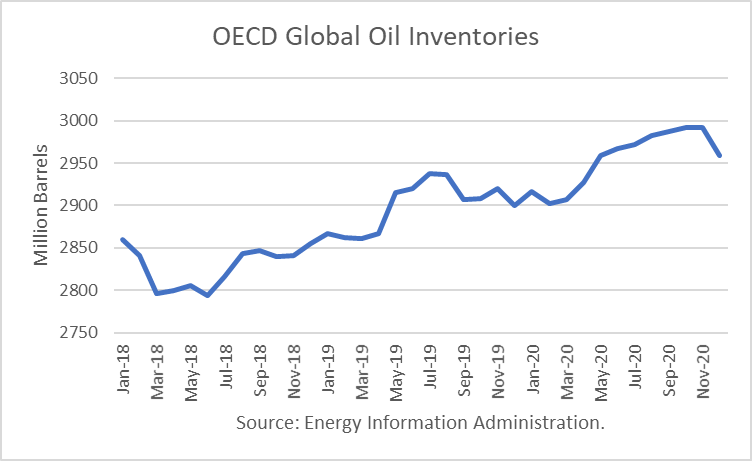
World Oil Supply And Price Outlook, November 2019

The Energy Information Administration released its Short-Term Energy Outlook for November, and it shows that OECD oil inventories likely bottomed last June 2018 at 2.794 billion barrels. It estimated stocks rose by 1 million barrels in October to 2.909 billion, 69 million barrels higher than a year ago.

For the balance of 2019, OECD inventories are projected to stabilize at 2.900 billion, 55 million higher than end-2018. For 2020, EIA projects that stocks will build by 59 million barrels to end the year at 2.959 billion.

Oil

The EIA estimated that OPEC production rose by 1.325 million barrels per day in October, 1.3 of which was in Saudi Arabia due to the recovery from the attack on its oil facilities. It is estimating that OPEC production averaged about 29.52 million in October. For 2020, it estimates that OPEC production will average about 29.52 million, about 160,000 b/d above the call (demand) for OPEC oil in 2020. Continue reading "World Oil Supply And Price Outlook, November 2019"

Indexes Hit Record Highs On Trade Optimism

Hello traders everywhere. The DOW hit a record high Friday after White House economic adviser Larry Kudlow said China and the U.S. were getting close to reaching a trade deal trading 120 points higher. The S&P 500 and NASDAQ also hit all-time highs, climbing +0.6% and +0.7%, respectively.

Trade-sensitive names such as Caterpillar, Boeing, Apple, and Micron Technology all rose at least +0.5%. Gold, meanwhile, gained +.60% for the week trading at $1,472.10 per ounce. Crude oil, however, hasn't had the same fate losing -.35% on the week entering a sidelines position, much like gold.

The U.S. Dollar continues to trade right around the $98 level, and we're waiting on a breakout above $98.39 to give us a green weekly Trade Triangle, which would indicate a move to a long-term uptrend. On the flip side, Bitcoin continues to be stuck in a tight trading range, but we could get a move lower if it breaks below $8,363, triggering a red weekly Trade Triangle. Continue reading "Indexes Hit Record Highs On Trade Optimism"

Zero Fee Trades Likely Means Lower Fee ETFs - Part 2

Now that its clear investors understand how fees affect their returns and the financial industry as a whole is responding by lowering trading commissions to zero and cutting management fees on funds, its just a matter of time until we see ‘indexed’ funds begin to offer zero or near zero, as in 0.01% expense ratio, fee funds.

Why? Simple because they have to stay competitive if they want to stay in business.

For years the biggest argument for one someone would buy an index fund is because it would be so cumbersome and costly to go out and buy a few shares of all the different stocks that make up a specific index. For example, if an investor wanted to mimic the Dow Jones Industrial Average, they would need to go out and buy one share of each of the 30 companies that currently make up the index.

In the past, that would be 30 different stocks in someone’s personal portfolio, which honestly isn’t that much higher than what the average retail investor owns, typically somewhere between 15 and 20. However, that would also mean the investor would have paid a trading commission 30 different times in order to set up that portfolio (1 trading commission for each different company they bought a share or multiple shares of). If the average investor was paying $4.95 per trade, that’s $148.50 in trading commissions just so they could mimic the Dow Jones Industrial Average without having to pay a mutual fund or ETFs fees every year. Continue reading "Zero Fee Trades Likely Means Lower Fee ETFs - Part 2"

The Times They Are A' Changin'

Talk about charter creep. This is more like a charter leap.

As we know well by now, the Federal Reserve’s famous “dual mandate” is to promote price stability and maximum sustainable employment. But as we also know, the Fed really has a third mandate, maintaining moderate long-term interest rates (don’t ask me why they still call it a dual mandate).

So it should be no surprise, then, that the Fed has now gone way beyond that dual (or treble) mandate by wholeheartedly injecting itself into what is really a political debate, namely climate change. And how ironic it is that it rose to the forefront during the same week that the U.S. withdrew from the Paris Climate Agreement.

Last week Fed officials were out in force, declaring that climate change would now be a major factor in not only how it regulates federally chartered commercial banks but also how it conducts U.S. monetary policy.

On Thursday, in a speech at the GARP Global Risk Forum, Kevin Stiroh, an executive vice president responsible for regulating banks at the New York Fed, said financial firms need to take the dangers and costs of climate change into their risk-management decisions.

“Climate change has significant consequences for the U.S. economy and financial sector through slowing productivity growth, asset revaluations, and sectoral reallocations of business activity,” he said. “The U.S. economy has experienced more than $500 billion in direct losses over the last five years due to climate and weather-related events.” Continue reading "The Times They Are A' Changin'"