Oil Market Readies For Iran Sanction Waivers, Round 2

Crude oil production in Iran had reached 3.84 million barrels per day (mmbd) in the period following the lifting of sanctions by the Obama Administration. But following President Trump’s announcement in May 2018 that the U.S. would re-impose sanctions in November, demand for Iranian crude dropped to 3.7 mmbd by October. In November, the Trump Administration allowed limited waivers to the sanctions to eight countries, but Iranian production dropped by another 700,000 b/d by March.

The waivers were designed to terminate on May 2nd, but Secretary of State Mike Pompeo announced April 22nd that the waivers would not be extended. "This decision is intended to bring Iran's oil exports to zero, denying the regime its principal source of revenue," the White House said in a statement.

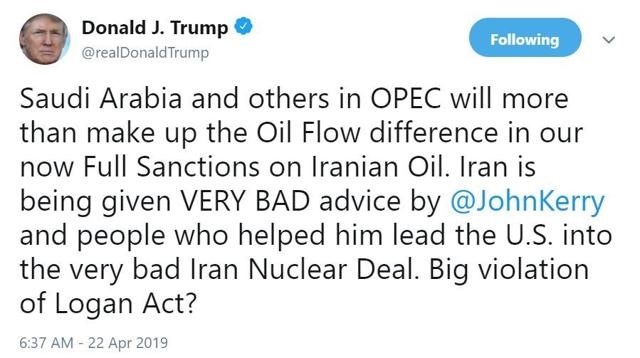
According to the International Energy Agency (IEA), Iran’s exports of crude and condensates are running about 1.1 mmbd in April. President Trump tweeted Saudi Arabia and others in OPEC had assured him that they would make up the impact of any decline in Iran’s exports:
Iran

In the months leading up to last November, KSA had increased its output to 11.1 mmbd, at the request of the White House, to ensure that oil supplies would be adequate once the Iranian sanctions took effect in November. But Trump’s granting of the waivers immediately created an oversupply in the global oil market, and oil prices collapsed as a result. Continue reading "Oil Market Readies For Iran Sanction Waivers, Round 2"
Can't Get No Satisfaction

President Trump has already won his argument for loosening Federal Reserve policy. While Fed Chair Jerome Powell can boast all he wants about the sanctity of the Fed’s independence, the fact is he and his FOMC followers knuckled under to the pressure Trump – and the financial markets – exerted on them to call a halt to any more interest rate increases for a while. Indeed, the discussion has since moved to cutting interest rates, a thought that seemed unimaginable just a few months ago.

Back in October, we were talking about how many rate increases we could expect this year. Now that any rate hikes are basically off the table for the foreseeable future, according to the Fed, the talk has shifted to a potential rate cut, possibly before the end of this year.

So why can’t Trump be satisfied with that? Instead, he’s sabotaging his chance to fill the two remaining seats on the Fed’s board of governors by publicly considering two people – Herman Cain and Stephen Moore – both of whom have way too much political baggage to hope to be confirmed, never mind actually nominated (remember, Cain was never formally nominated before he withdrew, nor has Moore).

While Fed independence is certainly a noble idea, the fact is that every person considered for the board has some political taint to them, expressed or not. Otherwise, they wouldn’t have been nominated in the first place. We all need to realize that and not try to pretend otherwise. Jerome Powell was nominated by Trump because he’s a Republican, while his predecessor, Janet Yellen, was nominated by President Obama because she’s a Democrat. Simple and reasonable. Continue reading "Can't Get No Satisfaction"

Weekly Futures Recap With Mike Seery

Chart Structure, Futures Trading, gold futures, how to trade futures, mike seery, seeryfutures.com, weekly futures recap, Guest Bloggers, Risk Management,

We've asked Michael Seery of SEERYFUTURES.COM to give our INO readers a weekly recap of the Futures market. He has been Senior Analyst for close to 15 years and has extensive knowledge of all of the commodity and option markets.

Michael frequently appears on multiple business networks including Bloomberg news, Fox Business, CNBC Worldwide, CNN Business, and Bloomberg TV. He is also a guest on First Business, which is a national and internationally syndicated business show.

Gold Futures

Gold futures in the June contract settled last Friday in New York at 1,276 ending the week on a positive note up $11 to close around 1,290 an ounce. Gold prices hit a 4 month low earlier in the week only to rally the last four trading sessions as I think it's just a kickback due to the oversold conditions as the downtrend line remains intact. Gold prices are now trading under their 20 and 100-day moving average as the trend has turned south in the short term with the next major level of support around the 1,250 area as the U.S. dollar hit a fresh yearly high this week as that has put pressure on the precious metals. Low inflation in the United States continues to keep a lid on gold as prices have gone nowhere over the last 6 months as the commodity markets, in general, are lacking trends and excitement at this time. If you are bullish gold I would buy it at today's price level while placing the stop loss under the most recent low which was hit on April 23rd at 1,267 as an exit strategy as the risk would be around $2,300 per contract plus slippage and commission, however like I've stated before I'm recommending clients to sit on the sidelines.
TREND: MIXED - LOWER
CHART STRUCTURE: SOLID
VOLATILITY: AVERAGE

Continue reading "Weekly Futures Recap With Mike Seery"

IBM Continues To Win Over Investors

International Business Machines (IBM) continues its long turn back to growth, focusing on high-value faster-growing business segments while embracing the future of technology with AI and hybrid cloud architecture via the Red Hat acquisition. Investors are ostensibly being appeased with the blended approach of M&A, realigning its business mix to current and future trends, maintaining its dividend payout and continuing to buy back shares until the Red Hat acquisition closes. IBM’s stock has been on an upward trend after investors decided to move past its initial displeasure of announcing its RedHat acquisition when shares were sold-off and traded down to ~$108. IBM's executive leadership has set the growth and value narrative, and investors are quickly realizing the value that Red Hat brings to the table while washing away fears that IBM overpaid for the $34 billion acquisition. From the $108 dip, IBM has been in a position of strength and has broken out past $140 after its recent Q1 2019 earnings. Long-term imperatives are beginning to bear fruit in emerging high-value segments that has fundamentally changed its business mix while evolving its offerings to align with new age information technology demands. The Red Hat acquisition will augment its transition away from its dependency on legacy businesses to the future of hybrid cloud, artificial intelligence, and analytics. IBM presents a compelling investment opportunity with a 4.5% dividend yield, share buyback program and continuously acquiring companies to drive the business into the future.

Q1 2019 Earnings – Solid

IBM reported Q1 earnings that were solid, not great and investors seemed content. IBM reported EPS of $2.25 and revenue of $18.2 billion which was a -4.7% year-over-year decline while missing analysts’ targets. IBM slide the following day initially however quickly arrested that decline to rise above the $140 again. The company laid out its growth narrative and Red Hat acquisition catalysts. IBM's revenue was flat across most of its business segments; however, its Cloud revenue grew by 10%.

"In the first quarter, our cloud revenue growth accelerated, and we again grew in key, high-value areas in Cloud and Cognitive Software and in consulting,” "IBM’s investments in innovative technologies coupled with our industry expertise and our commitment to trust and security position us well to help clients move to chapter two of their digital reinvention."
Ginni Rometty, IBM chairman, president, and chief executive officer

IBM has slipped back into a revenue contraction in its last few quarters however I think there’s a lot to like moving forward. There’s a reassurance that the dividend is safe, stabilizing revenues and a lot of shots on goal for future growth especially with Red Hat coming into to fray and strategic imperatives becoming a larger segment of IBM’s overall revenue pie as this is a higher growth business (Figure 1). Continue reading "IBM Continues To Win Over Investors"

Market Stalls At The End Of Record Week

Hello traders everywhere. Stocks swung between small gains and losses Friday after figures showed the U.S. economy grew at a strong rate in the first quarter but the pace of consumer and business spending slowed. First-quarter gross domestic product was 3.2%, the Commerce Department said on Friday, topping the consensus economist estimate of 2.5%, according to Dow Jones. An increase in exports drove the increase. The better-than-expected print was driven by a rise in exports.

On a weekly level, the S&P 500 gained +.82% and was on track for another weekly advance. The S&P 500 sits just below Tuesday's record and is up 17% for the year. The Dow Jones Industrial Average also climbed 0.1% after entering the day 1.4% below last year's record but will finish the week in negative territory losing -.32%. The Nasdaq Composite dropped 0.1% and, as the S&P 500, was just below its record from earlier in the week and will post a weekly gain of +1.38%.

Crude oil prices

The U.S. dollar will back to back weekly gains with a gain of +.58% this week. Continue reading "Market Stalls At The End Of Record Week"