Oil: Is It 2014 All Over Again?

Lior Alkalay - INO.com Contributor


In the past two weeks, crude oil futures took a beating; WTI futures ended last week at $46.47 per barrel while futures for Brent crude, the global benchmark, closed at $49.47 per barrel. Both WTI and Brent contracts have now concluded a 15% and 16% fall from their respective peak prices, closing at their lowest point since the deal between OPEC oil producers and 13 non-OPEC oil producers was signed. And the outlook for oil is not encouraging as a broader analysis of both the fundamentals and technical at play reveal a worrisome pattern—a pattern of an oversupplied oil market, ready to nose dive, as it did in 2014.

At the heart of the matter, as in 2014, is the US shale oil industry. Only this time around the US shale industry is significantly more competitive. According to Ron Ness, president of the North Dakota Petroleum Council quoted by Reuters, “the cost of extracting oil at Dunn County, North Dakota, is as low as in Iran” and “the cost of producing a barrel of oil is at $15 and falling" That figure is truly nothing short of dramatic! True, the production cost at Eagle Ford and Permian Delaware facilities is higher than Dunn country. And yet this figure underpins a very important change. In the next oil slump, shale producers won't be under the same pressure to cut production. Meanwhile, oil production in America has risen to 9.29 million barrels a day and is expected to surge to 10 million barrels a day by 2018. All the while, crude oil inventories are stubbornly high. The latest data from the EIA shows crude oil inventories were at 527.8 million barrels, at the higher end of the 5-year range. In fact, as the EIA chart below shows, US crude oil inventories have been persistently above the 5-year range for some time, suggesting demand for crude in the United States is too weak to accommodate the rising supply from shale oil. Continue reading "Oil: Is It 2014 All Over Again?"

Talk About Chutzpah

George Yacik - INO.com Contributor - Fed & Interest Rates


If you’ve ever wondered why so many of today’s American college students seem to live in a self-delusional world where they take little personal responsibility for anything that goes wrong in their lives, you don’t have to look any further than the professors who teach them.

In a recent op-ed column in the New York Times, Susan M. Dynarski, a professor of education, public policy and economics at the University of Michigan, takes the Trump Administration to task for its failure to take the proper steps, in Ms. Dynarski’s eyes, to fix the student debt problem, as if Donald Trump himself caused the crisis.

Nowhere in her lengthy critique does she ever address head-on the real culprits in the student debt crisis: the government agency that made these loans in the first place, and the colleges and universities that have exploited these loans in order to drive up the price of higher education, forcing millions of students and their parents into debt if they want to attend college.

First, she says, “the Education Department has weakened accountability for the companies that administer student loans,” specifically calling out Navient, formerly a part of Sallie Mae. Now privatized, Navient is the largest servicer of government student loans. As such, Dynarski says, “companies like Navient are the face of the student loan system, and often the source of enormous frustration for borrowers.” Continue reading "Talk About Chutzpah"

Silver Update: The Backup Plan

Aibek Burabayev - INO.com Contributor - Metals


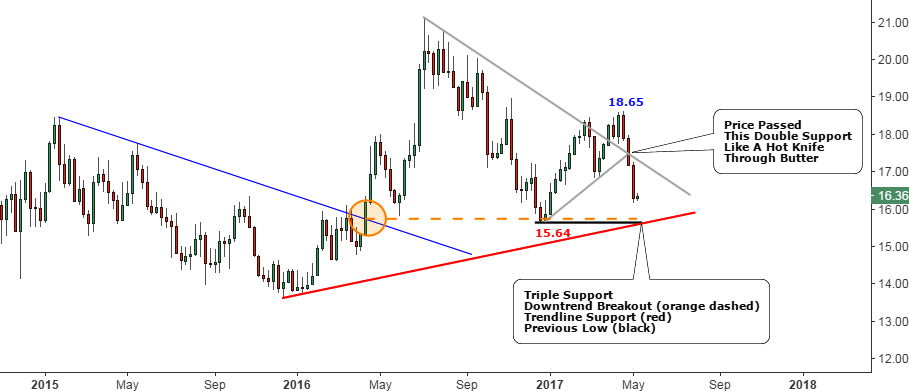
In this post I’ve updated the charts to reflect the recent dramatic changes in the silver market.

Chart 1. Silver Weekly: Triple Support

Weekly Silver Chart
Chart courtesy of tradingview.com

On the weekly chart above, there is a mixture of reconstructed trend lines (gray lines) set in the previous update and newly added lines, which highlight the important support levels nearby.

The silver price has passed the double support (gray former resistance + gray support) set at the $17.5 mark like a hot knife through butter two weeks ago. The three red bearish weekly candles from the top erased all of the earlier gains and even broke below the previous low at the $16.84 mark. Continue reading "Silver Update: The Backup Plan"

Disney: The Media Juggernaut Continues Hot Streak

Noah Kiedrowski - INO.com Contributor - Biotech


The Media Juggernaut

I’ve been a long bull of The Walt Disney Company (NYSE:DIS) stock, particularly since the post-ESPN induced sell-off in throughout 2016. Since the lows of October 2016, Disney has seen a huge appreciation in stock price, breaking out to above $115 per share level as of late. This upswing has been on the heels of multiple catalysts such as of reporting record annual results, breaking the all-time worldwide box-office record, witnessing a slew of analyst upgrades, Iger extending his contract as CEO, ESPN woes subsiding, Shanghai Disney opening and Disney’s movie line-up announced through 2020. This inflection point coincided with Doctor Strange, Moana and Star Wars Rouge One in Q4 of 2016 followed by a record opening for its live action film, Beauty and the Beast. The stock fell from the $120s in late 2015 to the high $80s and had been stuck in the $80-$90 range all throughout 2016. This perpetual slump was almost entirely attributable to the decrease in ESPN subscribers and subsequent revenue and profit declines from that franchise. The ESPN franchise within the Media Networks segment generates revenue/operating income that is disproportionate to the amount of the company’s overall revenue and operating profit. Thus, one can see why investors were spooked after consecutive significant declines in ESPN subscribers and thus financial numbers over the past three years. Excluding ESPN, Disney has been executing well and reporting record numbers throughout all of its other business segments. Disney has a deep and diversified enough entertainment portfolio that made a compelling case that these ESPN fears were being overblown. Disney offered and still offers a compelling long-term investment opportunity considering the growth, pipeline, diversity of its portfolio, share repurchase program and dividend. Continue reading "Disney: The Media Juggernaut Continues Hot Streak"

ETFs For Those In Their 50s

Matt Thalman - INO.com Contributor - ETFs


So you are now just a decade or so from retirement and don’t want another 2008 market crash to wipe out our nest egg, forcing you to work for longer than you are planning. Finding safe investment options is a goal, but at the same time you don’t want to be too conservative because you do need to continue realizing capital appreciation so your nest egg can support you during your 'golden years'.

The balance between safety and growth is more difficult than one may think. If you get too safe, the growth will lag and you may not have a large enough retirement account. If you get too focused on growth, you may be taking on more risk than you should, which could leave you vulnerable to a big market crash.

While Exchange Traded Funds offer diversity, I personally don’t like very many of the mixed portfolio options available today (a fund that holds a combination of investment options such as stocks, bonds, RIETS, MLP's, currency, futures, etc.) and especially don’t like the 'age-based target funds' offer through many 401(k) plans and other mutual fund companies. Now I want to make it clear I am always a proponent of a well-diversified portfolio and I believe that idea holds true more so for those in this age group than investors who are younger.

With that being said, investors in their 50's should be thinking more about buying a few different ETFs, as opposed to the one-stop shops. I have found that the one-stop-shop ETFs typically tend to be either too conservative or too aggressive and this causes them dramatically trail the market returns or be way too exposed to a market pull-back. Continue reading "ETFs For Those In Their 50s"