It's Official, They Exit! Risk Aversion Chronicles: Gold Leads The Safety Demand!

Aibek Burabayev - INO.com Contributor - Metals


Today is a historic day in World financial history, which will be recorded in our memory forever! And it was a long and sleepless night all over the world as financial markets were frozen in agonizing suspense.

We should admit that Britons are firm and consecutive in pursuing their goal of independence. Almost a quarter century ago, they decided to withdraw their currency from the European Exchange Rate Mechanism (ERM) and they didn’t turn off their road yesterday on the final referendum.

Bookies and analysts got it all wrong as they forecasted the win of the "STAY” option, but more and more we have witnessed that all efforts to calculate human emotions and perceptions fail. The economic consequences for Brexit are harmful to the UK in a short term, but they still voted to leave. People are irrational in their behavior and the realization of this fact would bring the dramatic changes in the economic science in the future. Continue reading "It's Official, They Exit! Risk Aversion Chronicles: Gold Leads The Safety Demand!"


Fed To Markets: See You In 2019

George Yacik - INO.com Contributor - Fed & Interest Rates


The Federal Reserve has made it pretty clear, by its actions if not by many of its pronouncements, that, like Melville’s Bartleby the Scrivener, it really would prefer not to do anything. Now it looks like it’s planning to take off not just the rest of this year but the next couple of years, too.

Instead of no rate increase this year, which is looking more and more like a done deal, we may not see higher rates until 2019 at the earliest, at least according to one Fed official.

Last week, as expected, the Fed left interest rates unchanged while lowering expectations for future rate increases, both this year and beyond. In arriving at that decision, which was unanimous, the Fed’s monetary policy committee cited recent weakness in the jobs market, previously an area of relative strength in the economy. Continue reading "Fed To Markets: See You In 2019"

Using Covered Puts To Trade Options

Timing the market has proven to be very difficult if not altogether impossible. However creating opportunities to artificially accentuate further downward movement in a given stock one is looking to own is possible. If a stock of interest has substantially fallen yet not enough to pull the buy trigger, then one has an option to “buy” the stock at an even lower price at a later date while collecting a premium in the process. This is called a covered or secured put option. Leveraging covered or secured put options in opportunistic scenarios may augment overall portfolio returns while mitigating risk when looking to initiate a future position in an individual stock. Options are a form of derivative trading that traders can utilize in order to initiate a short or long position via the sale or purchase of contracts. In the event of a covered put, this is accomplished by leveraging the cash one currently has by selling a put contract against those funds for a premium. Traders may also initiate a short or long position via the purchase of option contracts to the underlying security. An option is a contract which gives the buyer of the contract the right, but not the obligation, to buy or sell an underlying security at a specified price on or before a specified date. The seller has the obligation to buy or sell the underlying security if the buyer exercises the option. An option that gives the owner the right to buy the security at a specific price is referred to as a call (bullish); an option that gives the right of the owner to sell the security at a specific price is referred to as a put (bearish). I will provide an overview of how a covered put is utilized and executed. Further details focusing on optimizing cash leverage (covered puts) and the ability to sell these types of options in a conservative way to generate cash while initiating positions in one’s portfolio will follow. Continue reading "Using Covered Puts To Trade Options"

Charting The Energies Data Release

Robert Boslego - INO.com Contributor - Energies


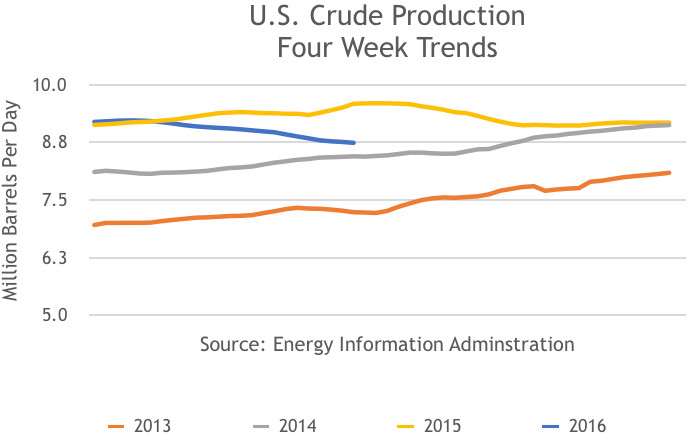
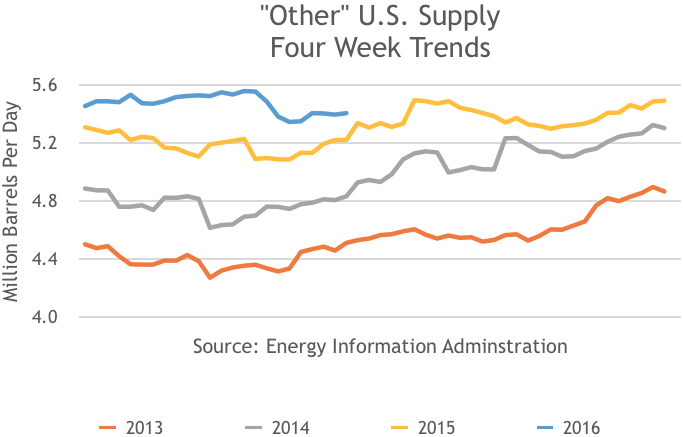
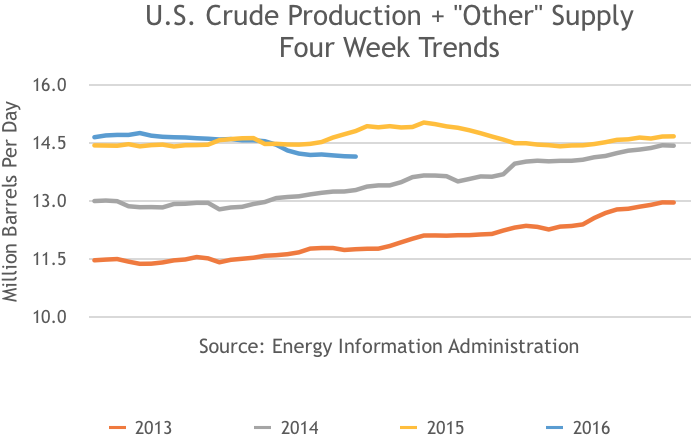
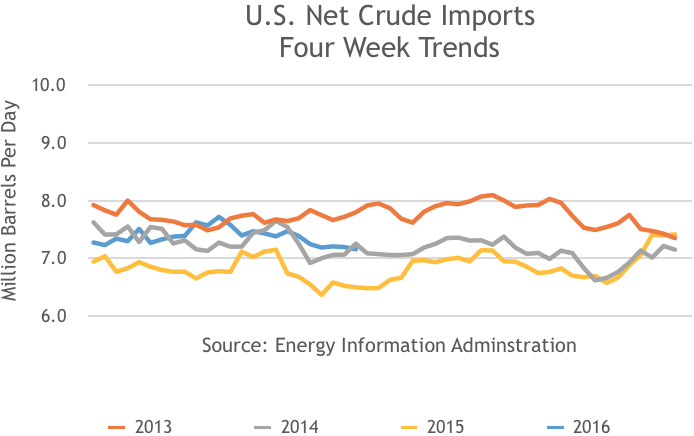
Each week, the Energy Information Administration (EIA) reports estimates for crude oil and petroleum products. These supply, demand and inventory estimates are used by traders to assess the inventory surplus (or deficit), the supply-demand balance and whether the market is tightening or not. The best measure of the latter is to look at the crude stock change and petroleum product stock change graphs.

These stocks and trends are best understood in perspective and so comparisons are made to previous years. Interpreting the data reported by the EIA might otherwise be difficult or time-consuming.

It is important to note that these estimates are provided from surveys and EIA models and are subject to revision. The EIA crude production data, in particular, has been revised substantially in monthly data released a few months after the weeklies.

US Crude Production, 4 Week Trend, 2013, 2014, 2015, 2016

Other US Supply Four Week Trends, 2013, 2014, 2015, 2016

US Crude Production and Other Supply, 4 Week Trend, 2013, 2014, 2015, 2016

US Net Crude Imports, 4 Week Trend, 2013, 2014, 2015, 2016


Continue reading "Charting The Energies Data Release"

Why Oil Is At $50 With An Inventory Glut

Robert Boslego - INO.com Contributor - Energies


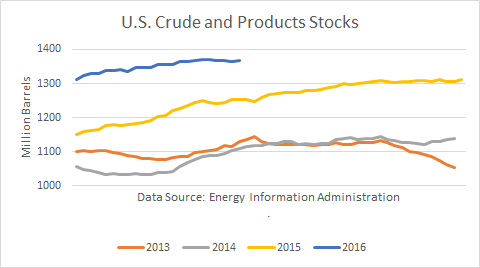
According to the Energy Information Administration (EIA), world oil inventories are about 425 million barrels higher than their “normal” levels. In the U.S., inventories stand a 1.368 billion barrels, a few million off their recent peak. Given that supply glut, how could oil futures prices be at $50 after falling below $30?

U.S. Crude and Product Stocks

One answer is that the futures market assesses future developments. As discussed below, the peak of the glut appears behind us and the U.S. oil market is tightening, as rising demand narrows the supply-demand gap. This is best observed by looking at the trends in inventory storage changes for both petroleum products and crude oil. Continue reading "Why Oil Is At $50 With An Inventory Glut"