What's The Right 'Neutral' Interest Rate?

Will last Friday’s August jobs report showing that wages rose nearly 3% compared to a year ago finally convince the Federal Reserve that inflation really is starting to pick up steam? If not, what exactly will it take?

That report was certainly good news for workers, who have waited a long time – since 2009, apparently – to see their wages rise by so much. But it also provides convincing evidence that 2% inflation – which the Fed has been trying to stoke for the past 10 years – has finally arrived. But will the Fed actually believe it and do something before it “overheats,” to use its word?

A hike in the federal funds rate to 2.25% at the Fed’s September 25-26 monetary policy seems like it’s already baked in the cake. But it’s still not a given that another one will happen at the December meeting. According to CME’s Market Watch tool, the odds of a rate hike at the yearend confab are only 72%, compared to more than 98% for this month’s meeting. (While the Fed does meet in early November – just a day after the “most important election in our nation’s history,” if you believe some of the political pundits – a rate change then is very unlikely. The Fed has indicated that it will only adjust rates at a meeting that ends with a press conference by the Fed chair. That pretty much disqualifies November).

After the jobs report was released, the yield on the two-year Treasury note hit 2.70%, its highest level in more than 10 years. The benchmark 10-year note closed last week at 2.94%, its highest point in over a month. That those rates didn’t go even higher seems to indicate that the market isn’t yet sold on two more rate increases this year.

At least one member of the Fed is. Continue reading "What's The Right 'Neutral' Interest Rate?"
Stock Market Rebounds After Weak Open

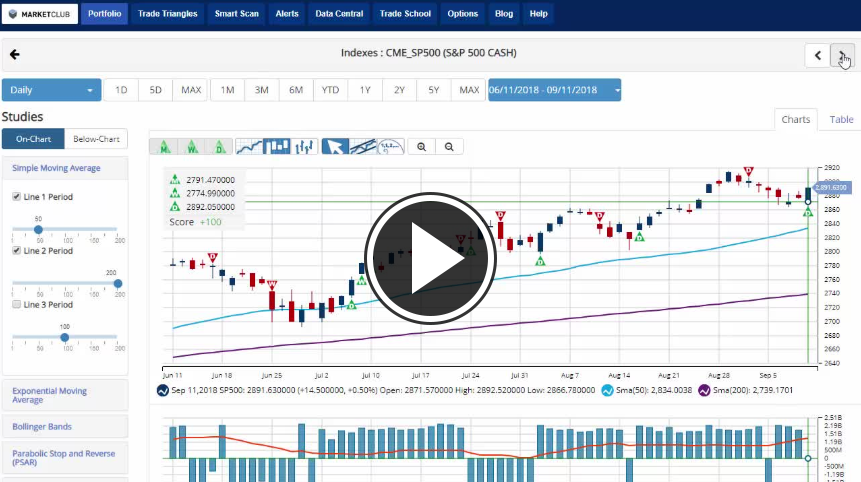
Hello traders everywhere. After a weak Tuesday open the stock market was bailed out by a surge in the tech and energy sectors. The tech sector has shrugged off growing concerns over trade and federal regulation led by the FAANG stocks which are all in positive territory led by Apple which is posting a +2% gain. The jump by Apple is related to analysts at UBS raised their price target to $250 from $215, citing the potential growth of the company's services business.

Trade worries continue to linger as President Trump's threat on Friday to slap tariffs on nearly all Chinese imports was met with a statement from China that said it would approach the World Trade Organization next week for permission to slap sanctions on the United States due to its non-compliance with a ruling in a dispute over U.S. dumping duties.

Stock Market Rebounds

The energy sector is getting a hurricane boost as hurricane Florence is bearing down on North and South Carolina. Florence is expected to make landfall on Thursday and will be the largest hurricane to make landfall in that region in over 60 years. With that news, traders jumped on crude oil and gasoline pushing oil up +2.5% and gasoline up +2.3%.

Key Levels To Watch This Week:

Continue reading "Stock Market Rebounds After Weak Open"

U.S. Crude Production Growth Rebounds In June

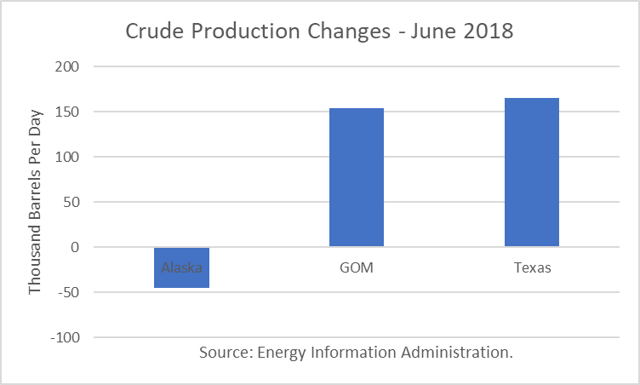
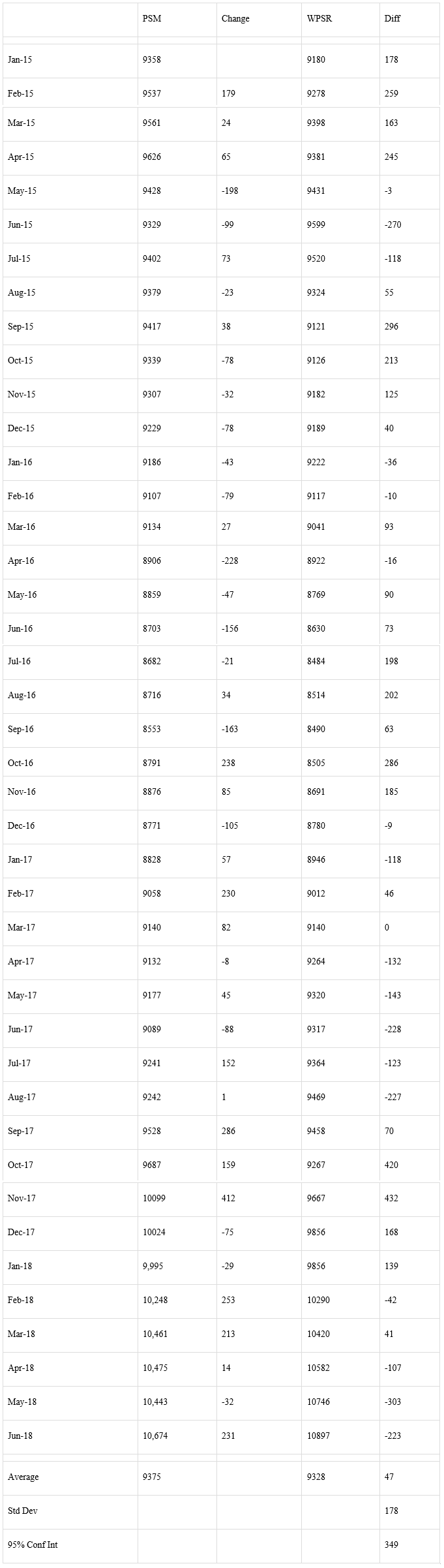
The Energy Information Administration reported that June crude oil production averaged 10.674 million barrels per day (mmbd), up 231,000 b/d from May. The surge was partly on the back of a rebound of 154,000 b/d in the Gulf of Mexico (GOM) which had fallen due to unplanned maintenance. In addition, there was a surge of 165,000 b/d in Texas and a loss of 45,000 b/d in Alaska due to normal summer maintenance.

U.S. Crude Production Growth Rebounds

The EIA-914 Petroleum Supply Monthly (PSM) figure was 223,000 b/d lower than the weekly data reported by EIA in the Weekly Petroleum Supply Report (WPSR), averaged over the month, of 10.897 mmbd.

U.S. Crude Production Growth Rebounds

EIA has since kept weekly production estimates essentially flat, as it apparently waits for the monthly survey numbers to catch-up. Continue reading "U.S. Crude Production Growth Rebounds In June"

Marijuana ETFs Aren't Too 'High' Just Yet

With Canada set to legalize the recreational use of marijuana on October 17th, marijuana-related stocks and thus marijuana ETFs built around these equities have been on the rise. Many investors believe the marijuana industry will the next big growth industry since the drug has never been legal, but known to be rather popular with those looking to relax. Not only have individual investors been looking to the industry as a way to grow their wealth, but the alcohol industry has recently shown serious interest in the industry.

In August we saw Constellation Brands (STZ) increase its stake in Canopy Growth (CGC), we saw Molson Coors (TAP) partner up with Hydropothecary Corp. (HEXO) and there were reports that Tilray (TLRY) was in talks with Diageo (DEO). The rumors that Diageo and recently IPO’d Tilray where in talks has helped TLRY jump more than 100% since going public in mid-July of this year. While the moves from TLRY, HEXO, and CGC have all been astonishing in the past few months, the fact remains that the industry as a whole can still go higher in the future.

When marijuana became legal in Colorado and then California, the industry experienced a significant increase in demand literally overnight. That demand is once again going to jump on October 17th when Canada becomes legal. Furthermore, with the trend appearing to be taking hold not only around the country but the world, it's not hard to see how within maybe the next five to ten years from now, some of the marijuana stocks will be as big as the top alcohol companies.

But, that is where the problem rests. Trying to determine today, which companies are going to dominate the marijuana market in the coming years is not only a daunting task but perhaps more like gambling than investing.

Luckily though, we have a few ETFs that you can pick from today. Continue reading "Marijuana ETFs Aren't Too 'High' Just Yet"

Weekly Futures Recap With Mike Seery

We've asked Michael Seery of SEERYFUTURES.COM to give our INO readers a weekly recap of the Futures market. He has been Senior Analyst for close to 15 years and has extensive knowledge of all of the commodity and option markets.

Michael frequently appears on multiple business networks including Bloomberg news, Fox Business, CNBC Worldwide, CNN Business, and Bloomberg TV. He is also a guest on First Business, which is a national and internationally syndicated business show.

Gold Futures

Gold futures in the December contract is currently trading at 1,202 after settling last Friday in New York at 1,205 an ounce down about $3 for the trading week as prices are still consolidating the recent downdraft that has occurred over the last several months as I remain bearish. If you are short a futures contract continue to place the stop loss at 1,221 as the downtrend line remains intact as I still believe that we will retest the August 16th low of 1,167 in the coming days ahead as the U.S. economy is strong as we added another 201,000 jobs last month as I still see no reason to own gold. The 10-year note is now yielding 2.94% as the Federal Reserve is probably going to continue to raise interest rates which is also fundamental bearish indicator towards gold prices as I remain bearish the entire sector as it looks like silver could hit a 9-year low in the coming weeks ahead so stay short. Gold prices are trading under their 20 and 100-day moving average as the trend remains to the downside as I still think there could be significant room to run as prices still look expensive especially compared to silver historically speaking. The U.S. dollar remains strong as I still believe we will touch the 100 level in the coming months ahead which will have a negative influence on prices as gold fundamentally and technically speaking doesn't have anything going for it at this time.
TREND: LOWER
CHART STRUCTURE: IMPROVING
VOLATILITY: LOW

Continue reading "Weekly Futures Recap With Mike Seery"