Stock Analysis From A To Z: Letter "B"

Aibek Burabayev - INO.com Contributor - Metals


In this post I would like to share with you the analysis of the stocks with a name starting with letter “B”. There are more stocks to choose from this time, according to the earlier mentioned filter criteria. Four stocks were shortlisted this time as they have clearer chart structure, but only two stocks reached the “well done” level. I witnessed again and again that U.S. stock market offers a lot of opportunities for investors and traders.

Below is the long list for letter “B”.

Table 1. Selected stocks for letter B
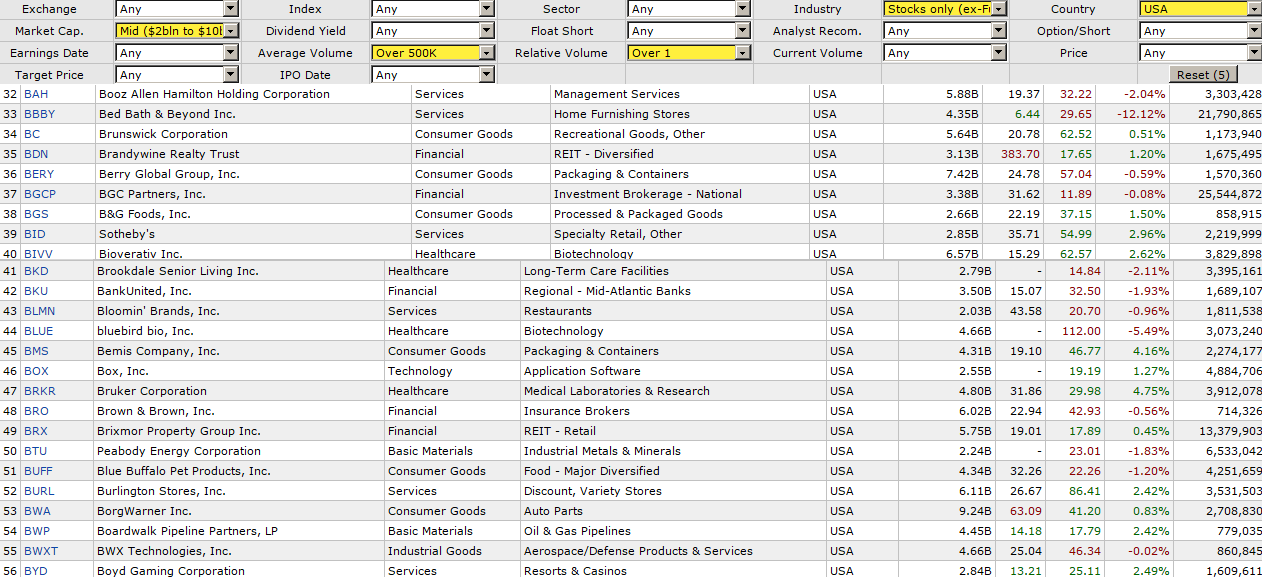
Table 1. Selected stocks for letter B
Image courtesy of finviz.com

Out of 24 filtered stocks I picked only four as they have clear chart structure: BBBY, BGCP, BWA and BYD. BBBY is oversold and has the potential for the long trade setup, but one should wait for the breakout of the multi-month downtrend, and try not to guess the bottom, which is always risky. Others have potential short trade setups. BYD, like BBBY is also not ready and continues upside. As I told you many times before, we shouldn’t be biased. I am neither a Permabear nor a Permabull, however only short setups have appeared recently on the chart radar. Continue reading "Stock Analysis From A To Z: Letter "B""


Nikkei 225: Follow The Trail

Lior Alkalay - INO.com Contributor


Since the start of 2017, the Nikkei 225 has lagged in performance; with a 2.8% return since 2017 began, it lagged the S&P 500'S 2.8% RETURN, and it lagged its Asian peers, the Hang Sang and the South Korean KOSPI, which gained 16% and 16.7%, respectively, year to date. Despite all that lagging, however, the future trend for the Nikkei 225 might be the most promising. The reason? The BoJ’s monetary policy, and how it is trailing the performance of the Japanese economy.

BoJ Policy vs Reality

In a recent speech at the University of Oxford, Bank of Japan Governor Haruhiko Kuroda stressed that, despite the latest improvement in Japan’s economic performance, inflation (the rise in prices) is still far from the BoJ’s target of 2%. As the official statistic released from Japan’s statistic Bureau suggests, Kuroda is right. Japan’s headline inflation hit 0.4%, still persistently close to 0%. Add to that the risk of another sell-off in oil and the downside risk for Japanese inflation seems very present. Together, that makes it incumbent upon the Bank of Japan to keep its ultra-loose policy. Nonetheless, something about Japan’s official data doesn't add up. Continue reading "Nikkei 225: Follow The Trail"

Disney Quietly Retreats - Buying Opportunity

Noah Kiedrowski - INO.com Contributor - Biotech


The Quiet Buying Opportunity

The Walt Disney Company (NYSE:DIS) has quietly retreated from its recent highs of $116 to sub $104 thus presenting a buying opportunity in this media juggernaut heading into earnings. We’ve all heard the endless bickering over its slumping ESPN franchise. Although ESPN makes up a disproportionate amount of the company’s revenue, all of its other franchises are posting healthy growth hence Disney will be relying less and less on its ESPN franchise over the coming years. Disney’s perpetual stock slump leading up to its recent resurgence was almost entirely attributable to the decrease in ESPN subscribers and subsequent revenue and profit declines from that franchise. The ESPN franchise within the Media Networks segment generates revenue/operating income that is disproportionate to the amount of the company’s overall revenue and operating profit. Thus, one can see why investors were spooked after consecutive significant declines in ESPN subscribers and thus financial numbers over the past three years. Excluding ESPN, Disney has been executing well and reporting record numbers throughout all of its other business segments. Disney has a deep and diversified enough entertainment portfolio that makes a compelling case that these ESPN fears are overblown. Disney offers a compelling long-term investment opportunity considering the growth, pipeline, diversity of its portfolio, share repurchase program and dividend growth in light of this recent retreat.

Long-Term Narrative and Positive Analyst Sentiment

I’ve been a long bull of Disney (DIS) stock, particularly since the post-ESPN induced sell-off throughout 2016. Since the lows of October 2016, Disney has seen a huge appreciation in stock price, breaking out to above $116 per share before this current downtrend. This upswing has been on the heels of multiple catalysts such as of reporting record annual results, breaking the all-time worldwide box-office record, witnessing a slew of analyst upgrades, Iger extending his contract as CEO, ESPN woes subsiding, Shanghai Disney opening and Disney’s movie line-up announced through 2020. This inflection point coincided with Doctor Strange, Moana and Star Wars Rouge One in calendar Q4 of 2016 followed by record openings for its live action film, Beauty and the Beast and Guardians of the Galaxy 2. The stock fell from the $120s in late 2015 to the high $80s and had been stuck in the $80-$90 range all throughout 2016. That stock slump offered investors an opportunity to purchase a high-quality company at a significant discount. Continue reading "Disney Quietly Retreats - Buying Opportunity"

Weekly Futures Recap With Mike Seery

We've asked Michael Seery of SEERYFUTURES.COM to give our INO readers a weekly recap of the Futures market. He has been Senior Analyst for close to 15 years and has extensive knowledge of all of the commodity and option markets.

Michael frequently appears on multiple business networks including Bloomberg news, Fox Business, CNBC Worldwide, CNN Business, and Bloomberg TV. He is also a guest on First Business, which is a national and internationally syndicated business show.

Gold Futures

Gold futures in the August contract settled last Friday in New York at 1,256 an ounce while currently trading at 1,256 in a pretty uneventful trading week. I'm not currently involved in this market, but I'm looking at a possible short position in next week's trade. Gold prices hit a 5-week low in Wednesday's trade. However, the 10-day high stands at 1,284 which is a little too far away in my opinion so I will wait for the chart structure to tighten up with a rally or a couple more days off the calendar then I will be looking at getting short. I'm still bearish gold and the precious metals in general. The next major level support is at 1,225 with prices trading right at their 20 & 100-day moving average telling you that there is no trend at this time. The commodity markets, in general, remain weak except for the stock market which continues to move higher. I am also recommending a bullish position in the Dow Jones as I still think money flows will enter that market & out all the gold market in the coming weeks, so keep a close eye on this market for a possible short position.
TREND: MIXED
CHART STRUCTURE: IMPROVING

Continue reading "Weekly Futures Recap With Mike Seery"

Exchange Traded Funds Are Becoming More Popular Because of This One Undeniable Benefit

Matt Thalman - INO.com Contributor - ETFs


The vast majority of American investors do so through mutual funds, but that trend seems to be changing for the better because investing for the masses is getting a lot cheaper.

Data from 2016 indicated that over half of U.S. households invested in mutual funds and the industries total assets under management were $16.34 trillion at the end of the year. Over the past few years net cash inflows to mutual funds have been shrinking and even turned negative in 2015. In 2007 cash inflows to mutual funds hit an all-time high at $879 billion, which makes sense because this was the peak of the market before the crash caused by the housing crisis. In 2009, 2010, and 2011 cash inflows were negative, -$146 billion, -$282 billion and -$96 billion respectively.

In 2012 cash in-flows returned positive and hit $200 billion, but the industry has seen declining in-flow ever since; $177 billion in 2013, $104 billion in 2014, a negative $101 billion in 2015 and even worse a negative $229 billion in 2016.

It was easy to see and understand why mutual funds experienced cash flow decline in 2008, 2009, and 2010 as the market was falling and investors were scared. But the fact that less money is moving into mutual funds while the stock market in general has increased the past few year's means there is likely a larger force at play. Continue reading "Exchange Traded Funds Are Becoming More Popular Because of This One Undeniable Benefit"