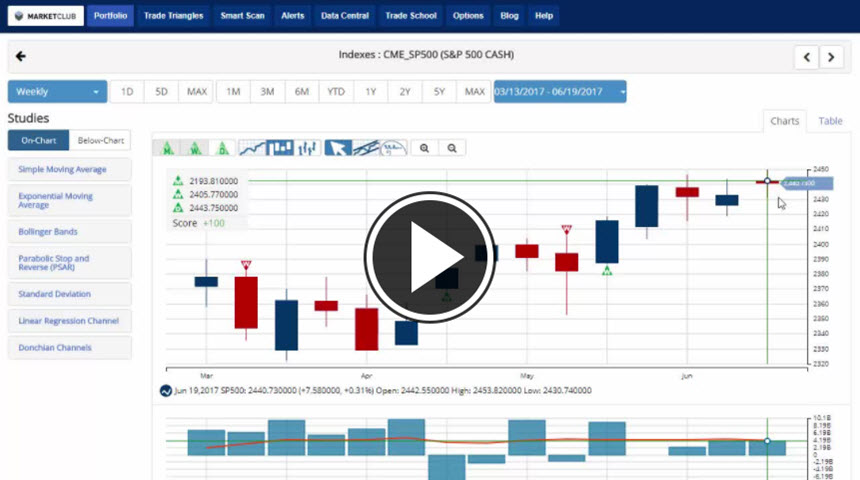
Oil Stabilizes As The Dollar Falls

Hello MarketClub members everywhere. The drop by the U.S. Dollar today has helped to pull crude oil off of its 10-month lows producing two straight days of gains heading into the weekend.

Overall, U.S. stocks have been little changed this week, with the Dow and S&P flat in the period. Meanwhile, the NASDAQ is on track to post a weekly gain of almost 2% after two weeks of losses.

MarketClub's Mid-day Market Report

Key levels to watch next week: Continue reading "Oil Stabilizes As The Dollar Falls"

Secret CBD Company Grows Sales 1,300% in 12 Months

Analysis originally distributed on June 15, 2017 By: Michael Vodicka of Cannabis Stock Trades

In the old days, pot was seen as a way to get stoned.

But now, researchers are discovering that pot can actually have many health benefits.

Most of those come from Cannabidiol - one of the most prevalent compounds found in hemp plants that is commonly refereed to as CBD on the Street.

Studies have shown that the non-psychoactive elements of CBD can deliver relief to a wide range of ailments, including aches, pains, anxiety, insomnia and arthritis - without the euphoric effects provided by THC.

These benefits are creating a huge growth market.

The Hemp Business Journal, a CBD media and data company, estimates the CBD market will grow to $2.1 billion in consumer sales by 2020. That would be a 700% increase from 2016.

This is an exciting segment of the cannabis industry that doesn't get a lot of attention. Continue reading "Secret CBD Company Grows Sales 1,300% in 12 Months"

Is Amazon Threatening CVS Health?

Noah Kiedrowski - INO.com Contributor - Biotech


Introduction

CVS Health Corporation (NYSE:CVS) has been stuck in a sideways trend since selling off over 24% from August through November 2016. CVS fell from an all-time high of ~$112 per share in 2015 to ~$70 in November of 2016 wiping out 38% of its enterprise value. Since its high of $112 in 2015, a slew of issues negatively impacting its growth and marketplace have plagued the stock. Firstly, the political backdrop was a major headwind for the entire pharmaceutical supply chain from drug manufacturers to pharmacies/pharmacy benefit managers (i.e. CVS and Walgreens) and the drug wholesalers in-between (i.e. McKesson and Cardinal Health). Secondly, recent marketplace trends forced CVS to cut guidance for Q4 2016 and the full-year 2017 numbers. CVS stated that “unexpected marketplace actions that will have a negative impact on our Q4 2016 results and a more meaningful impact on our outlook for 2017”. Thirdly, CVS lost a contract with the Department of Defense which carries tens of millions of prescriptions on an annual basis. A new restricted network relationship between Prime Therapeutics and Walgreens impacts CVS Pharmacy’s participation in selected fully-insured networks in several key states and in many cases make CVS Pharmacy a non-preferred provider for Medicare Part D as well. These prescriptions tend to be the most profitable prescriptions as well. Lastly, Amazon’s purchase of Whole Foods has incited rumors that Amazon is looking to gain entry into the pharmacy space via leveraging the Whole Foods physical footprint of store fronts. I’ve written several articles contending that CVS presents a compelling investment opportunity in the ever expanding healthcare space. My investment thesis was based on proposed sector consolidation (Rite Aid and Walgreens), aging population and growth in long-term care facilities and the pharmacy benefit management segment. All of this in a backdrop of CVS being highly acquisitive, continuing to deliver robust earnings growth, revenue growth, growing dividends and has an aggressive share buyback program in place. It’s a matter of time before CVS will trend higher and in the meantime investors will be paid to wait via dividends and share buybacks. The wildcard may be the Amazon threat with its first real pivot after acquiring Whole Foods with subsequent potential in entering the pharmacy space as well. Continue reading "Is Amazon Threatening CVS Health?"

The Gold Clone: Time's Up

Aibek Burabayev - INO.com Contributor - Metals


Last week time ran out for the clone of the previous consolidation in the gold chart that I posted in April. I’ve updated the chart with a snapshot of the experiment’s result.

Snapshot Of The Experiment’s Results: Good, But Not Ideal

Gold
Chart courtesy of tradingview.com

All experiments are some sort of magic as we have an idea in our mind and try to apply it in the real world through an uncountable series of experiments to reach the desired result. But any result is a step forward to better understand what is going on in the real world. And the many side effects can bring us something genuinely new, especially when the experiment brings you an unexpected result. Continue reading "The Gold Clone: Time's Up"

Janet From Another Planet

George Yacik - INO.com Contributor - Fed & Interest Rates


For most of the past 10 years the financial markets have been led if not actually directed by the all-knowing, all-seeing Federal Reserve. But over the past year or so the roles have changed, or at least the markets have basically stopped listening to the Fed.

Case in point: Last week the Fed, largely as expected, voted 8-to-1 to raise short-term interest rates by another 25 basis points; Minneapolis Fed President Neel Kashkari, who wanted to keep rates unchanged, was the lone dissenter. The Fed has now raised its benchmark federal funds rate three times since last December.

Normally, that move should have induced long-term rates – which are set by traders and investors in the bond market, not the Fed – to rise, too. But that hasn’t happened. In fact, long-term rates have gone in the other direction, falling to their lowest levels since last November, to the point where the yield curve – the difference between short-term and long-term rates – has flattened out to a point we haven’t seen in years.

Last week the yield on the U.S. Treasury’s benchmark 10-year note ended at 2.15%, which is down nearly 50 basis points from a recent high of 2.63% three months ago. Over that same period, the yield on the three-month T-bill has risen by about 25 bps, from 0.75% to 1.01%. That means the difference between the two has been cut to about 115 bps from 188 bps in just three months.

Why the disconnect between what the Fed is doing, and thinks is happening, and what the bond market perceives is really happening? Continue reading "Janet From Another Planet"