If This Same Pattern Repeats, Watch Out!

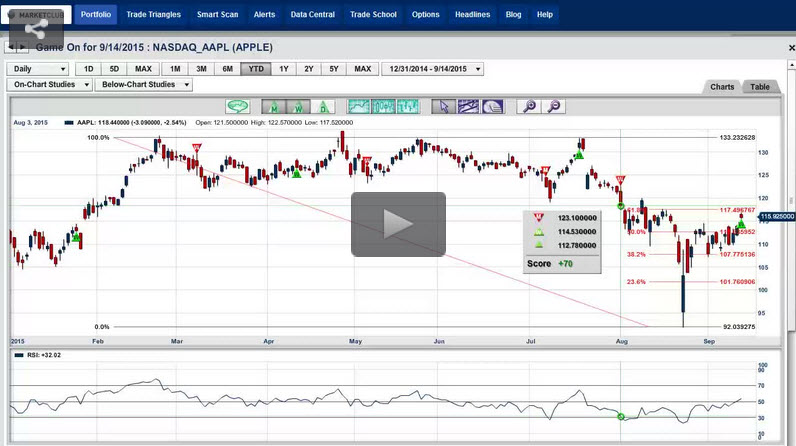
For the past nine weeks, the Dow and S&P have been repeating a pattern that if repeated this week, will spell trouble for the markets. The market has been going up and down in a somewhat regular fashion. If you look at a weekly chart of the Dow and S&P, you can see that they have not had two consecutive weeks closing in the same direction, either on the downside or the upside.

Last week we saw the indices close higher for the week and if the pattern repeats, this should be a down week with a lower weekly close.

Here are the key levels to watch today. Should these levels be broken, I would expect the markets to accelerate to the downside. Continue reading "If This Same Pattern Repeats, Watch Out!"

Navigating Volatile Markets Via Coupling Dividends And Share Buybacks - Part 3

Noah Kiedrowski - INO.com Contributor - Biotech


Introduction

The broader indices have been highly volatile recently due to weakness in China, an imminent Federal Reserve rate hike and persistently low oil prices. Navigating these volatile markets can be difficult. I posit that via investing in high-quality companies that offer the combination of high-quality dividends along with share buybacks may position an investor to contend with this volatility while potentially being rewarded handsomely during bull markets. On the front half of this dual synergy is the dividend space. This space offers many quality attributes such as decreased volatility, healthy yields, moderate risk exposure and a hedge against downside risk thus may be an ideal synergy for any long portfolio. Historically, companies that have an established track record of not only paying dividends but growing their dividends over the long-term have generally outperformed their respective index with decreased volatility. On the back half of this synergy is share buybacks. Share buybacks can serve as an effective way to drive shareholder value via returning capital to shareholders by repurchasing its own stock.

At times, I'll be using both The Vanguard High Dividend Yield ETF (VYM) and The PowerShares Buyback Achievers ETF (PKW) as proxies for this analysis. I will also select specific high-quality companies to exemplify these attributes. The combination of VYM and PKW may present an ideal investing strategy in which to invest and potentially capitalize on a cohort of companies that engage in both dividends and aggressive share buyback programs, particularly in these volatile markets. This article caps off a three-part series focusing on navigating volatile markets while focusing on high-quality companies that pay out dividends and engage in aggressive share buybacks. This series is primarily focused on these attributes utilizing ETFs as proxies to exemplify the mitigation of downside risk while being well positioned in bull markets. Continue reading "Navigating Volatile Markets Via Coupling Dividends And Share Buybacks - Part 3"

Amid Stock Market Turmoil, Investors Cling to Hope. Why?

By: Elliott Wave International

I was watching financial television as the Dow Industrials fell 400-plus points on Sept. 1.

Two market professionals were interviewed: Both said the big decline in recent weeks represented a buying opportunity.

Optimism is so entrenched that even the worst month (August) for the Dow in five years didn't faze them.

Other market observers have also shrugged off the volatility. Here are just a few headlines:

  • 10 oversold stocks ready to pop (CNBC, August 26)
  • Why I'm throwing money at the stock market (Marketwatch, August 26)
  • Why this bull market is not dead (CNBC, August 25)
  • Buy the Dip Becomes Buy the Correction ... (Bloomberg, August 25)
  • Is Stock Market's 'Black Monday' Time to Buy? Some Analysts Think So (NBC News, August 25)
  • Relax, we're about to hit the bottom in stocks (CNBC, August 21)

This is an amazing display of optimism. Yet there is an explanation for this persistent hope in higher stock prices, namely: Continue reading "Amid Stock Market Turmoil, Investors Cling to Hope. Why?"

Weekly Futures Recap With Mike Seery

We've asked Michael Seery of SEERYFUTURES.COM to give our INO readers a weekly recap of the Futures market. He has been Senior Analyst for close to 15 years and has extensive knowledge of all of the commodity and option markets.

Michael frequently appears on multiple business networks including Bloomberg news, Fox Business, CNBC Worldwide, CNN Business, and Bloomberg TV. He is also a guest on First Business, which is a national and internationally syndicated business show.

Gold Futures

Gold futures in the December contract settled last Friday in New York at 1,121 an ounce while currently trading at 1,106 down about $15 this week trading below its 20 and 100 day moving average near a 3 week low as I’m currently sitting on the sidelines as this market remains choppy with poor chart structure. I still see no reason to own gold currently as the risk/reward is not your favor so look at other markets that are starting to trend such as the silver market which I am currently recommending a short position because the chart structure is outstanding. Gold prices had a significant rally in the month of August bottoming out around 1,080 then rallying to 1,170 which was impressive in my opinion due to short covering and a flight to quality as the stock market has experienced volatility in recent weeks sending money out of stocks and into gold as a safe haven but things have settled down putting short-term pressure on gold. Continue reading "Weekly Futures Recap With Mike Seery"

Has China Lost Control?

Lior Alkalay - INO.com Contributor - Forex


This morning's newswires are filled with stories of yet another dramatic intervention by China in the Yuan exchange rate. This time, though, it's in favor of the Yuan. That news, more than any, has investors alarmed as it seems to suggest that China has lost control. To that, I say how can you lose something you never had?

China Never Had Full Control

China and its financial authorities, namely the Peoples Bank of China, are viewed as the effective forces controlling the Chinese money market. That means not just the currency but also the financial markets and inflation. Hence, the state of alarm currently dominating markets makes sense. But the fact is that China never really had the control that investors believed it had. Because simultaneously controlling monetary policy and the currency is like "trying to hold the stick at both ends;" it's just not possible. Continue reading "Has China Lost Control?"