Weekly Futures Recap With Mike Seery

Silver Futures

Silver futures in the September contract settled last Friday in New York at 16.19 an ounce while currently trading at 16.42 up about $0.23 for the trading week continuing it's bullish momentum as prices are right near a 1 year high.

Fundamentally speaking the European Union looks to lower interest rates even more as that is a positive fundamental factor towards the precious metals coupled with the fact that the Federal Reserve is probably going to lower interest rates by 25 basis points next week as this market still looks to crack the 17 level.

I have been recommending a bullish position from around the 14.93 level & if you took that trade continue to place the stop loss which now stands at 15.34 which is the 2 week low, however, the chart structure will improve daily next week therefor the monetary risk will be reduced significantly.

I also have bullish recommendations in platinum and copper as I think the precious metals across the board is headed higher so stay long and continue to place the proper stop loss as I still believe there is significant room to run to the upside.

TREND: HIGHER
CHART STRUCTURE: IMPROVING
VOLATILITY: HIGH

Palladium Futures

Palladium futures in the September contract is currently trading at 1,537 after settling last Friday at 1,508 up nearly $30 for the trading week as I had been recommending a bullish position from around the 1,388 level getting stopped out around the 1,525 level last week, however I'm looking at the possible bullish position soon. Continue reading "Weekly Futures Recap With Mike Seery"
IBM Nearing 52-Week Highs

Big Blue – International Business Machines (IBM) – just delivered a duo of impressive back-to-back quarters with Wall Street applauding the results. This pair of consecutive quarters has elevated the stock and is now testing its 52-week high. These results solidify IBM’s long turn back to growth after posting revenue declines for 20-plus consecutive quarters. IBM has accomplished this nascent pivot back to growth via focusing on high-value faster-growing business segments while embracing the future of technology with AI and hybrid cloud architecture (i.e., Red Hat acquisition). Investors are ostensibly being appeased with the blended approach of M&A, realigning it business mix to current and future trends, maintaining its dividend payout and continuing to buy back shares until the Red Hat acquisition closes. IBM’s stock has been on an upward trend after investors decided to move past its initial displeasure of announcing its Red Hat acquisition when shares were sold-off and traded down to ~$108. IBM's executive leadership has set the growth and value narrative, and investors are quickly realizing the value that Red Hat brings to the table while washing away fears that IBM overpaid for the $34 billion acquisition. From the $108 dip, IBM has been in a position of strength and has broken out past the $150 level after its recent Q2 2019 earnings. Long-term imperatives are beginning to bear fruit in emerging high-value segments that has fundamentally changed its business mix while evolving its offerings to align with new age information technology demands. The Red Hat acquisition will augment its transition away from its dependence on legacy businesses to the future of hybrid cloud, artificial intelligence, and analytics. IBM presents a compelling long-term opportunity with a 4.3% dividend yield, P/E ratio of ~11, share buyback program, and continuously acquiring companies to drive the business into the future.

Q1 2019 + Q2 2019 Earnings – Growth Narrative

IBM reported Q2 earnings, and investors applauded the results by lifting the stock immediately post-earnings. IBM reported EPS of $2.81 and revenue of $19.61 billion, which was a -4.2% year-over-year decline while missing analysts’ targets. IBM shares quickly rose near its 52-week, breaking out to $150 per share. The company laid out its growth narrative and Red Hat acquisition catalysts. Continue reading "IBM Nearing 52-Week Highs"

One Lump Or Two?

With the financial markets already primed for a 25-basis-point cut at next week’s Federal Reserve monetary policy meeting, the talk has now shifted to the possibility that the Fed may go even further and reduce its benchmark federal funds rate by 50 basis points instead.

That speculation was fueled by New York Fed President John Williams, who exhorted an audience of the Central Bank Research Association in New York last week to “take swift action when faced with adverse economic conditions” and “keep interest rates lower for longer” when reducing rates.

“Don’t keep your powder dry—that is, move more quickly to add monetary stimulus than you otherwise might,” he added, which may have left some listeners wondering what year this was – 2008, when the Great Recession was just beginning, or 2019 when the economy is still growing. Either way, listeners on Wall Street were happy to hear it and immediately pushed stock prices higher.

The New York Fed subsequently walked back Williams’s comments, saying that he didn’t mean to suggest that the Fed was about to double-down on a rate increase next week, downplaying his comments as an “academic speech” and “not about potential policy actions at the upcoming FOMC meeting.”

But Fed Vice Chairman Richard Clarida swiftly echoed Williams’ comments, telling the Fox Business Network, “You don’t wait until the data turns decisively if you can afford to. If you need to [cut rates], you don’t need to wait until things get so bad to have a dramatic series of rate cuts.”

The only difference is that Williams described the economy as “pretty strong” – begging the question why the Fed feels it needs to lower rates at all, whether by 25 or 50 basis points – while Clarida implied that the economy is ready to hurtle over the cliff unless the Fed rides to the rescue.

Along comes Boston Fed president Eric Rosengren with a different take. Continue reading "One Lump Or Two?"

OPEC's Unplanned Outages Supported Oil Prices

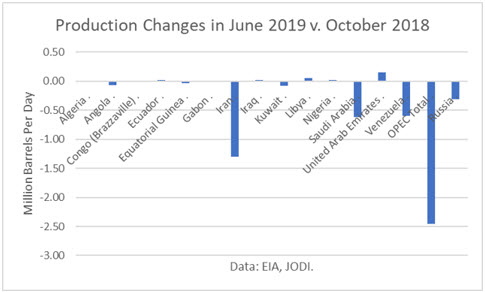
In early July, OPEC+ rolled-over its December 2018 agreement for another nine months ending March 2020. To get an idea of compliance with that agreement to-date, I compared changes in production from October 2018 (the base period) and June 2019, except for Russia, May 2019 due to a lack of data for June.

I found that OPEC delivered a cut of 2.46 million barrels per day, of 8%. That is more than three times its pledge of 800,000 b/d. The primary reason for such a large cut was sanctions on Iran and Venezuela.

Iran reduced its reported output by 1.3 million barrels per day or 38%. Venezuela reduced its output by 600,000 b/d, or 46%. It’s important to understand that both of those cuts were involuntary.

The largest voluntary cut was by Saudi Arabia, 620,000 b/d, or 8%. Saudi Aramco (ARMCO) lifted its production by 200,000 b/d in June from May to 10.1 million barrels per day.

OPEC

Note: Russia’s change is until May 2019. Continue reading "OPEC's Unplanned Outages Supported Oil Prices"

Libra - Facebook's Cryptocurrency Implications

Facebook Inc. (FB) is making a bold move that stands to have vast implications across its business model and its user base via launching its cryptocurrency called Libra. Cryptocurrencies are still in a nascent stage in terms of adoption, acceptance, application, and full understanding of these virtual coins. The cryptocurrency market thus far has been speculative, volatile, and met with skepticism from users and governments alike. Despite the tumultuous albeit short history of cryptocurrencies, these alternative forms of currency have vast implications. These implications include potential disruption of central banks, destabilizing government-backed currencies, reshaping the financial transactions space (i.e., banks and credit cards) while displacing central database infrastructures via blockchain (i.e., banks, clearinghouses, credit card networks). Facebook’s Libra stands to address the unbanked (those without traditional bank accounts) segment of its user base in a major way. The President and Jerome Powell, along with many others in government have either voiced concerns or publically made clear that they’re not embracing this move by Facebook. Government officials are concerned about appropriate regulatory framework being in place considering the company’s past privacy scandals. Nonetheless, will this cryptocurrency bode well for Facebook moving forward?

What is Libra?

Libra will be dissimilar from Bitcoin in its underpinning blockchain technology and mining. Libra will not run on a decentralized disturbed blockchain ledger, and no mining of any additional coins will occur. The blockchain is permissioned and will be managed by the Libra Association, which is a membership organization that consists of 27 payment, technology, telecommunication, online marketplace, venture capital, and non-profits. Libra is planned to be launched sometime next year 2020. Libra will allegedly be backed by financial assets such as a basket of currencies and US Treasuries to circumvent volatility. Unlike Bitcoin, which isn’t backed by anything and can highly volatile, Libra’s value should be anchored and less variable. Each member of the Libra Association will add $10 million, so the cryptocurrency has full asset backing. The supply of Libra will expand and contract based on demand; if demand is high, then the association will purchase more of the underlying assets and create new Libra. If users want to cash out of the cryptocurrency, the association will pay them and destroy the equivalent amount of Libra. Continue reading "Libra - Facebook's Cryptocurrency Implications"