Weekly Futures Recap With Mike Seery

Silver Futures

Silver futures in the September contract is currently trading at 15.22 an ounce after settling last Friday in New York at 15.00 higher by about 22 cents continuing its bullish momentum. Volatility is very low as the rest of the precious metals sector is having tremendous price swings daily as I am shocked that silver hasn't joined the party, but I think it will and if your patient enough I still think higher prices are ahead.

I have been recommending a bullish position from around the 14.93 level, and if you took the trade, I'm going to continue to keep the stop at 14.70 as we need to give this trade some room. Silver prices are trading right at their 20 and 100-day moving average, however for the bullish momentum to continue we have to break the June 21st high of 15.62 as that could happen on any given day, especially if the volatility increases.

I also have bullish recommendations in platinum, palladium, and copper, as demand has come back into this sector as the commodity markets have bottomed out my opinion as most of my recommendations have been to the long side which is the path of least resistance.

TREND: HIGHER - MIXED
CHART STRUCTURE: EXCELLENT
VOLATILITY: LOW

Continue reading "Weekly Futures Recap With Mike Seery"
Financials: The Delicate Balance of Rates and Yield Curve

The financial cohort is in a difficult space as the broader economic backdrop continues to dictate whether these stocks can appreciate higher. A delicate balance between interest rates, Federal Reserve commentary, yield curve inversion, trade war, and concerns over a potential recession in late 2019 or early 2020 must be attained. A disruption in this complex web can lead to the financials breaking down as witnessed in Q4 2018 and in May of 2019. In Q4 2018 rates were increased by the Federal Reserve and sent the financials in a downward tailspin. In May 2019, a trifecta of a yield curve inversion, trade war concerns, and increased chatter about a potential recession on the horizon again sent the cohort lower. The broader market appreciated markedly in June, and the bank stocks participated in the rally. Coupled with renewed record share buybacks and increased dividend payouts stemming from successful stress tests, banks elevated higher on the news. Now, the market is anticipating that the Federal Reserve will cut rates at its next meeting, which may serve as another catalyst to propel some bank stocks to new 52-week highs.

The Q4 2018 Federal Reserve and Jerome Powell

The market-wide sell-off in the fourth quarter of 2018 was largely induced by the Federal Reserve and its alleged commitment to sequential interest rate increases into 2019. This was largely viewed as reckless and misguided while turning a blind eye to broader economic data-driven decision making about further interest rate hikes. The stock indices responded to the sequential interest rate hike stance with overwhelming negative sentiment, logging double-digit declines across the broader markets. Many market observers were questioning the Federal Reserve’s aggressive stance as companies issued weakness in ancillary economic metrics (slowing global growth, strong U.S. dollar, trade war, government shutdown, weak housing numbers, retail weakness, auto sluggishness, and oil decline) as an indication that cracks in the economic cycle were materializing. The strong labor market and record low unemployment served as a basis to rationalize increasing rates to tame inflation; however, these aforementioned economic headwinds appeared to cause the Federal Reserve to pivot in its aggressive stance. As Chairman Jerome Powell began to issue a softer stance on future interest rate hikes, January saw very healthy stock market gains after being decimated for months prior. On January 30th, Jerome Powell issued language that the markets were craving to levitate higher as he left interest rates unchanged and exercised caution and patience as a path forward. Using data-driven decision making as a path forward was cheered by market participants as the broader indices popped for healthy gains on top of the already robust gains throughout January. Continue reading "Financials: The Delicate Balance of Rates and Yield Curve"

Very Long-Term Silver

Just for fun because I am a chart guy who all too often bores you (and me) to death with ratio and indicator charts and all too seldom makes charts just for the fun of it anymore…

So this long-term silver chart is just for the fun of it. What do we have here?

  • A very long-term Cup & Handle; and boy what a handle. It killed the true believers years ago. I like that the 2011 (bubble) right side high is higher than the 1980 (bubble) left side high (monthly closing basis).
  • A price that has held a very long-term support level at 14, coinciding with a 79% Fib retrace (if you believe Fibs are relevant).
  • Vertical cycle lines spaced around 8 years apart that have marked the two bubble highs, a minor high in the late 80s that led to a years-long trough, a whole lot of nothing in the mid-90s and the start of a massive bull market in 2003. The current line would appear to be a marker to a low.
  • Yes, that thing from 2006 to today looks like an ugly Head & Shoulders pattern, so let’s give it its due as well. If I am wrong about an inflationary near future – and the Gold/Silver ratio still stands in defiance of an inflation trade on this day – you’d want to at least be aware of the bear’s potential.
  • Another thing I don’t care for is the decade long trough that sprung the 2003 bull market vs. the much shorter flat period leading to today. Silver has certainly not had that level of desolation to its investment landscape since the most recent bubble popped in 2011.

So okay, there are at least two caution points if you want to take the long-term chart seriously.

That said, nothing’s changed. I am bullish on silver at this time and prepared to get more bullish if/when it takes over for gold. But obviously, that very important support around 14 that silver twice tested in the last year and three times tested in the last 5 needs to hold. Continue reading "Very Long-Term Silver"

Gold Update: Pitfall Or Pit Stop?

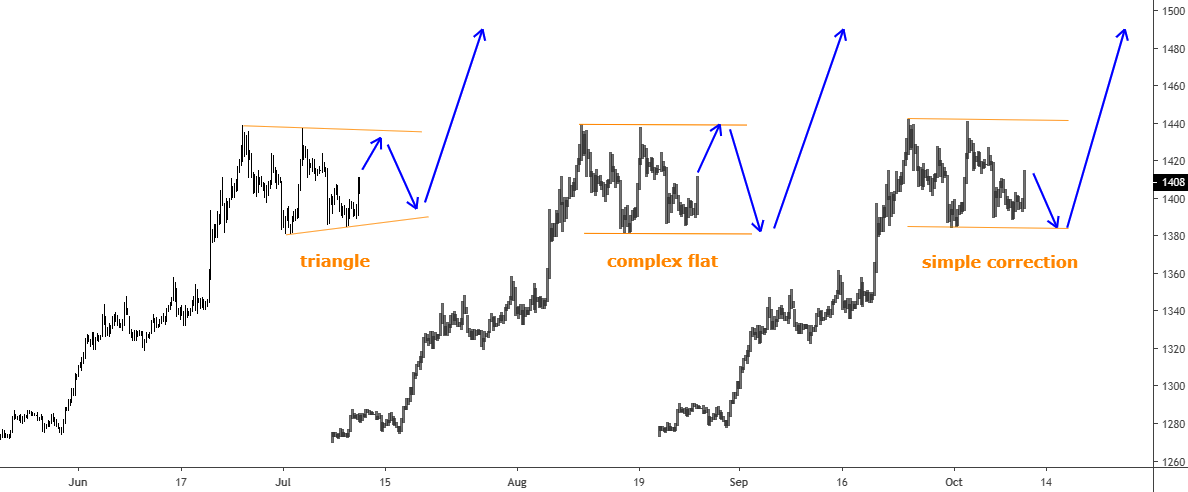
The mighty metal has almost hit the Bull Flag’s target, which was set two months ago. Gold was got close as it reached $1439 on June 25th and only had $6 left to reach that level. Usually, when the impulse of the price gets exhausted without breaking the important level or after it briefly penetrates the latter, then the price quickly retraces in the opposite direction. And that’s what we got with the gold price as the impulse initially looked strong enough to catapult the metal to the $1500 area, but suddenly it failed. Therefore, the price dropped back below $1400 to $1382. Then the buyers actively bought this drop up again to the former top, but they stopped just $1 below it and capitulated there as the price plummeted to $1386 back below $1400. These seesaw moves make traders nervous as it is dangerously volatile with more than $50 setbacks.

The question is if it is a pitfall and we shouldn’t expect any further strength of gold, or it’s just a pit stop to make a pause to accumulate a momentum for another push higher? Let’s look into the chart below to try to figure it out.

I dipped into the 4-hour time frame to show you what happens there.

Gold
Chart courtesy of tradingview.com

First of all, I would like to point out that I believe that we are just in a correction before another push higher, so I choose the pit stop option for the gold. Therefore, my chart will be based on this idea. Continue reading "Gold Update: Pitfall Or Pit Stop?"

Promises, Promises

Pity poor Jerome Powell. He just can’t seem to stay out of his own way.

For the past several weeks the Federal Reserve chair has been promising – ok, maybe not promising, but strongly “indicating” – that it’s only a matter of time that the Fed will cut interest rates. He’s certainly been grooming the financial markets for such a move, and the markets have duly responded, as the major U.S. equity indexes all jumped more than 7% last month while bond yields plunged.

Now comes last Friday’s jobs report that came in much stronger than most people expected and far stronger than the previous month’s totals. The Labor Department said the economy added 224,000 new jobs in June, well above not only the consensus Street forecast of 165,000 but also the most bullish individual estimate of 205,000. It was also far stronger than May’s total of 72,000, which was actually revised downward by 3,000 from the original figure.

Following May’s underwhelming report, most people seemed to believe that the jobs boom had finally played itself out, and it would be all downhill from here, with a recession looming in the not-too-distant future. And then what do you know, the June report comes out and takes everyone by surprise, not least of all Jay Powell himself. Continue reading "Promises, Promises"