Did The Fed Just Send A Message?

In case you missed it, last Friday, the Federal Reserve agreed to let a year-long suspension of capital requirements for big banks that allowed them to exclude Treasury securities and deposits held at the Fed from their supplementary leverage ratio expire at the end of the month.

While the subject of bank capital ratios usually puts some people to sleep, the Fed decision could have very real consequences for the financial markets and the nascent economic rebound at large. It also seems to diverge from the Fed’s own stated and oft-repeated monetary policies.

Then again, the Fed may have just sent a subtle message that its low-rate stance is about to change.

As the New York Times explained, the intention of relaxing the banks’ capital requirements last year at the outset of the pandemic-induced economic lockdown “was to make it easier for financial institutions to absorb government bonds and reserves and still continue lending. Otherwise, banks might have stopped such activities to avoid increasing their assets and hitting the leverage cap, which would mean raising capital. But it also lowered bank capital requirements, which drew criticism.”

At a practical level, Friday’s decision may add further fuel to the fire that is driving up bond yields by discouraging banks from buying Treasury securities, which would seem to run counter to the Fed’s low-interest-rate policy. The Fed, of course, is buying trillions of dollars of Treasury and mortgage-backed securities, which it has stated it has no intention of stopping. Yet, it saw fit to make a move that could have the effect of driving the banks – also big buyers of government securities – out of the market. So why did the Fed do this? Continue reading "Did The Fed Just Send A Message?"
Gold & Silver: Dollar Is Going Down

U.S. dollar index (DXY) 4-hour chart

Dollar Index

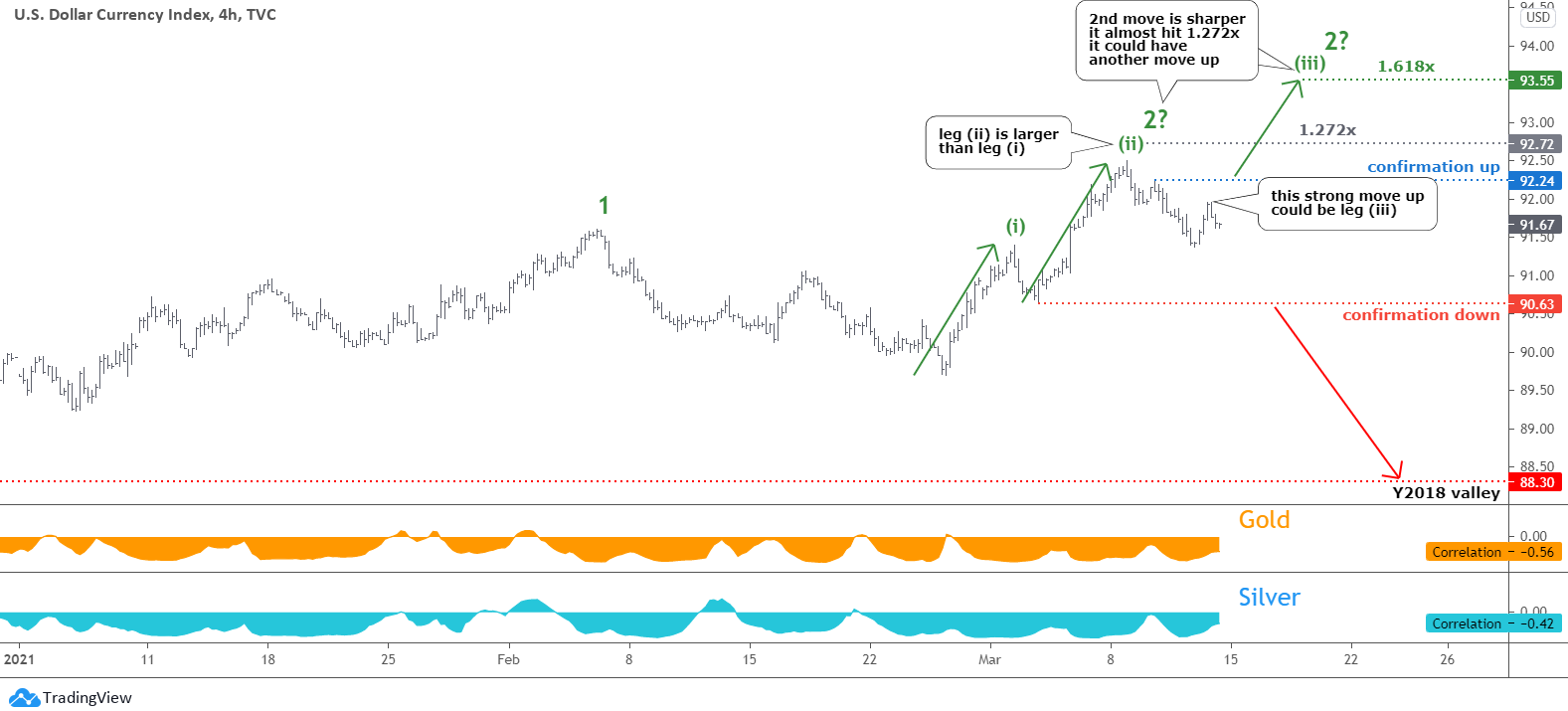
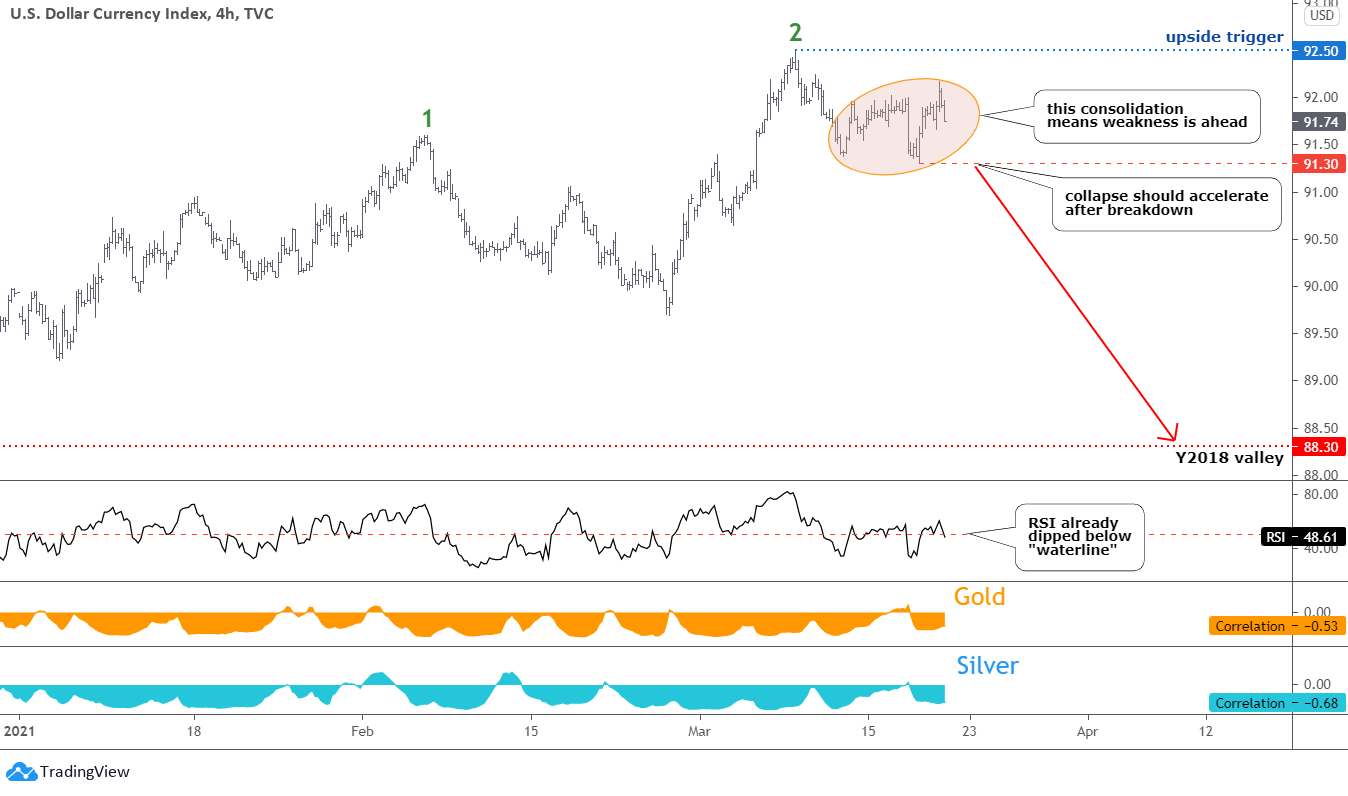
Last time the chart structure of the dollar was less clear; hence I put two opposite scenarios in the chart with triggers.

As time goes by, the market reveals itself more clearly. The DXY price built a familiar two-leg consolidation highlighted with the orange ellipse. It follows the preceding move down from the recent peak of green leg 2. It means further weakness is ahead. I put the trigger on the 91.30 mark (bottom of the minor consolidation) for confirmation. The target remains intact in the area of the Y2018 valley. Continue reading "Gold & Silver: Dollar Is Going Down"

The State Of The Macro

As our Continuum chart predicted over a year ago, Jerome Powell was called to his higher inflationary powers when the macro markets liquidated with great violence and terror. This link shows the Continuum (30yr yield and its monthly EMA 100 limiter) as it was then, begging for inflationary action…

Oh Jerome? Bond market calling…

Below is the Continuum today. Since the linked post from February 2020, a lot has happened and it has been according to the plans we laid out last spring. The plan was inflationary because the Fed was going into steroidal inflation mode. The ‘Fed comfort box’ on the chart has thinned out from the original post because the red dotted limiter (monthly EMA 100) has declined appreciably since then.

These many months the NFTRH target has been 2.5% to 2.7% on the 30yr Treasury yield. This week that zone’s lower bound got dinged. It is coming time for a cool down at least if the macro reflation is going to get a second wind. What could provide that second wind? Continue reading "The State Of The Macro"

Tech Selloff Continues To Pressure Market

The DOW slid 234.33 points or -0.7%, to 32,627.97 on Friday, pressured by Visa and JPMorgan. The S&P 500 dipped -0.1% to 3,913.10, closing off its lowest level of the day when it fell 0.7%. The NASDAQ gained +0.8% to 13,215.24 as investors bought the dip in tech shares which had been putting pressure on the market after continuing to selloff earlier in the week. Facebook gained +4%, while Amazon and Netflix rose about +1.5% each.

On a weekly level, The DOW and the S&P 500 lost -0.5% and -0.8%, respectively, this week, breaking their two-week win streak. The NASDAQ also declined -0.8% for the week, posting its fourth negative week in the last five. Continue reading "Tech Selloff Continues To Pressure Market"

How To Achieve A 98% Options Win Rate

Achieving an options win rate of 98% requires following a core set of 10 basic rules supplemented by some general guidance. Following these rules while deploying an array of option types (i.e., put spreads, call spreads, iron condors, and diagonal call/put spreads) across a diverse large-cap ticker list is the foundation of this success. Staggering expiration dates, managing winning trades, keeping trade allocation in balance with overall portfolio size, and trading in tickers that are liquid in the options market are other critical components to this success. Sticking to high probability outcomes via leveraging delta as a proxy, layering in some basic technical analysis, and maintaining appropriate portfolio structure is essential while ideally maintaining a 50% cash in addition to a hybrid long equity/options approach.

Options Trading Framework - 10 Essential Rules

A set of trading fundamentals must be followed to run an options-based portfolio over the long-term successfully. Specifically, position-sizing, sector diversity, maximizing the number of trade occurrences, and risk-defined strategies are some notable areas that traders need to heed for long-term successful options trading.

The following option trading fundamentals must be exercised in every trade. Violating any of these fundamental rules will jeopardize this strategy and possibly negate this approach's effectiveness on the whole. Below are 10 option trading rules that provide a basic framework of options trading to maintain discipline and systematic trading mechanics (Figure 1). Continue reading "How To Achieve A 98% Options Win Rate"