Silver Futures Experience Volatile Week

Silver Futures

Silver futures in the September contract experienced one of the craziest trading weeks of all time as the volatility is extraordinarily high as prices traded as high as 29.91 before selling off to 23.58 having over a $6 trading range for the week as this commodity is not for the light-hearted.

I have been recommending a bullish position over the last month or so from the 18.61 level, and if you took that trade, continue to place the stop loss under the 2 week low standing at 23.58 as an exit strategy. However, the chart structure will not improve for another 8 trading sessions, so you will have to accept the monetary risk at this time. If you are not involved in this market, I would avoid it like the plague as the risk/reward is not in your favor, as I still think higher prices are ahead. Still, there is a high probability that we could consolidate the recent run-up in price over the next couple of weeks.

At the same time, I also have a bullish platinum trade, which continues to move higher weekly as the U.S. dollar is at a 2 year low. That is a fundamental bullish factor coupled with the fact that the Coronavirus situation doesn't seem to end anytime soon, so stay long.

TREND: HIGHER
CHART STRUCTURE: IMPROVING
VOLATILITY: HIGH

Platinum Futures

Platinum futures in the October contract settled last Friday at 970 an ounce while currently trading at 974 in a crazy volatile trading week as prices cracked the 1,000 level once again before profit-taking came about.

I have been recommending a bullish position over the last month or so from around the 868 level. If you took the trade, continue to place the stop loss on a closing basis only at 930 as an exit strategy. However, the chart structure will not improve for quite some time, so you will have to accept the monetary risk. Platinum prices are still Continue reading "Silver Futures Experience Volatile Week"
Options Trading - S&P Outperformance Despite Epic Bull Run

A total of 80 options trades were placed in May, June, July, and thus far in August as the markets rebounded after the COVID-19 lows. During this timeframe, all 80 trades were winning trades to lock in a 100% option win rate with an average income per trade of $189 and an average return on investment (ROI) per trade of 7.5%. After the tumultuous market lows of March and into early April, leveraging a minimal amount of capital, mitigating risk, and maximizing returns was essential. An options-based portfolio can offer the optimal balance between risk and reward while providing a margin of downside protection with high probability win rates. As the market continues to rebound, optimal risk management is essential when engaging in options trading as a means to drive portfolio performance.

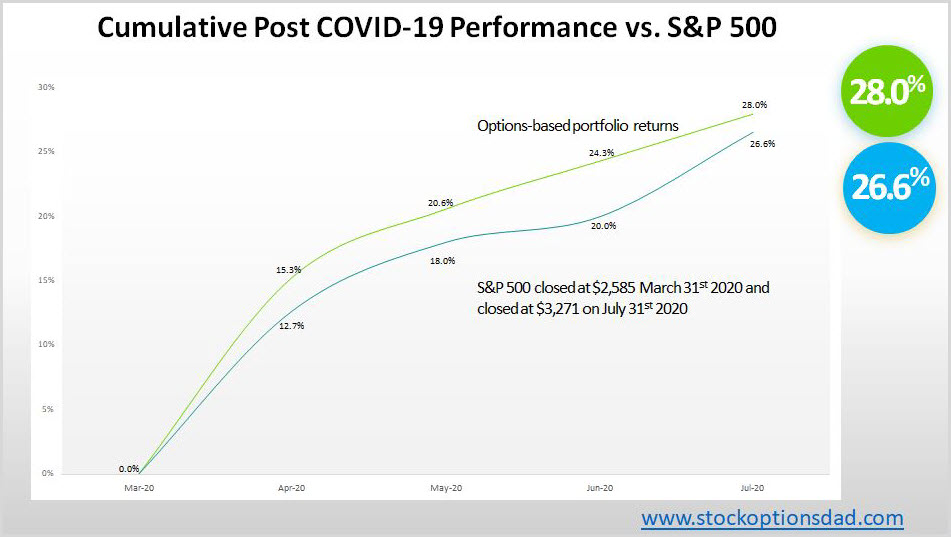
Through the end of July, an option-based portfolio broken out into roughly three equal parts of cash, long equity and options outperformed the S&P 500 by a comfortable margin, posting returns of 28.0% and 26.6%, respectively. When engaging in options trading, risk mitigation needs to be built into each trade via risk-defining trades, staggering options expiration dates, trading across a wide array of uncorrelated tickers, maximizing the number of trades, appropriate position allocation, and selling options to collect premium income. Maintaining disciple via continuing to risk-define trades, leveraging small amounts of capital while maximizing return on investment, is essential despite the impressive streak of 80 consecutive winning trades.

Anchoring Down An Options-Based Portfolio

Anchoring down an options-based portfolio is a key component to taking advantage of black swan events such as COVID-19 via broad-based ETF exposure. During the market lows of March/April, the cash-on-hand component of an options-based portfolio was used to go long equity via Dow Jones (DIA), S&P 500 (SPY), and Nasdaq (QQQ). The cash-on-hand was repurposed to balance out the portfolio into roughly three equal parts of one-third cash, one-third long ETF-based equity, and one-third options driven. Through the end of July, an option-based portfolio broken out into roughly three equal parts of cash, long equity and options outperformed the S&P 500 by a comfortable margin, posting returns of 28.0% and 26.6%, respectively (Figure 1).

Options

Figure 1 – Overall options-based portfolio returns compared to the S&P 500 returns over the previous four months post COVID-19 lows of 28.0% and 26.6%, respectively

4 Months Post COVID-19 Results

After placing 80 trades throughout May, June, July, and thus far in August, a 100% options win rate, 99% premium capture, and 7.5% ROI per trade was achieved. This was accomplished via leveraging a minimal amount of Continue reading "Options Trading - S&P Outperformance Despite Epic Bull Run"

World Oil Supply And Price Outlook, August 2020

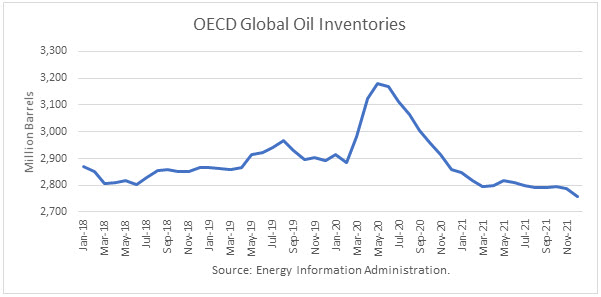
The Energy Information Administration released its Short-Term Energy Outlook for August, and it shows that OECD oil inventories likely bottomed in this cycle in June 2018 at 2.804 billion barrels. It estimated stocks dropped by 58 million barrels in July to end at 3.113 billion, 172 million barrels higher than a year ago. It estimates that inventories peaked in May 2020 at 3.181 billion.

The EIA estimated global oil production at 88.72 million barrels per day (mmbd) for July, compared to global oil consumption of 93.42 mmbd. That implies an undersupply of 4.69 mmbd or 146 million barrels for the month. About 88 million barrels of the draw for July is attributable to non-OECD stocks.

For 2020, OECD inventories are now projected to draw by a net 34 million barrels to 2.859 billion. For 2021 it forecasts that stocks will draw by 102 million barrels to end the year at 2.757 billion.

Oil

The EIA forecast was made to incorporate the OPEC+ decision to cut production and exports. According to OPEC’s press release: Continue reading "World Oil Supply And Price Outlook, August 2020"

Gold ETFs Setting New Highs

During the final days of July, Gold hit new all-time highs just below $2,000. The record run higher for the precious yellow metal, and for most of the precious metals, it has been in large part caused by the worldwide pandemic. As investors become nervous about the future, many find safe harbor in gold and other hard asset metals.

The bull market will likely continue as long as the pandemic and world economies struggle to gain traction. But, if we see a vaccine that really protects against Covid-19, the price of gold will likely begin to fall as investors move back away from safe investments and back into equities, bonds, and other higher-risk – higher growth investments. When the rally ends, well, that’s, of course, the trillion-dollar question and one that I can’t help with. However, I can point you in the right direction of what to invest in regardless of which way you think the price of gold is headed.

The big dog in the gold Exchange Traded Fund world is the SPDR Gold Trust (GLD). GLD has over $77 billion in assets under management and has been in existence since 2004. The fund charges a 0.4% expense ratio and has an average daily dollar amount volume of just over $1.76 billion, meaning it typically has liquidity. GLD tracks the spot price using gold bars held in vaults in London. This is an excellent option for anyone who wants the protection of gold but doesn’t want the hassle of buying actual gold bars. Continue reading "Gold ETFs Setting New Highs"

Let's Move Forward, Not Back

Since the beginning of the coronavirus crisis, the Federal Reserve has probably done more to try to ease the financial pain of businesses, consumers, and institutions than just about any other organization on earth with their monetary policy. It’s lowered interest rates, purchased trillions of dollars of assets – some of which, like corporate bonds, it’s never bought before – eased bank capital requirements, and increased existing or created new lending programs to help Americans weather the storm and get back on their feet.

Now the president of the Minneapolis Fed and a current voting member of the Fed’s monetary policy committee is calling on people to suffer a few more weeks in quarantine in order to get the virus under control and the economy back on an upward trajectory – as if it weren’t on that already.

“If we were to lock down really hard, I know I hate to even suggest it. People will be frustrated by it,” Neel Kashkari told CBS’s Face the Nation program. “But if we were to lock down hard for a month or six weeks, we could get the case count down so that our testing and our contact tracing was actually enough to control it the way that it's happening in the Northeast right now. That’s the only way we’re really going to have a real robust economic recovery.”

“Now, if we don't do that and we just have this raging virus spreading throughout the country with flare-ups and local lockdowns for the next year or two, which is entirely possible, we're going to see many, many more business bankruptcies, small businesses, big businesses, and that's going to take a lot of time to recover from to rebuild those businesses and then to bring workers back in and re-engage them in the workforce. That's going to be a much slower recovery for all of us.”

If we take his advice and do another “hard lockdown” for six weeks or a month, how many more businesses will fail, and how many more people will be laid off or lose their jobs permanently in the meantime? Continue reading "Let's Move Forward, Not Back"