Stocks Have Worst Week Since Financial Crisis

Trading on Friday opened much like it had the rest of the week, down. And that was really no surprise as fears over the coronavirus, and its impact on the economy continue to scare investors. As we head into the close on Friday, stocks will have their worst week since the 2008 financial crisis.

The DOW was down more than 600 points after plunging 1,000 points in morning trading and down -2% on the day. The S&P 500 fell -1.5%, while the NASDAQ fell -0.7% after sinking more than -3% earlier.

So what does the worst week since the financial crisis look like? Continue reading "Stocks Have Worst Week Since Financial Crisis"

Are Bonds Still Relevant?

Do bonds have a place anymore in your portfolio in the new Federal Reserve paradigm?

The Fed has a long history of creating asset bubbles, then later – sometimes years later – letting the air out of the balloon through monetary policy or regulatory change, leaving investors licking their wounds.

The most recent and most dramatic bubble inflation and subsequent deflation, of course, occurred in the first decade of this millennium. Through a policy of low-interest rates, the Fed largely encouraged American consumers to borrow heavily against their homes, while its laissez-faire regulation of the banks it’s supposed to monitor allowed these same consumers to borrow whether or not they had the wherewithal to pay the loans back.

We all know what happened when the Fed suddenly reversed course and raised interest rates and, perhaps more importantly, required banks to make their customers actually prove that they were good credit risks (imagine that?). We’re still feeling the fallout more than 10 years later, as millions of people defaulted on their loans because they couldn’t borrow any more money.

Now we have a similar story, only with stocks and bonds, but the Fed has taken a different attitude. It’s showing no inclination to prick the bubble it has created in financial assets through historically low-interest rates for a historically long period of time and through quantitative easing, i.e., attempting to corner the market on U.S. Treasury and mortgage-backed securities basically.

Yields on long-term government securities are now at their all-time lows, mortgage rates are at or near their all-time lows, while stocks are near their all-time highs even after this week’s coronavirus-inspired panic selloff. Yet the Fed has not responded as it has in the past, by letting some air out of the bubble, Continue reading "Are Bonds Still Relevant?"

$50 Crude Oil Not Likely To Hold

Citi is the latest to revise its estimates of the demand destruction from COVID-19. It said that it now believes inventories of crude oil could grow to 2 million barrels per day in February alone, which would put “even more sustained pressure on prices.” A week ago, the firm’s thought the potential build would be over one million barrels per day for the quarter.

Numerous sources have estimated China’s demand for crude had dropped between two and three million barrels per day since petroleum product consumption had dropped, and the profitability of running refineries had plummeted. But Goldman Sachs (GS) subsequently revised its estimate last week, that they now expect “a cumulative global stock build of 180 million barrels in 1H20, four times its pre-virus forecast.”

The Goldman forecast is based in part on an estimated hit in China’s crude oil demand of 4 million barrels per day. Goldman assumes that OPEC+ will deepen its cuts in 2Q by about 500,000 b/d.

OPEC’s Joint Technical Committee (“JTC”) met from February 4 to 6th and recommended “a further adjustment in production until the end of the second quarter of 2020” and “extending the current production adjustments until the end of 2020.” The cut would be an additional 600,000 b/d on top of the cuts announced in December.

But Russian Energy Minister Alexander Novak told reporters: Continue reading "$50 Crude Oil Not Likely To Hold"

Has The Equities Waterfall Event Started?

Or is this a buying opportunity? Over the past 5+ days, a very clear change in market direction has taken place in the US and global markets. Prior to this, the US markets were reacting to Q4 earnings data and minimizing the potential global pandemic of the Coronavirus. The continued “rally to the peak” process was taking place and was very impressive from a purely euphoric trader standpoint. Our researchers found it amazing that the markets and the Dow Jones Industrial Index continued to rally many weeks after the news of economic contraction and quarantines setup in China/Asia.

Make sure to opt-in to our free-market trend signals newsletter before you continue reading this or you may miss our next special report!

We believe a number of critical factors may have pushed global investors away from their comfortable, happy, bullish attitude over the past 5+ days – most importantly the reality that the virus pandemic was very real and would continue to result in a more severe global economic contraction process and the outcome of the Caucus voting where Bernie Sanders appears to be leading almost every early voting event. There are now two major concerns hanging over the global markets and the future of the US 2020 Presidential elections. These two major issues may be enough to change investor sentiment and present a very real volatility event.

Uncertainty breeds fear and can cause traders to move away from risk. We discussed these topics in research posts many months ago. Continue reading "Has The Equities Waterfall Event Started?"

Gold Hits Target And Seven Year High

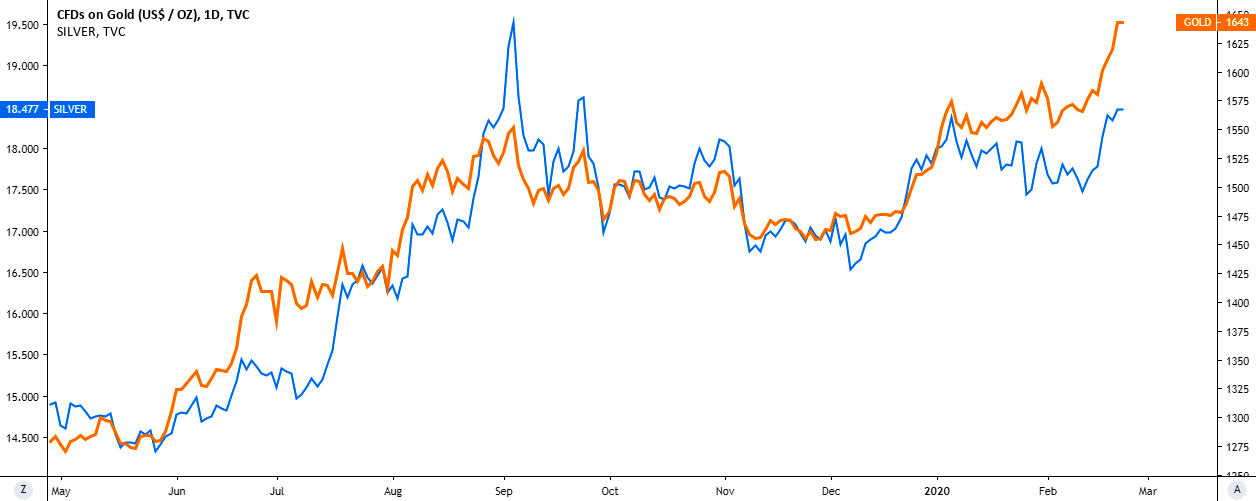
Before we start analyzing gold, let’s see how two precious metals behave in comparison on the chart below.

Gold
Chart courtesy of tradingview.com Gold (orange, right scale), Silver (blue, left scale)

This chart above starts from the bottom area of 2019. The most of the time, the yellow metal leads the game as Silver follows suit showing sharp moves to catch up with the gold. Sometimes the laggard throws over the leading trend amid excessive market reaction to the big moves of the top metal. Such extremes are rare and quickly get normalized by market “whales.” From this perspective, there is nothing new we can find on the chart. Continue reading "Gold Hits Target And Seven Year High"