Coronavirus Sickens The US Market

Hello traders everywhere. The stock market gave back early Friday morning gains after the second U.S. case of the deadly coronavirus was confirmed. The Centers for Disease Control and Prevention (CDC) said a Chicago resident who traveled to Wuhan, the Chinese city where the coronavirus originated, in December was diagnosed with the sickness. So far, the outbreak in China killed 26 people and infected more than 900 in the past week, raising concerns about its fallout on the global economy.

That report pushed the DOW was down over -175 points, the S&P 500 slid -08% and the NASDAQ fell -.75% on the day. Overall for the week, the DOW is on pace to lose -.8%, it's the first weekly loss in two weeks. The S&P 500 will also post its first loss in two weeks, with a loss of -.5%. However, the bigger shock to the system is that the NASDAQ will post a weekly loss of -.1% its first weekly loss in over six weeks.

Crude oil continues to under heavy pressure from rising inventories and weakening demand. Crude will post it's third straight week of losses with a loss of -7.9% trading below $54 a barrel. The EIA itself earlier this week said it expected crude oil production in the shale patch to continue increasing, adding 22,000 bpd next month to reach a total of 9.2 million bpd. The increase will come from the Permian and the Bakken, which will together add 50,000 bpd to their daily average, more than offsetting declines across the rest of the shale patch. Continue reading "Coronavirus Sickens The US Market"
Crude Oil To Chemicals Transition And Aramco's Plans

Crude oil and Petrochemicals are the building blocks that are essential to making the goods that make modern life possible — from paints to plastics, space suits to solar panels, medicines to mobile phones. All of these things start with just six basic petrochemicals — ethylene, propylene, butylenes, benzene, toluene, xylenes — that are combined with other chemicals and transformed into other materials that make products better.

Petrochemicals do things like:

  • Make your phone water-resistant
  • Keep food fresher longer
  • Make your carpets stain resistant
  • Help tires repair themselves
  • Keep first-responders safe with fire-retardant clothing
  • Extend lives with cutting-edge medical technologies

Source: American Fuel & Petrochemical Manufacturers (AFPM)

According to a recent study, "Wells, Wires and Wheels… EROCI and the Tough Road Ahead for Oil," published by BNP Paribas Asset Management, the author, Mark Lewis, writes: Continue reading "Crude Oil To Chemicals Transition And Aramco's Plans"

QE or Not QE: The Consequences Are The Same

It may look, swim and quack like one, but Federal Reserve Chair Jerome Powell insists that the Fed’s recent reinflation of its balance sheet past the $4 trillion mark isn’t quantitative easing. Oh no, he says, just because the Fed’s portfolio recently rebounded to $4.175 trillion at the middle of January, up from a six-year low of $3.76 trillion since the beginning of September, doesn’t mean that the Fed is back to its old QE ways, which had pushed the Fed’s balance sheet to a steady $4.5 trillion between 2014 and 2018 when it started to shrink.

But QE by any other name is still QE.

At least one voting member of the Fed’s monetary policy committee has expressed some concern about the recent boost in the Fed’s balance sheet – more than $400 billion in just the past four months.

“The Fed balance sheet is not free and growing the balance sheet has costs,” Robert Kaplan, the president of the Dallas Fed, told reporters at a recent Economic Club of New York event, according to the Wall Street Journal. “Many market participants believe that growth in the Fed balance sheet is supportive of higher valuations and risk assets. [That’s Fed-speak for a bubble]. I’m sympathetic to that concern.”

For the past 12 years, ever since the financial crisis in 2008, the Fed has swollen the size of its balance sheet – its holdings of U.S. Treasury and government-insured mortgage-backed securities – from less than $1 trillion to more than four times that. Its first burst of bond-buying took place in 2008, during the depths of the meltdown when its portfolio more than doubled in less than a year. It then gradually increased to more than $3 trillion over the next five years, at which time QE took it to $4.5 trillion, where it held steady until 2018, when the Fed started to allow its holdings to run off as they matured, until its recent policy U-turn.

And what was the direct result of all that buying? Continue reading "QE or Not QE: The Consequences Are The Same"

Gold Hits Second Target

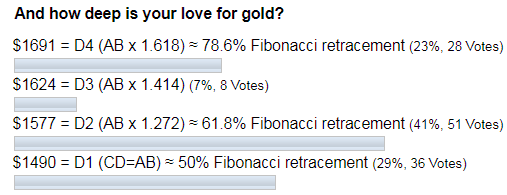
On the 6th of January, gold had hit the second target of $1577 that I showed you last June when we measured the depth of gold bugs love. I will update the big chart for you below to show why this second target is crucial. By the way, this target was the most favored then as you can see in the graph of ballots below.

gold poll

It’s a real miracle that we witnessed the Santa Claus Rally again this year. I updated the short-term chart for gold right ahead of Christmas as I thought the correction would extend itself to delay the rally for a later period. The invalidation point for the bearish scenario was set at $1516 as the price moved almost $100 above that point for someone’s benefit.

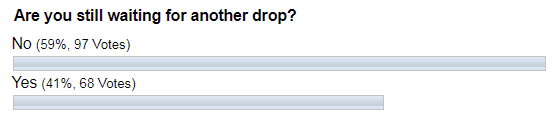
gold poll

Most of you voted for the immediate rally as you didn’t expect another drop, and you were amazingly right, again!

I think it’s time to check big charts to adjust our short-term navigation plans. Continue reading "Gold Hits Second Target"

What An Expiring Bubble Looks Like

The Nasdaq bubble popped in 2000 after motoring upward on increasing volume in two separate phases. Volume rammed upward and RSI diverged. Like shootin’ fish in a barrel, it was, except that at the time I was too inexperienced to see it. It was a steep slope and blow out.

compq bubble

The 2006 bubble in copper made a consolidation and a steep slope and blow out of its own with a little help from rising volume, but nothing like the above. No notable divergences here. The inflation trade of the time was starting to rotate, and rotate commodity herds did… Continue reading "What An Expiring Bubble Looks Like"