Happy Halloween

The last week of October is likely to be an eventful one. Halloween is on Thursday, the last day of the month, and Major League Baseball will crown a new World Series champion. And, oh yes, the Federal Reserve will hold its next-to-last monetary policy meeting this year, at which it is expected to continue on its path of easing monetary policy in the face of not-so-terrible economic news that doesn’t appear to warrant another interest rate cut.

The Fed meeting begins on Tuesday and culminates on Wednesday afternoon at 2:00 EST, with a likely announcement that it is cutting its federal funds rate by 25 basis points for the third time in as many meetings. The Fed hasn’t cut rates this often since the financial crisis when the world economy and financial markets looked like the world was coming to an end. Now we’re looking at the U.S. economy weakening from about a 3% annual growth rate to about 2%, and the Fed is acting like its 2008 again.

Of course, the Fed may not be looking to do another rate cut for economic reasons, but because it has pretty much painted itself into a corner by practically promising the markets that yet another rate cut is coming. What would the market’s reaction be if the Fed decides on Wednesday to leave rates unchanged? No doubt it would be ugly, which is why I’m siding with the consensus market view that the Fed will indeed lower rates this week, whether it’s “data-driven” or not.

Speaking of data, Continue reading "Happy Halloween"

Weekly Futures Recap With Mike Seery

Silver Futures

Silver futures in the December contract is trading higher for the 2nd consecutive trading session ending the week on a positive note up 40 cents at 18.20 an ounce after settling last Friday in New York at 17.57 up about 63 cents for the week hitting a four week high.

Dovish comments Thursday from ECB President Draghi bolstered the outlook for additional ECB stimulus measures, which was positive for the precious metals when he said the incoming data confirm "protracted weakness of the Eurozone economy.

I am recommending a bullish position if prices close above 18.00 while then placing the stop loss under the 10-day low standing at 17.18 as the risk is around $2,050 per 2 mini contracts plus slippage and commission as this market looks to test the contract high at 19.75 in my opinion.

I also have a bullish recommendation in copper as the whole sector looks to move higher. Silver prices are trading above its 20 and 100-day moving average as the trend has turned to the upside, so play this higher while making sure that you risk 2% of your account balance on any given trade.

TREND: HIGHER
CHART STRUCTURE: SOLID
VOLATILITY: HIGH

Continue reading "Weekly Futures Recap With Mike Seery"

Silver & Gold To Inform Dr. Copper

They call copper the metal with the Ph.D. in Economics. But these days Doctor Copper is little more than a quack in that regard, taking a cue from the metals whose interplay will be critical to deciding the coming macro for 2020 and the run-up to the next US election. Thus, they are the 3 Metallic Amigos, riding together but providing different signals at different times (this being nftrh.com, you will have to put up with the odd shtick from time to time).

Silver Gold Copper

As we have noted repeatedly, the Silver/Gold ratio takes it place alongside other indicators (like long-term Treasury yields, yield curve, TIPs ratios, inflation breakevens, etc.) of a would-be inflationary environment. When silver (more cyclical, commodity-like characteristics) rises vs. gold (more counter-cyclical, liquidity haven characteristics) it is a hint toward an inflationary macro.

A daily chart of silver/gold shows a constructive ratio at yesterday’s close and this morning in pre-market silver is +2.77% while gold is +.77%. The implication could well be an end to the current bull flag consolidation at the moving averages and the next upturn in silver/gold, the miners and possibly the inflation/reflation trades that tend to follow. Continue reading "Silver & Gold To Inform Dr. Copper"

S&P 500 Vies For Record Close

Hello traders everywhere. As we head into the Friday close, the S&P 500 is making a run at its intra-day record high of 3,027.98 by trading just shy of it hitting 3,027.39, which happens to be above its record close of 3,025.86 which was set on July 26th of this year. The move higher was bolstered by strong quarterly earnings from Intel along with apparent progress on the U.S.-China trade front.

On a weekly level, the S&P 500 will post a weekly gain of +1.2% while the DOW will check in with a weekly gain of +.8% and not too be outdone the NASDAQ is looking to close out the week with an increase of +1.8%, leading the pack. For the NASDAQ, this will be four straight weeks of gains, while the S&P 500 will have three weeks, and the DOW will have its second winning week out of the last three.

Crude oil spiked this week, gaining +4.7% for week triggering a new green weekly Trade Triangle. The spike is due to news that OPEC will consider instituting even deeper production cuts at its December meeting and a drop in the oil rig count. The US oil and gas rig count fell sharply this week, according to Baker Hughes, with a decline of 25 rigs for the week. This week marks nine decreases out of the last ten weeks. The total oil and gas rig count now stand at 830, or 238 down from this time last year. Continue reading "S&P 500 Vies For Record Close"

Outlook For OPEC's Next Meeting

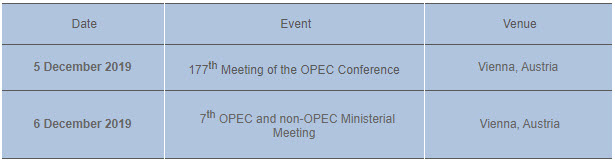
The next OPEC meetings are scheduled for early December. At issue is how they will deal with the outlook for the reduced demand for OPEC oil in 2020.
OPEC
Source: OPEC

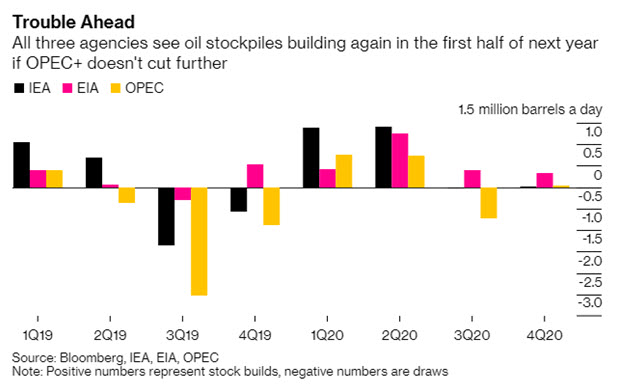
According to Bloomberg:

“The OPEC+ group of oil producers will need to make deeper output cuts when they meet in December. That’s the inescapable conclusion from the latest round of monthly reports published by the three big oil-forecasting agencies.”
OPEC

According to Reuters reporting, “Saudi Arabia, OPEC’s de facto leader, wants to focus first on boosting adherence to the group’s production-reduction pact with Russia and other non-members, an alliance known as OPEC+, before committing to more cuts, the sources said…A second OPEC source said: “Of course deeper cuts are an option, but some things should happen before that. The rest of the OPEC+ countries will not cut deeply if Iraq and Nigeria don’t comply 100%.”

Supply Adjustments

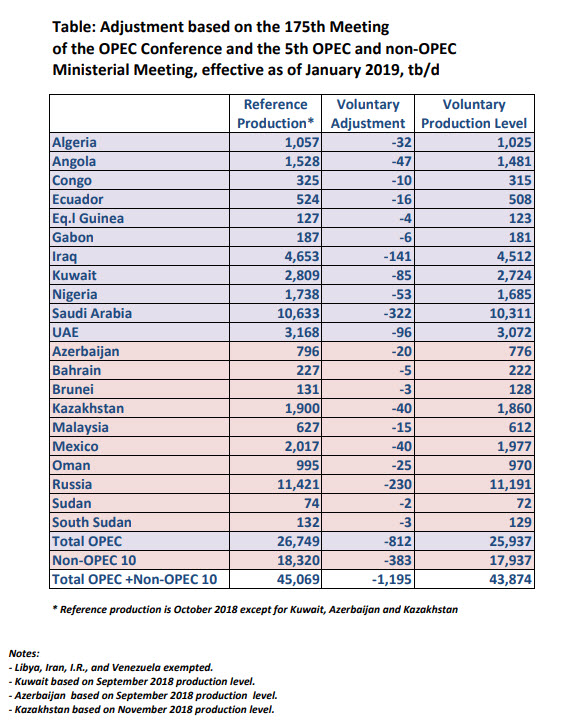
OPEC released a table in January showing the “Voluntary Adjustment” to “Reference Production,” which result in the “Voluntary Production Level” for the OPEC and non-OPEC participants. Libya, Iran, and Venezuela were exempted.
OPEC

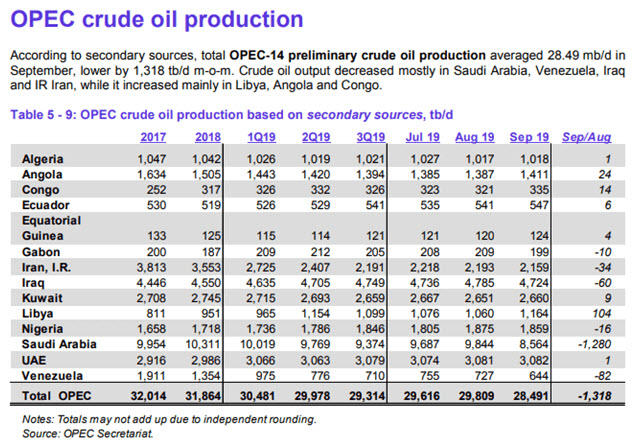
As shown above, OPEC production “quotas” for the other OPEC members totaled 25.937 million barrels per day. For August 2019, prior to the attack on Saudi facilities in September, OPEC production totaled 29.8 million barrels per day.
OPEC

Using the 25.937 million as a base, and adding actual September production of 2.159 for Iran, 1.164 for Libya, and .644 for Venezuela gives a total of 28.894. Demand for OPEC oil is projected (by OPEC) to be 29.6 in 2020, so it requires an additional cut of .294 million barrels per day.

Saudi Arabia has been willing to cut that much below its target. So the key for them is getting the biggest over-producers to comply, which is Nigeria, Iraq, and Russia.

Nigeria

Nigeria will make cuts to its crude oil output to comply with OPEC output targets, Mele Kolo Kyari of the Nigerian National Petroleum Company (NNPC) said.

According to OPEC’s numbers, Nigeria had pumped 1.859 in September, 175,000 b/d beyond its quota.

However, there may be a bigger problem brewing for the future. Kyari said that Nigeria hoped to raise oil production to about 3 million bpd in the next 2 to 3 years.

Iraq

Iraq will be fully compliant by October with agreed oil output cuts under an OPEC-led supply deal, and Baghdad’s reduction will amount to 175,000 barrels per day (bpd), Oil Minister Thamer Ghadhban said.

Iraq produced 4.724 in September. Its quota is 4.512. So the difference is actually a little more than 200,000 b/d.

Russia

According to numbers reported by the Joint Organizations Data Initiative (JODI), Russian production in August was only 86,000 b/d lower than last October, the reference month. The country had promised to cut its output by 230,000 b/d.
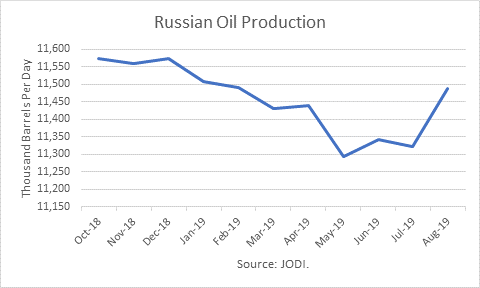
Russian oil production

Conclusions

Thanks to the effects of sanctions on Iran and Venezuela, OPEC’s production cuts are far greater than had been planned. And so the task of lowering production to meet demand in 2020 is doable, assuming those overproducing actually do comply, and Saudi Arabia is willing to keep underproducing.

However, the opposite side of the coin is the risk that U.S. sanctions on Iran will be lifted prior to the U.S. presidential election next year. If they are, OPEC will have upwards of another 1.7 million barrels to cut to make room for Iran, and that would be very challenging, at best.

Check back to see my next post!

Best,
Robert Boslego
INO.com Contributor - Energies

Disclosure: This contributor does not own any stocks mentioned in this article. This article is the opinion of the contributor themselves. The above is a matter of opinion provided for general information purposes only and is not intended as investment advice. This contributor is not receiving compensation (other than from INO.com) for their opinion.