Restless Bitcoin Makes Fiat Elite Sleepless Again

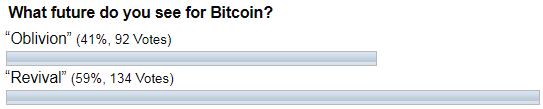
A year ago, “Bitcoin was at a crossroads” as then I spotted a triangular consolidation on the chart. The price could go both upside and downside, and I marked them as “Revival” and “Oblivion” areas accordingly. Below are your bets for the future of Bitcoin a year ago.

Bitcoin

Crypto enthusiasts are in the majority, although haters scored a hefty 41%. This violent confrontation shows that Bitcoin again threatens the interests of the elite as there are a lot of people, including President Trump, who expresses their opposition to cryptocurrencies as a whole. And it’s a natural course of things as human beings often reject changes and the elite try to shield their ultimate position.

Bitcoin broke both the downside of the triangle and the bearish confirmation level at the $6400 entering the “Oblivion” territory. The bearish target of $1250 had not been reached as the price of crypto gold had reversed ahead of $3000 notch. So, the first move was to the downside, and those of you who chose the “Oblivion” option was right.

This year Bitcoin entered the “Revival” area. It’s time to update the chart, and I am going to start with the monthly time frame. Continue reading "Restless Bitcoin Makes Fiat Elite Sleepless Again"

World Oil Supply And Price Outlook, July 2019

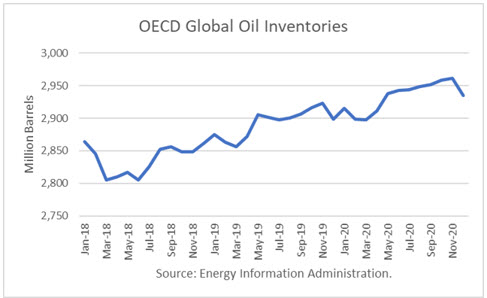
The Energy Information Administration released its Short-Term Energy Outlook for July, and it shows that OECD oil inventories likely bottomed last June 2018 at 2.805 billion barrels. It estimated stocks dipped by 4 million barrels in June 2019 to 2.902 billion, 97 million barrels higher than a year ago.

However, throughout 2019, OECD inventories are no longer expected to rise any further, on balance. At year-end, EIA projects 2019 to be with 2.899 million barrels, 37 million more than at the end of 2018. For 2020, EIA projects that stocks will build 35 million barrels to end the year at 2.934 billion.

oecd oil inventories

The EIA has revised its estimates for future OPEC production down significantly, given the sanctions on both Iran and Venezuela. For much of the balance of 2019 and 2020, it expects OPEC production to remain under 30 million barrels per day. June was reported at 29.8 mmbd.

OPEC has revised its call (demand) for OPEC oil. For 2020, the average is 29.2 mmbd. Therefore, OPEC must cut supply by another 550,000 b/d from June next year just to balance stocks. Continue reading "World Oil Supply And Price Outlook, July 2019"

Weekly Futures Recap With Mike Seery

Silver Futures

Silver futures in the September contract is currently trading at 15.22 an ounce after settling last Friday in New York at 15.00 higher by about 22 cents continuing its bullish momentum. Volatility is very low as the rest of the precious metals sector is having tremendous price swings daily as I am shocked that silver hasn't joined the party, but I think it will and if your patient enough I still think higher prices are ahead.

I have been recommending a bullish position from around the 14.93 level, and if you took the trade, I'm going to continue to keep the stop at 14.70 as we need to give this trade some room. Silver prices are trading right at their 20 and 100-day moving average, however for the bullish momentum to continue we have to break the June 21st high of 15.62 as that could happen on any given day, especially if the volatility increases.

I also have bullish recommendations in platinum, palladium, and copper, as demand has come back into this sector as the commodity markets have bottomed out my opinion as most of my recommendations have been to the long side which is the path of least resistance.

TREND: HIGHER - MIXED
CHART STRUCTURE: EXCELLENT
VOLATILITY: LOW

Continue reading "Weekly Futures Recap With Mike Seery"

Financials: The Delicate Balance of Rates and Yield Curve

The financial cohort is in a difficult space as the broader economic backdrop continues to dictate whether these stocks can appreciate higher. A delicate balance between interest rates, Federal Reserve commentary, yield curve inversion, trade war, and concerns over a potential recession in late 2019 or early 2020 must be attained. A disruption in this complex web can lead to the financials breaking down as witnessed in Q4 2018 and in May of 2019. In Q4 2018 rates were increased by the Federal Reserve and sent the financials in a downward tailspin. In May 2019, a trifecta of a yield curve inversion, trade war concerns, and increased chatter about a potential recession on the horizon again sent the cohort lower. The broader market appreciated markedly in June, and the bank stocks participated in the rally. Coupled with renewed record share buybacks and increased dividend payouts stemming from successful stress tests, banks elevated higher on the news. Now, the market is anticipating that the Federal Reserve will cut rates at its next meeting, which may serve as another catalyst to propel some bank stocks to new 52-week highs.

The Q4 2018 Federal Reserve and Jerome Powell

The market-wide sell-off in the fourth quarter of 2018 was largely induced by the Federal Reserve and its alleged commitment to sequential interest rate increases into 2019. This was largely viewed as reckless and misguided while turning a blind eye to broader economic data-driven decision making about further interest rate hikes. The stock indices responded to the sequential interest rate hike stance with overwhelming negative sentiment, logging double-digit declines across the broader markets. Many market observers were questioning the Federal Reserve’s aggressive stance as companies issued weakness in ancillary economic metrics (slowing global growth, strong U.S. dollar, trade war, government shutdown, weak housing numbers, retail weakness, auto sluggishness, and oil decline) as an indication that cracks in the economic cycle were materializing. The strong labor market and record low unemployment served as a basis to rationalize increasing rates to tame inflation; however, these aforementioned economic headwinds appeared to cause the Federal Reserve to pivot in its aggressive stance. As Chairman Jerome Powell began to issue a softer stance on future interest rate hikes, January saw very healthy stock market gains after being decimated for months prior. On January 30th, Jerome Powell issued language that the markets were craving to levitate higher as he left interest rates unchanged and exercised caution and patience as a path forward. Using data-driven decision making as a path forward was cheered by market participants as the broader indices popped for healthy gains on top of the already robust gains throughout January. Continue reading "Financials: The Delicate Balance of Rates and Yield Curve"

Capping Off A Record Week For Stocks

Hello traders everywhere. Stocks continued their momentum Friday ending a record-setting week on a high note after testimony from the top Federal Reserve official signaled that a rate cut was coming.

The Dow climbed +180 points to an all-time high. The S&P 500 traded 0.3% higher and also reached a record. The Nasdaq was up 0.4%.

The S&P 500 also notched a record close trading above $3,000 for the first time this week and looked to close above that level as near the close of trading this afternoon. The Dow closed above 27,000 for the first time Thursday and continues to trade above that level this afternoon.

The major indexes were headed for slight weekly gains. Entering the afternoon session, the Dow is up +1.16%, S&P 500 is up 0.5%, and the NASDAQ is up 0.47% while giving us a new green weekly Trade Triangle joining its brethren.

Fed Chair Jerome Powell testified in front of congressional leaders this week that "crosscurrents" from weaker overseas economic activity and rising trade tensions are dampening the outlook on the U.S. economy.

Key Levels To Watch Next Week:

Every Success,
Jeremy Lutz
INO.com and MarketClub.com