Weekly Futures Recap With Mike Seery

S&P 500 Futures

The S&P 500 in the September contract is trading at 2989 lower by 11 points off of the monthly jobs number showing that we added another 224,000 new jobs which was construed as bearish because the Federal Reserve might not lower rates. If you have followed any of my previous blogs, you understand that I've had a bullish bias towards the upside for quite some time, and I still think higher prices are ahead.

The primary catalyst for the surge in equity prices is the fact that the 10-year note is now yielding 2.02% which is remarkable in my opinion especially for the growth rate that we are experiencing here in the United States with the GDP average of over 3%.

Generally speaking, you don't see interest rates this low when economies are surging. However, one of the main reasons for bond yields to continue to head lower is the fact that Europe, which is a collection of socialist countries that have no economic growth. They are the catalyst for lower interest rates as many of them are experiencing negative rates while at the current time, the 10-year note stands at 2.02% and still looks expensive.

I still believe the S&P 500 will trade significantly higher come year end as I see no reason to be bearish the U.S. economy as this is the perfect soup with low-interest rates coupled with the fact that the Federal Reserve will back up the U.S. economy.

TREND: HIGHER
CHART STRUCTURE: IMPROVING
VOLATILITY: AVERAGE

Silver Futures

Silver futures in the September contract settled last Friday in New York at 15.34 an ounce while currently trading at 15.02 down over $0.30 for the trading week as prices hit a 2 week low.

I have been recommending a bullish position from the 14.93 level and if you took that trade continue to place the stop loss under 14.70 on a closing basis only as an exit strategy as I'm hoping that today's sell-off was exaggerated due to the low volume because of the holiday. Continue reading "Weekly Futures Recap With Mike Seery"
Options: Long-Term Game of Discipline and Outperformance

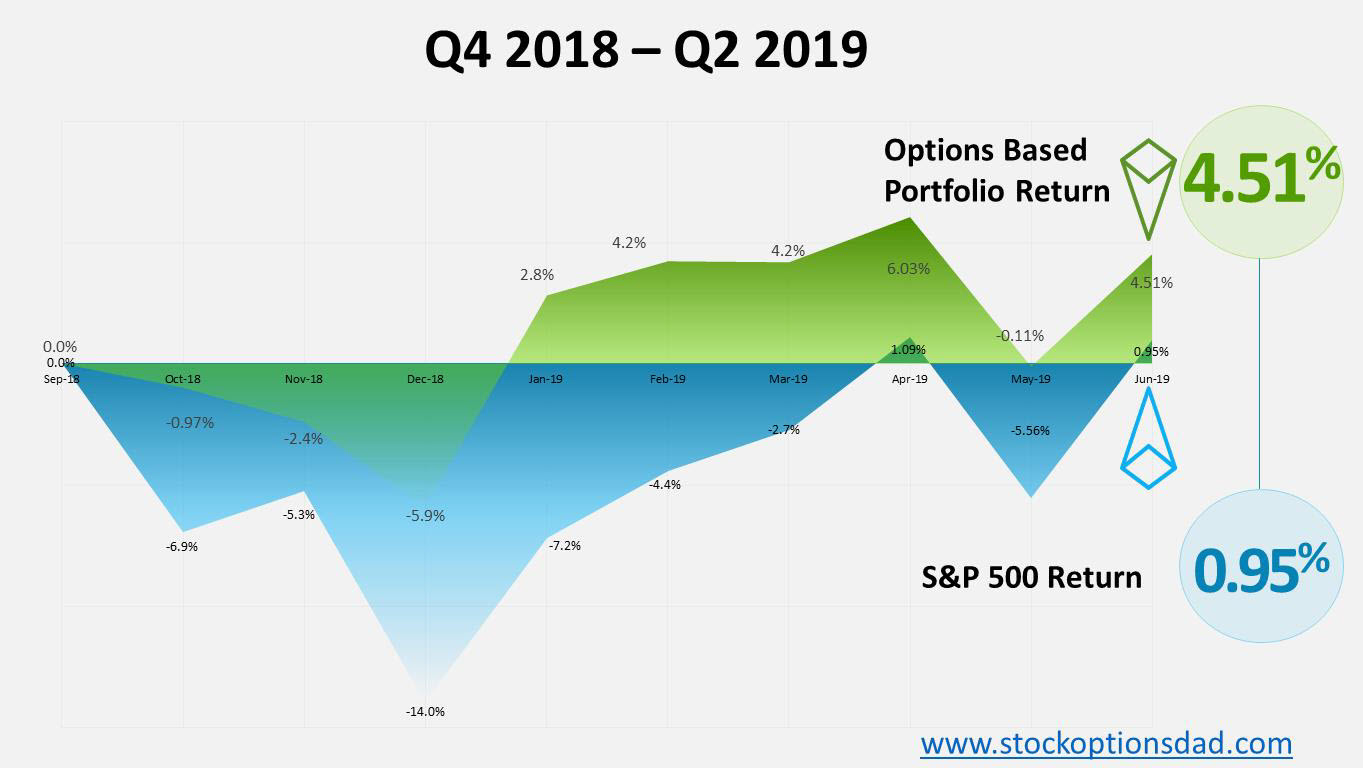
Options trading is a long game that requires discipline, patience, time, maximizing the number of trade occurrences and continuing to trade through all market conditions. To this end, an options-based portfolio requires discipline and time to materialize in order to reach its full benefits when benchmarked to a broader index. An options-based approach provides a margin of safety with a decreased risk profile while providing high-probability win rates. An options centric portfolio ebbs and flows just like any portfolio as various types of trades are executed, management of trades are carried out and the inevitability of assignment of occurs. Over the long-term, this approach provides smooth portfolio appreciation while generating consistent income. Since options are a bet on where stocks won’t go, not where they will go, this is accomplished without predicting which way the market will move. When adhering to options trading fundamentals, this approach can provide long-term durable high-probability win rates to generate consistent income while mitigating drastic market moves. Following these option trading fundamentals, I’ve demonstrated an 85% (175/205) options win rate over the previous 9 months through both bull and bear markets while outperforming the S&P 500 over the same period by a wide margin producing a 4.51% return against a 0.95% for the S&P 500.

Results

The broader market has been tumultuous over the past 9 months, to say the least. In Q4 2018, the S&P 500 posted one of its worst quarters and since the Great Depression with the index selling off 14% and erasing all of its gains for the year. 2019 started off on a high note for the S&P 500 with January posting a 7.9% gain, logging its best January in over 30 years. This was followed by continued strength in February, putting the index on its best footing since 1991 with a cumulative return of 11% through the first two months and rounding out Q1 2019 up just over a 13% return. May witnessed a market sell-off which saw a decline of -5.8%. June 2019 was the best June for the Dow since 1938 whereas the S&P 500 posted its best first half of a year since 1997, notching a 17.3% gain. Sticking to a set of disciplined fundamentals through this volatile market over the previous 9 months generated superior returns relative to the historic run by the S&P 500 (Figures 1-4).

Options Trading
Figure 1 – Options based portfolio return (4.51%) in comparison to the S&P 500 return (0.95%)
Continue reading "Options: Long-Term Game of Discipline and Outperformance"

Are Real Estate ETFs The Next Big Trade? - Part 2

In part I of this research post, we highlighted how the shifting landscape of the US real estate market may be setting up an incredible trading opportunity for technical traders. It is our belief that the continued capital shift which has been driving foreign investment into US assets, real estate, and other investments may be shifting away from US real estate as tell-tale signs of stress are starting to show. Foreclosures and price drops are one of the first signs that stress exists in the markets and we believe the real estate segment could be setting up for an incredible trade opportunity.

The Proshares Ultrashort Real Estate ETF (SRS) has recently completed a unique “washout low” price bottom that we believe may become an incredible trading opportunity for technical traders. If the US Fed pushes the market into a panic mode, sellers will become even more desperate to offload their homes and buyers will become even more discerning in terms of selecting what and when to buy.

Our opinion is that the recent “washout low” price bottom in SRS is very likely to be a unique “scouting party” low/bottom that may set up a very big move to the upside over the next 4 to 12+ months. If our research is correct, the continued forward navigation for the US Fed, global central banks and the average consumers buying and selling homes is about to become very volatile.

If SRS moves above the $25.50 level, our first upside Fibonacci price target and clears the $24.25 previous peak set in April 2019, it would be a very clear indication that a risk trade in Real Estate is back in play. Ideally, price holding above the $21.65 level would provide a very clear level of support negating any future price weakness below $21.50. Continue reading "Are Real Estate ETFs The Next Big Trade? - Part 2"

S&P 500, DOW And NASDAQ Close At Record Highs

Hello traders everywhere. Stocks traded higher and closed at record highs on this holiday-shortened day as investors bet on a possible rate cut from the Federal Reserve later this month after the release of weaker-than-expected economic data.

The S&P 500, DOW and NASDAQ all closed at record highs today. The S&P 500 posted a close of 2,995.82, the DOW 26,966.00 and NASDAQ rounded out the record closes at 8,170.23, just shy of its all-time high of 8,176.08.

Private payrolls in the U.S. increased by 102,000 in June, ADP and Moody's Analytics said. Economists polled by Dow Jones expected growth of 135,000.

The disappointing data strengthens the Fed's case for lowering rates at its monetary policy meeting at the end of July. Last month, the central bank opened the door to easier monetary policy by stating it will "act as appropriate" to maintain the current economic expansion.

Key Levels To Watch This Week:

Every Success,
Jeremy Lutz
INO.com and MarketClub.com

U.S. Crude Production Surges In April

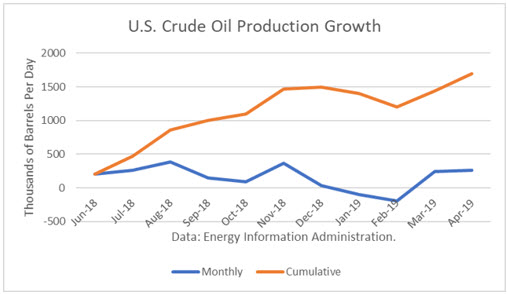
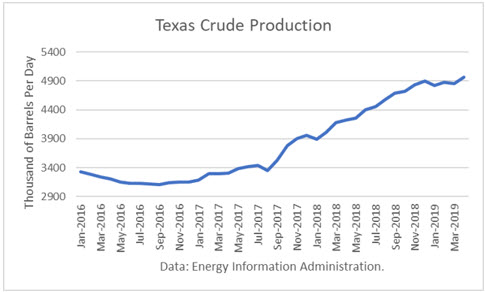
The Energy Information Administration reported that April crude oil production averaged 12.162 million barrels per day (mmbd), up 257,000 b/d from March. The rise resulted from a 107,000 b/d increase in Texas, a 77,000 b/d increase in the Gulf of Mexico (GOM), a 32,000 b/d increase in Oklahoma, a 14,000 b/d increase in Colorado, and a 13,000 b/d increase in Wyoming.

Crude Production

A pause in the growth rate in Texas had been expected due to pipeline constraints, which are expected to be alleviated in the second half of 2019 and the first half of 2020. Nonetheless, crude production set yet another record high in April.

Crude Production

The year-over-year gains have been especially impressive with the April figure being 1.687 mmbd. And this number only includes crude oil. Other supplies (liquids) that are part of the petroleum supply add to that. For April, that additional gain is about 630,000 b/d. Continue reading "U.S. Crude Production Surges In April"