Is The Bull Trap Complete?

Some of you may be old enough to remember when Desert Storm started in January 1991. The news of this war took the US and the world by storm – almost literally. It was televised and it changed the way people lived their lives at that time. People were almost glued to the TV watching the videos and satellite feeds. It turned into the ultimate reality TV series – must-see TV.

The US markets reacted to this foreign engagement. At first, the markets rallied for about 7+ weeks in early 1991, then they started to consolidate below resistance. For many people and businesses, this new reality event presented very real challenges for revenues and growth. Many businesses were forced to close because of the sudden shift in consumer activity and concerns. The reason I’m bringing this up right now is that I believe we are experiencing a new type of “reality event” (actually events) that has transitioned to become a driving force in the markets, namely COVID and the protests/riots in many cities across the US.

Chaos & Disease – The Ultimate Distractions

With the US Presidential Election only about 60+ days away and winter fast approaching, the US has a number of fundamental issues to contend with going forward. What happens if the US elections are contested in the courts? What happens to policy and the support for the consumer/markets when the US government potentially enters this chaotic phase? What happens when winter hits and businesses that have been struggling through the warm summer months suddenly find themselves losing more revenues and customers? What happens if the streets remain in a state of unrest throughout the rest of this year and into next year? Continue reading "Is The Bull Trap Complete?"
Facebook Advertising Boycott?

Facebook Inc. (FB) faced a very public onslaught of companies joining an advertising boycott across its social media platforms. However, its latest earnings suggest that this effort may have been largely symbolic and effectively inconsequential to the company’s revenue and growth numbers. The advertising boycott had grown to roughly a thousand groups and multinational companies. This presented a unique challenge that still has the potential to weigh heavier on the company since this boycott will directly impact revenue as overall compliance/security expenses swell. The magnitude of this boycott may inevitably influence the stock price if this movement expands in sheer numbers and duration. If Facebook can appease advertisers in a timely fashion, then this may be a temporary challenge as these companies rejoin the social media platforms. However, as advertising spending is abandoned indefinitely until further notice due to this boycott and overall spend slows due to COVID-19, this culmination could cast uncertainty around its stock valuation. Even though over 1,000-plus brands have fled its platforms, Facebook has an advertising moat. The breadth and depth of its advertising partners go far beyond this collection of ~1,000 groups and companies, which translates into only X% while the company still grew its revenue by 11% in Q2.

Q2 Earnings and 11% Revenue Growth

Facebook’s earnings for Q2 blew out expectations for both earnings and revenue with $1.80 vs. $1.39 expected and $18.7 billion vs. $17.4 billion expected, respectively. Daily active users were 1.79 billion vs. 1.70 billion expected, monthly active users came in at 2.7 billion vs. 2.6 billion expected, and average revenue per user came in at $7.05 vs. $6.76 expected.

These are blow out numbers across the board, and as expected, Facebook said that its user growth reflects increased engagement from consumers who are spending more time at home. Facebook has 3.14 billion monthly users across its platforms (Instagram, Messenger, and WhatsApp), compared to 2.99 billion in the previous quarter. The company forecast revenue growth for the third quarter of about 10%, beating analysts’ expectations for growth of 7.9% (Figure 1).

Better yet, Facebook said that through the first three weeks of July, its year-over-year revenue growth was about 10%. This forecast, while topping projections, takes into account ongoing headwinds, including economic volatility, the ad boycott, regulations around ad targeting and Apple’s upcoming iOS 14 operating system. Continue reading "Facebook Advertising Boycott?"

S&P 500 Futures Hit All-Time High

S&P 500 Futures

The S&P 500 futures in the September contract is currently trading at 3491 as prices are experiencing a 7-day winning streak hitting an all-time high this week trade continuing its bullish momentum as this by far is the strongest trend out of all sectors to the upside.

The Nasdaq-100 also hit another all-time high this week as money flows continue to enter this sector because there is nowhere else to park your money, and that situation is not going to change at least throughout 2020. If you are long a futures contract, continue to place the stop loss under the 10-day low at 3344 as an exit strategy. However, the chart structure will improve in 3 trading sessions. Therefore, the monetary risk will be lowered as I still think higher prices are ahead.

The S&P 500 is trading far above their 20 and 100-day moving average. The trend is strong to the upside continually grinding higher daily as the volatility has certainly decreased over the last couple of weeks. I think the commodity and stock markets continue to move higher. I see no reason to be short while trying to pick the top as that is extremely dangerous over time, as trading with the path of least resistance is the most successful way to trade, in my opinion.

TREND: HIGHER
CHART STRUCTURE: SOLID
VOLATILITY: AVERAGE

Silver Futures

Silver futures in the September contract settled last Friday in New York at 26.73 while currently trading at 27.57 an ounce up over $0.80 continuing it's bullish momentum still experiencing crazy volatility daily.

I have been recommending a bullish position over the last couple of months all the way back from the 18.61 level. If you took that trade, continue to place the stop loss under the 10-Day low now standing at 26.09 as an exit strategy and the proper money management technique. Continue reading "S&P 500 Futures Hit All-Time High"

Analysis Of The US Petroleum Inventories

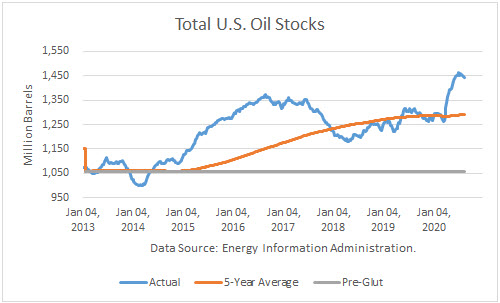
According to the Energy Information Administration, US petroleum inventories (excluding SPR) dropped by 2.6 million barrels last week to 1.444 billion, whereas SPR stocks dropped by 1.6 million barrels. Total stocks stand 152 mmb above the rising, rolling 5-year average and about 133 mmb higher than a year ago. Comparing total inventories to the pre-glut average (end-2014), stocks are 385 mmb above that average.

Total US Oil Stocks

Crude Production

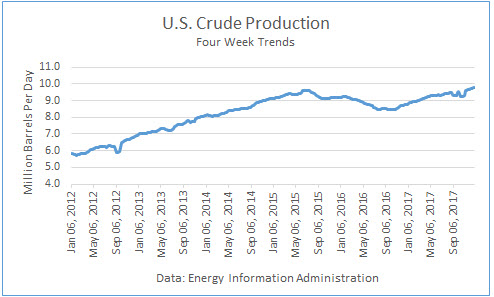
Production averaged 10.7 mmbd last week, down unchanged from the prior week, and 10.875 mmbd over the past 4 weeks, off 11.4 % v. a year ago. In the year-to-date, crude production averaged 11.974 mmbd, off 1.1 % v. last year, over 200,000 b/d lower.

US Crude Production

Other Supply

I have previously noted in an article how the “Other Supply,” primarily natural gas liquids and renewables, are integral to petroleum supply. The EIA reported that it dipped 3,000 b/d v. last week at 6.639 mmbd. The 4-week trend in “Other Supply” averaged 6.746 mmbd, off 6.7 % over the same weeks last year. In YTD, they are unchanged from 2019. Continue reading "Analysis Of The US Petroleum Inventories"

Gold ETFs Setting New Highs

During the final days of July, Gold hit new all-time highs just below $2,000. The record run higher for the precious yellow metal, and for most of the precious metals has been in large part caused by the worldwide pandemic. As investors become nervous about the future, many find safe harbor in gold and other hard asset metals.

The bull market will likely continue as long as the pandemic and world economies struggle to gain traction. But, if we see a vaccine that protects against Covid-19, the price of gold will likely begin to fall as investors move back away from safe investments and back into equities, bonds, and other higher-risk – higher growth investments. When the rally ends, well, that’s, of course, the trillion-dollar question and one that I can’t help with. However, I can point you in the right direction of what to invest in regardless of which way you think the price is headed.

The big dog in the gold Exchange Traded Fund world is the SPDR Gold Trust (GLD). GLD has over $77 billion in assets under management and has been in existence since 2004. The fund charges a 0.4% expense ratio and has an average daily dollar amount volume of just over $1.76 billion, meaning it typically has liquidity. GLD tracks the gold spot price using gold bars held in vaults in London. This is an excellent option for anyone who wants the protection of gold but doesn’t want the hassle of buying actual gold bars.

The only big downside to GLD is that one share will cost you roughly $185. But there is a solution to that problem, and it’s called the SPDR Gold MiniShares Trust (GLDM). GLDM is essentially the same thing as GLD, but it holds 1/10th as much gold per share as GLD, and therefore each share costs less. As of this writing, GLD is $184.98 per share, while GLDM is $19.61 per share. GLDM tracks the spot price of gold the same as GLD, but it also has a lower expense ratio of just 0.18%. It also has much fewer assets under management of just $3.22 billion and therefore is less liquid for large orders. But again, if you want to place a large order, go with GLD. GLDM is designed for the small retail investor, not the large funds that need exposure to gold. Continue reading "Gold ETFs Setting New Highs"