The Times They Are A' Changin'

Talk about charter creep. This is more like a charter leap.

As we know well by now, the Federal Reserve’s famous “dual mandate” is to promote price stability and maximum sustainable employment. But as we also know, the Fed really has a third mandate, maintaining moderate long-term interest rates (don’t ask me why they still call it a dual mandate).

So it should be no surprise, then, that the Fed has now gone way beyond that dual (or treble) mandate by wholeheartedly injecting itself into what is really a political debate, namely climate change. And how ironic it is that it rose to the forefront during the same week that the U.S. withdrew from the Paris Climate Agreement.

Last week Fed officials were out in force, declaring that climate change would now be a major factor in not only how it regulates federally chartered commercial banks but also how it conducts U.S. monetary policy.

On Thursday, in a speech at the GARP Global Risk Forum, Kevin Stiroh, an executive vice president responsible for regulating banks at the New York Fed, said financial firms need to take the dangers and costs of climate change into their risk-management decisions.

“Climate change has significant consequences for the U.S. economy and financial sector through slowing productivity growth, asset revaluations, and sectoral reallocations of business activity,” he said. “The U.S. economy has experienced more than $500 billion in direct losses over the last five years due to climate and weather-related events.” Continue reading "The Times They Are A' Changin'"
Disney's Streaming Growth Driver - ESPN/Disney+/Hulu

Disney (DIS) just delivered a stellar quarter beating on both the top and bottom lines while continuing to roll out its growth initiatives.

Disney’s growth rotation is still in its early stages with the remediation of its ESPN property and flurry of growth initiatives to meet modern-day media consumption trends via streaming with its Disney+ property. In the backdrop, the company continues to dominate the box office year after year with a long pipeline of blockbusters in the queue, notably Frozen 2 and Star Wars: The Rise of Skywalker. Additionally, its Parks and Resorts continue to be a growth avenue with tremendous pricing power. Disney is going all-in on the streaming front and will inevitably acquire full ownership of Hulu, and the company is launching its Disney branded streaming service that will compete directly with Netflix (NFLX).

Disney+ launches on November 12th, and Disney is unleashing all of its content (Marvel, Star Wars, Disney, and Pixar), which will be a formidable competitor in the ever-expanding streaming wars. As a result of its strong Q4 numbers, Disney has hit near all-time highs of ~$140 per share. I’ve been behind Disney for a long time, especially through this transition back to growth when the stock traded below $100, and I still feel that the company offers a compelling long-term investment opportunity given its growth catalysts that will continue to bear fruit over the coming years.

Disney’s Stellar Q4 Earnings

Disney’s Q4 earnings easily beat analysts’ expectations with substantial gains in its television networks and film studio by way of its Fox acquisition. Disney beat on both the top-line revenue and bottom-line profit. EPS came in at $1.07, beating by $0.10 per share, and revenue came in at $19.1 billion, beating by $80 million. Revenue grew by 34% year-over-year, and for the fiscal year, revenue was up 17% at $69.57 billion.

Disney’s business across the board came in strong, posting growth in every category. Revenue by segment: Media Networks, $6.51 billion (up 22%); Parks, Experiences and Products, $6.7 billion (up 8%); Studio Entertainment, $3.3 billion (up 52%); Direct-to-Consumer and International, $3.4 billion (up 361%). Operating income by segment: Media Networks, $2.14B (up 7%); Parks, Experiences and Products, $1.7B (up 4%); Studio Entertainment, $792M (up 13%); Direct-to-Consumer and International, -$553M. Continue reading "Disney's Streaming Growth Driver - ESPN/Disney+/Hulu"

Gold & Silver: Expected Drop Kicked Off

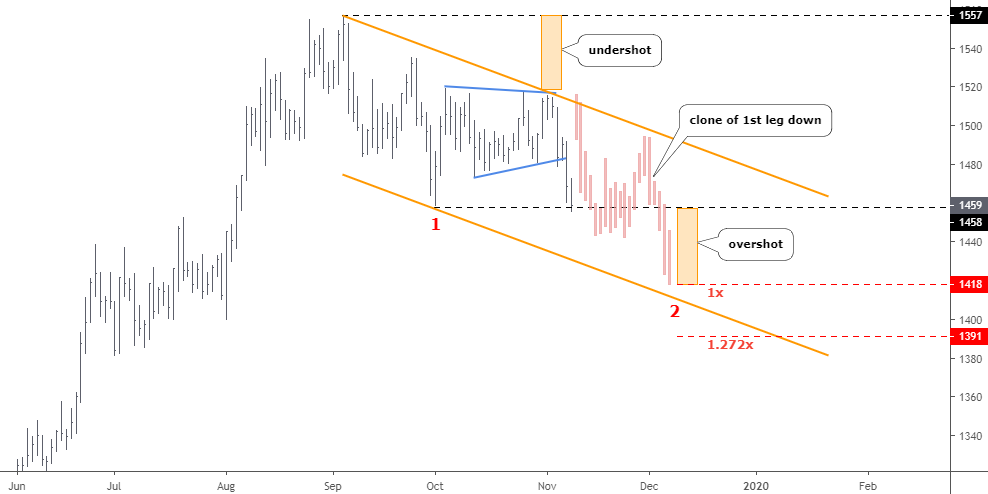
It was a timely call last week to "Beware Of Extended Consolidation" as right from last Monday we saw both metals plummet all the week long. Surely, it wasn't a self-fulfilling prophecy as the market was unexpectedly caught in a bullish euphoria. The chart structure was telling us about this possibility as such patterns appear from time to time. The same pattern had appeared on the Bitcoin chart as I had warned you this past August. That pattern of extended consolidation smashed Bitcoin’s value as planned from $10600 down to the projected target of $7800. Let's see where this pattern could send precious metals prices this time around.

Chart 1. Gold Daily: Undershot => Overshot

gold silver
Chart courtesy of tradingview.com

We've got the tricky junction between two legs down on the gold chart. The triangular structure (blue) had been shaped as lower peaks, and higher valleys were established there. This pattern is rarer than the regular zigzag that I was expecting to unfold. It created a huge undershot to the top of the range, which might result in a big overshot below the bottom of the range. By the way, gold already dropped like a rock to pierce the valley of the range last Friday. But, of course, that's not enough. Continue reading "Gold & Silver: Expected Drop Kicked Off"

Updating The 3 Amigos And The Global Macro Message

This morning in pre-market the Amigos’ futures charts update the macro story…

global macro

…which goes something like this…

Copper, the cyclical Amigo (weekly chart) has furthered the intermediate trend line break we noted on October 25th. This is in line with the rally in US and global stock markets and even more so, the global macro reflation theme. It does not look so impressive yet on this weekly chart, but other components of the macro trade are starting to look impressive, especially on daily charts. So… steady as she goes. Continue reading "Updating The 3 Amigos And The Global Macro Message"

Options Trading And The Bull Market No One Saw Coming

2019 has ushered in one of the most surprising bull markets that nearly no one saw coming. Unfortunately, the vast majority of Wall Street analysts underestimated the strength of this bull market as we enter into mid-November. Expectations for 2019 were largely muted when factoring in a slew of potentially negative economic issues such as the U.S./China trade war, Brexit, inverted yield curve, potential recession, Federal Reserve actions, and the presidential impeachment efforts. Despite all of these headwinds, the indices continue to post record highs, with the Dow Jones and S&P 500 notching gains of 18% and 23%, respectively.

This market has been dubbed the “most hated bull market in history,” illustrating the point that the ability for anyone to predict market returns is a futile endeavor. Reiterating why 92% actively managed funds do not outperform their benchmark and why there’s only a 36% chance of picking a stock that will outperform the market. An options-based portfolio approach can offer a superior alternative to traditional stock picking and position your portfolio to thrive in any environment such as this surprise bull market. An option-based strategy mitigates risk and circumvents drastic market moves. Selling options and collecting premium income in a high-probability manner generates consistent income for steady portfolio appreciation in both bear and bull market conditions. This is all done without predicting which way the market will move. Options trading is a great way to generate superior returns with less volatility over the long-term regardless of market conditions such as this “most hated bull market in history.”

Options and the Most Hated Bull Market

Market headwinds aplenty coupled with coming off a tough 2018, Wall Street had a negative view of stocks for 2019, and as a result, the vast majority of analysts missed one of the best years of the longest bull market in history. This market continues to make new highs after new highs. Per CNBC, of 17 forecasters for S&P 500 price, just three have targets that are above where the broad market index traded as of November 4th, 2019, with still nearly two months left in the year. Furthermore, negative sentiment is seen in the put-call ratio (a measure of sentiment among options traders), has remained above one since mid-September, a contrarian indicator that the market could be headed higher due to overly negative sentiment. Continue reading "Options Trading And The Bull Market No One Saw Coming"