Weekly Futures Recap With Mike Seery

Crude Oil Futures

Crude oil futures in the July contract settled last Friday in New York at 66.32 a barrel while currently trading at 69.64, up over $3 for the trading week as prices are right at a 3 year high.

Currently, I am not involved, but I think higher prices are ahead, and if you are long a futures contract, I would continue to place the stop loss under the 2 week low of 73.63 as the proper exit strategy. However, the chart structure will improve daily; therefore, the monetary risk will be reduced.

The main reason for the rally that we have experienced in 2021 is because the Biden administration is against fossil fuels. They have canceled the Keystone Pipeline, coupled with the fact that they are not allowing drilling in certain parts of Alaska as this situation will not end anytime soon. I think there's a chance we will be at $100 oil in the coming months ahead.

Crude oil is trading for above its 20 and 100-day moving average, telling you that the trend is to the upside. Gasoline and heating oil are experiencing long-term bullish secular trends, and I see absolutely no reason to be short as this situation will become dire as time goes by as now we rely on hostile foreign governments for much of our energy supply.

TREND: HIGHER
CHART STRUCTURE: SOLID
VOLATILITY: HIGH

Cocoa Futures

Cocoa futures in the July contract settled last Friday in New York at 2468 while currently trading at 2451 down slightly still stuck in a 3 month consolidation pattern looking to break out soon, in my opinion. Continue reading "Weekly Futures Recap With Mike Seery"
Weekly Stock Market Forecast

This week we have a stock market forecast for the week of 6/6/21 from our friend Bo Yoder of the Market Forecasting Academy. Be sure to leave a comment and let us know what you think!

The S&P 500 (SPY)

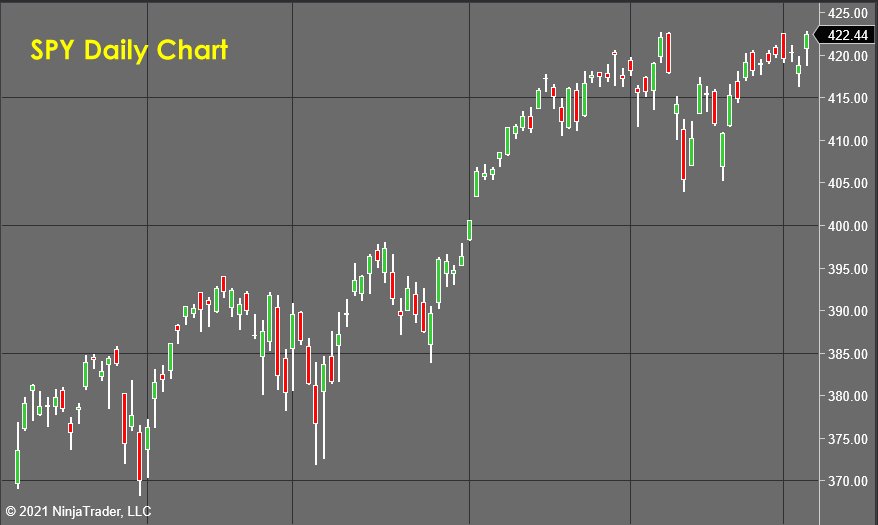
SPY Daily Chart - Stock Market Forecast

The S&P 500, (analyzed here using SPY has done pretty much what I posted in last week’s column.

“I suspect we will see a bullish whipsaw before any retest of the range lows can occur.”

This breakout isn’t well sponsored, so I would expect it to break out and then fail back down to the bearish side. I’m still not seeing the kinds of odds that I want in order to put on much new risk this week. I have one new opportunity to look at, but other than that I am still in a “risk-off” posture. Continue reading "Weekly Stock Market Forecast"

The Best Cryptocurrency Exchange

In our prior installments, we talked about Bitcoin (BTC) and Ethereum (ETH), two cryptocurrencies that were worthy of a place in just about everyone’s portfolio: BTC is the big boy on the block and is a great store of value while ETH takes advantage of the computational features of blockchain technology.

Hopefully, I was also painfully clear that investing in any cryptocurrency – including BTC and ETH -- involves substantial risk. You can lose big. So, if you’re thinking about taking the plunge, do so sparingly. A good rule of thumb: Don’t set aside more than 1% to 2% of your portfolio for crypto.

Now, after all, that, if you’re set to invest in a little cryptocurrency, welcome to the club! I think this class of assets is the future. It’s super-exciting and chock-full of potential, including profit potential.

But before you can get to that potential, you’ll need to actually buy some cryptocurrency. So, today, we’re going to do a deep-dive into one of the best ways to buy crypto: By using the popular crypto exchange, Coinbase (COIN).

Coinbase Is Big And Easy

Unless you’ve been under a rock for the past few months, you’ve heard about the wildly popular IPO (actually, direct listing) of Coinbase. Although it's off its highs, the shares now boast an eye-popping $63 billion market cap. And while Coinbase isn’t the biggest on a global scale, it’s the biggest in the U.S. Continue reading "The Best Cryptocurrency Exchange"

The Ever-Growing Number Of ETFs and Their Power Over The Markets

ETFs, like Mutual Funds and Index Funds, are often praised for their ability to offer exposure to ‘risky’ equities while offering portfolio protection and reducing single stock exposure issues.

The basic idea is that instead of trying to ‘cherry-pick’ a specific winner or loser in a particular industry or sector, you can just buy a sector-based exchange traded fund and reduce your risk that you chose the wrong company to be the dominant player in that industry. Furthermore, as long as the industry itself performs well, your industry-focused ETF should follow suit, and your investment will benefit.

As the demand for ETFs increases, the vast array of offerings has also been increasing. As an investor, you are no longer constrained to just buying industry or sector-focused funds. You can now buy funds that focus on pretty much any correlating data point imaginable. Those are the ones that have strict investment guidelines, unlike some ETFs that are actively managed and give the fund managers complete control and leeway to invest wherever and however they want.

Currently, there are over 2,500 actively traded Exchange Traded Funds in the US alone. There were 32 new ETFs offered to investors in May 2021 alone. Let’s think about that for a moment. Outside of the OTC or Over the counter equities available to investors with about 11,500 stocks in 2020, roughly around 6,000 companies’ investors can buy and sell stock in which are traded on the major US exchanges, the NYSE and the NASDAQ. Yes, that is correct, 6,000 US stocks and nearly half that in US ETFs. Continue reading "The Ever-Growing Number Of ETFs and Their Power Over The Markets"

Options: 275 Trades and 5 Losses - 98% Win Rate

Deploying skill and caution when engaging in options trading can generate consistent monthly income while defining risk, leveraging a minimal amount of capital, and maximizing return on investment. Options can augment portfolio appreciation across an array of different market scenarios. Over the past 13 months (May 2020 – May 2021) and 275 trades, a win rate of 98% was achieved with an average ROI per winning trade of 8.0% and an overall option premium capture of 85%.

The performance of an options-based portfolio demonstrates the durability and resiliency of options trading to drive portfolio results with substantially less risk via a beta-controlled manner. The options-based approach circumvented the September 2020, October 2020, and January 2021 sell-offs while outperforming/matching the S&P 500 over the 13-month post-pandemic bull run, posting returns of 58.2% and 61.8%, respectively (Figures 1-5).

Despite these results over the past 13-plus months and 275 trades, limitations and challenges come with any trading system. Specifically, acts of nature, legislative and regulatory actions can jeopardize option trades. Here, I will walk through the five trades that resulted in losses and the underlying reasons as to why these were beyond any remediation efforts. Legislative and regulatory risks are two areas that pose some of the greatest company-specific and/or sector-specific challenges.

Options
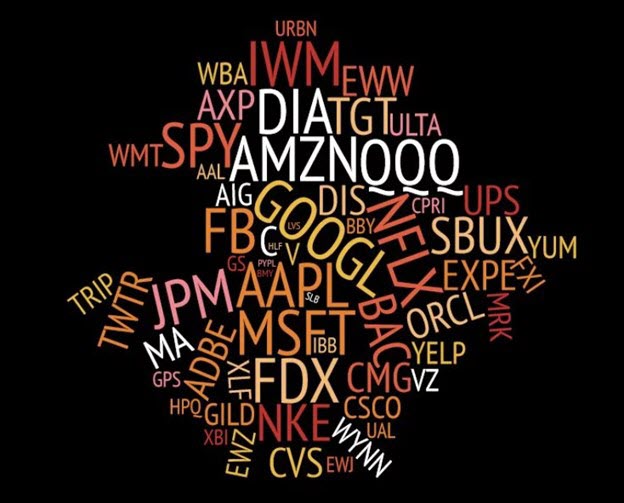
Figure 1 – Overall option tickers used from April 2020 – May 2021
Continue reading "Options: 275 Trades and 5 Losses - 98% Win Rate"